
Game review
Incremental Infinity
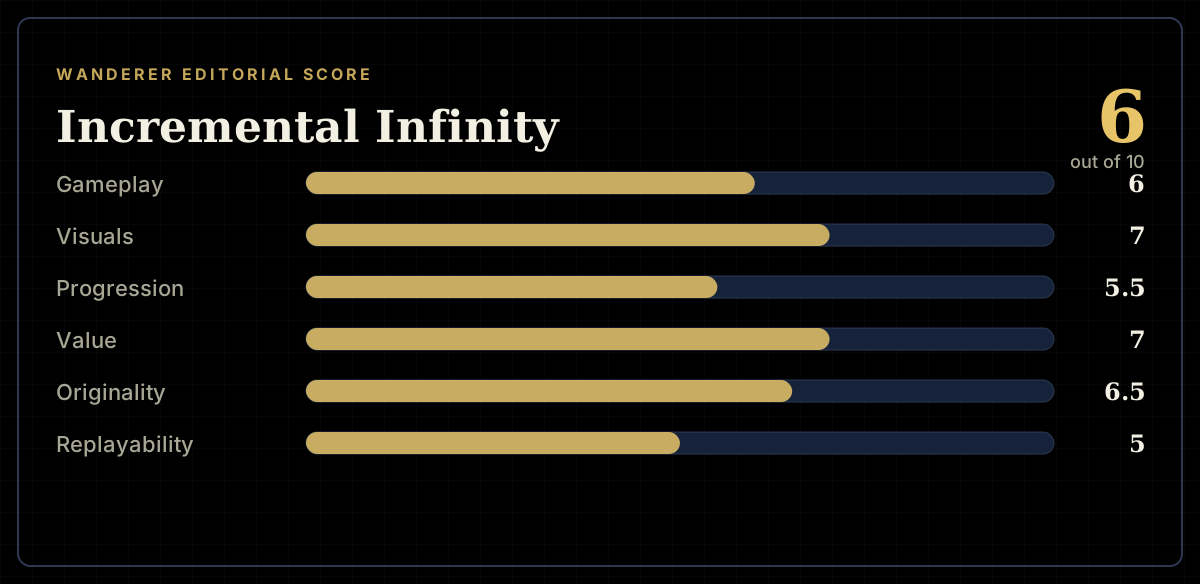
6 / 10
- Developer
- Rablo Games
- Publisher
- Rablo Games
- Released
- 20 July 2026
- Platforms
- Windows
- Genre
- Idle incremental
- Monetisation
- Paid once, no in-game purchases; an optional soundtrack DLC
- Players
- Single-player
The short version
A clean, cheap, genuinely pleasant thing to park in the corner of a monitor. You are a number, the number shoots, and an endlessly generated skill tree keeps handing you more ways to shoot. For the first few hours the growth curve does exactly what this genre is supposed to do.
What it never builds is a second layer. The tree is infinite but the choices inside it repeat, ascension adds multipliers rather than new questions, and the mid-game arrives with nothing to replace the novelty it's spending. Rablo Games has been patching hard since launch, which is the strongest argument for keeping an eye on it.
Biggest strengths
- The number-is-your-health-and-your-size conceit makes power legible at a glance, with no stat sheet needed
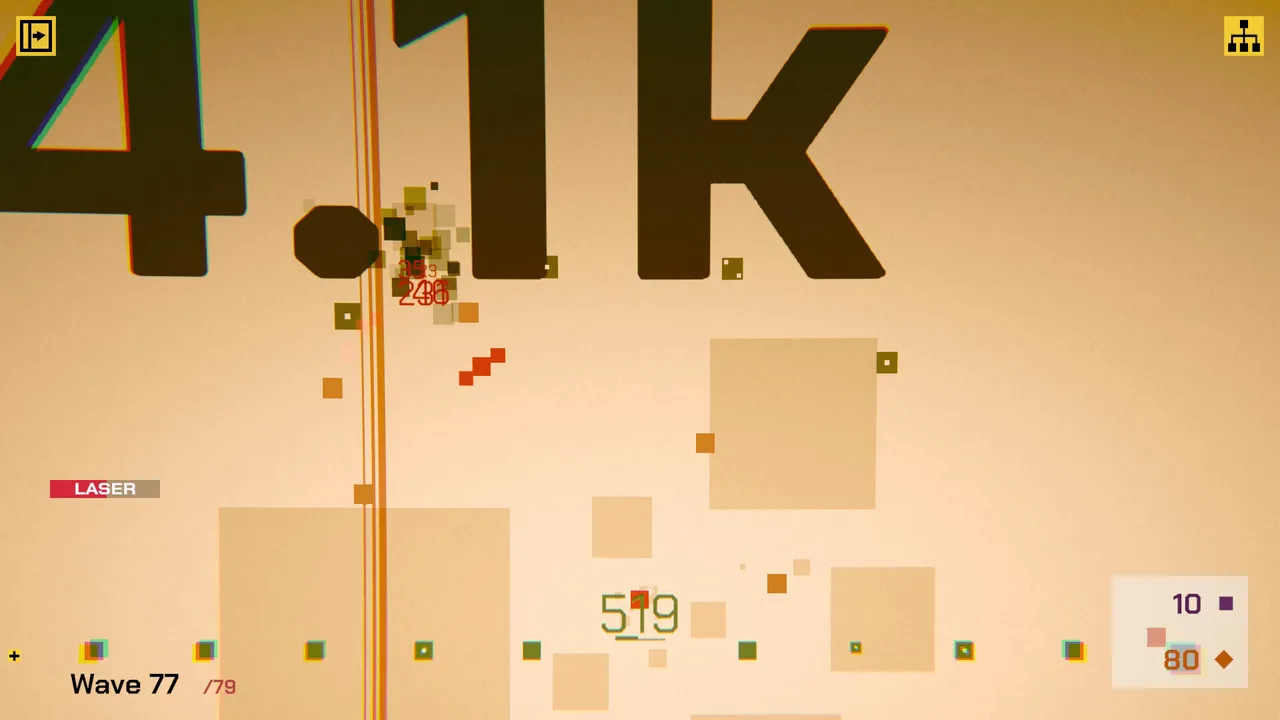
- Geometric presentation stays readable while dozens of projectiles are on screen
- Real companion-window mode, so it works as intended beside other work rather than demanding a monitor
Biggest weaknesses
- Skill-tree branches differ in name and number more than in how a run actually plays
- Ascension gives multipliers rather than new systems, so later runs are the early run with bigger figures
- Widening the upgrade pool used to thin your odds of drawing what you needed — a self-defeating loop the developer has only partly unwound
Who it's for: People who want something quiet running beside their work and are happy for the whole game to be a growth curve. Not for anyone who wants an incremental to eventually get complicated.
Our recommendation: Play the free demo first — it's the same loop, and if the tree hasn't hooked you in an hour the full version won't change that. At five dollars it's an easy yes if it does.
6 / 10
You are a 1. Not a knight with a sword, not a hero with a health bar — the digit itself, sitting in the middle of an empty field while other digits roll in to erase you. Your value is your hit points and it's also your physical size, so as you climb into the thousands you visibly swell until you're squatting over half the arena, spitting bullets in every direction. It's a lovely piece of design shorthand. Most incrementals need a stat panel to tell you you've got stronger. This one just makes you bigger.
That single idea carries Incremental Infinity further than a game this small has any right to go. The trouble is that it's asked to carry everything.
The loop, in about a minute
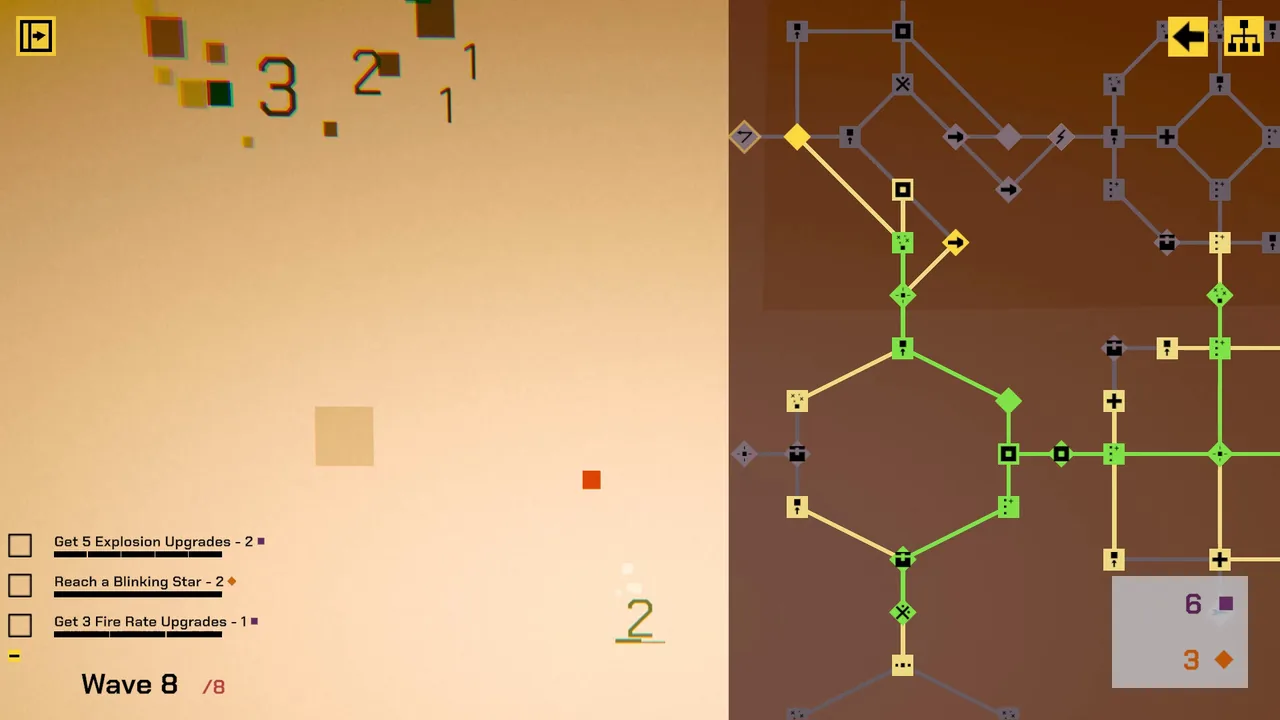
You never fire manually. Enemies arrive, your number shoots them automatically, kills pay out experience, and experience buys nodes on a skill tree that generates itself as you push outward into new sectors. The nodes do the usual work — base damage, fire rate, knockback — and further out they unlock abilities with a bit more personality: poison, multi-shot, mines, critical hits, a lightning chain, a laser. Quests sit alongside as a second income stream, paying Skill Points and Diamonds for hitting specific spending patterns.
Die and you go back to 1. Your tree stays. Ascend deliberately and you trade the run for permanent multipliers and a better experience rate, then climb again from the bottom with the ceiling raised.
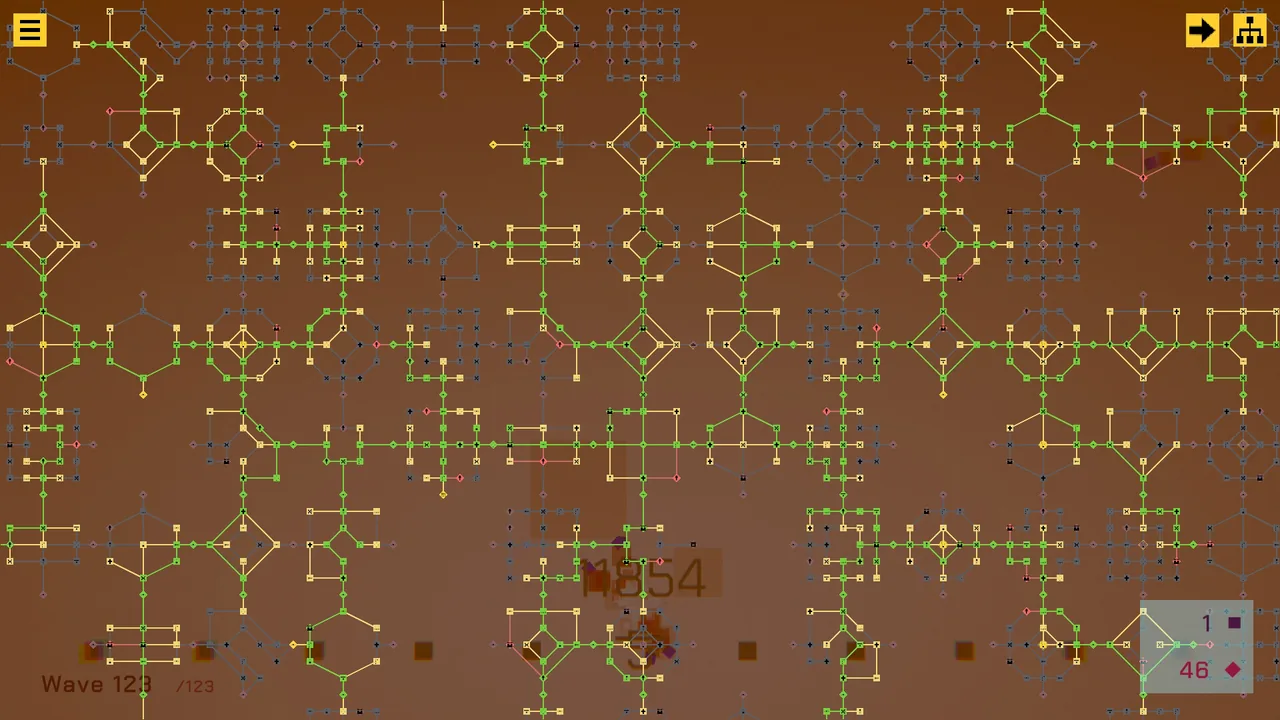
There is nothing surprising in that description, and Rablo Games clearly knows it. The pitch isn't novelty, it's scale: the tree is procedurally generated and formally endless, and the store copy promises no cap on how powerful you get. That's the hook, and it's worth asking honestly whether an infinite quantity of anything is the same as a lot of game.
Infinite is not the same as deep
It isn't, and this is where the score comes from.
An incremental earns its hours by changing what you're deciding, not just what you're multiplying. The good ones stagger their reveals — a new resource that makes an old one obsolete, a mechanic that rewrites the optimal build, a prestige layer that asks a different question from the one below it. Incremental Infinity has one question and asks it repeatedly: which multiplier next?
The branches look different on the map and behave almost identically in play. A poison build and a crit build both resolve to the same thing, which is a bigger number appearing over a dead enemy slightly faster. Because nothing you pick changes how a run is shaped — no positioning, no resource tension, no wave you have to answer rather than out-scale — build variety stays cosmetic. Ten turrets throwing bouncing projectiles across the screen is a genuinely great sight the first time. It's the same sight on run eight.
Ascension has the same problem one floor up. Prestige systems are supposed to be where an incremental gets interesting, the moment the game admits the previous layer was training. Here ascending mostly raises coefficients. You come back faster and go further, and the further you go looks like where you already were. Players hitting a motivation wall somewhere around the eighth ascension is not a mystery; that's roughly the point where the promise of infinity has been fully demonstrated and there's nothing behind it.
The pool that punished you for growing
The most instructive flaw is one you can watch the developer working on in real time.
Upgrades are drawn from a customisable pool, and for the first week after launch unlocking new node types diluted that pool — the more abilities you had access to, the lower your odds of being offered the plain damage node you actually needed. Progress made progress harder. That's the kind of interaction that looks elegant on a whiteboard and feels, in the chair, like the game is arguing with you.
The 25 July update went at it directly, guaranteeing that base damage nodes appear at a consistent rate regardless of what else you've unlocked, and adding Uncommon, Rare and Epic node rarities with bonus multipliers to give draws some texture. Both are real improvements. Neither fixes the deeper issue, which is that the tree is a slot machine you feed rather than a map you read, and rarity tiers make a pull more exciting without making a decision more meaningful.
A week of patches
Credit where it's due: the post-launch cadence here has been relentless. Within twenty-four hours of release a patch capped the frame rate at 60 and turned VSync off by default, after players reported the game running their CPUs and fans far harder than a screen of coloured polygons should. Day two raised default difficulty and added an Easy Mode, made same-type nodes highlight on hover, and made ascension nodes easier to spot. Day three brought a colourblind mode and a switch to disable particle effects. Then explicit in-game guidance on finding the next ascension node, two new synergy nodes with re-costed Diamonds, the rarity system, an optimisation pass and a pair of bug fixes — all inside the first week.
That is a developer paying attention, and it matters when you're deciding whether to buy a five-dollar game with a Mixed rating. It also tells you something about the state it shipped in. Performance tuning, difficulty calibration, accessibility options and tree readability are launch requirements, not stretch goals, and the fact that most of them landed as emergency patches is part of why the early reception went the way it did. The question worth watching is whether the same energy goes into new systems, because that is what this game is short of.
Shapes, screen space and the thing it isn't
Visually it's minimalist by conviction rather than by budget constraint — flat geometry, restrained palette, clean motion — and it holds up under load, which is harder than it sounds when the screen fills with bouncing projectiles. The weak point is the tree itself, which gets dense and low-contrast as it sprawls, so the interface is at its worst precisely where you spend your attention. The hover-highlight and colourblind additions help. A cleaner sense of hierarchy would help more.
One expectation to reset before you buy. The companion window is the whole of this game's answer to being away from it: a slim panel you leave running beside your actual work, ticking along in your peripheral vision. Nothing here is built around closing the game and coming back to a pile of accumulated progress the way Idle Iktah or Milky Way Idle are. It's Windows-only, mouse-only, and it wants to be on your screen. If your idea of an idle game is one that works while your machine is off, this isn't it.
What five dollars actually buys
The monetisation is the cleanest thing about it, and deserves saying plainly in a genre where it usually isn't. You pay once — US$4.99, or US$3.99 during the launch discount running to 3 August — and that's the transaction. No premium currency, no energy meter, no ad to double your offline gains, no timers nagging you back. Diamonds are earned in play and only in play. The only other thing on the store page is a soundtrack at US$1.99 that you can ignore entirely. (Prices checked 29 July 2026.)
For that money you get twenty-two achievements, eleven languages, Steam Cloud, and a loop that thins out somewhere in its low teens of hours, judging by where players tend to hit the ascension wall. That's honest value at the price of a coffee. It's also a fair reason not to expect the depth of an incremental you'd sink two hundred hours into, and it's why the Mixed rating reads to me less as a verdict on quality than as a collision between what "infinite" implies and what the game delivers.
Verdict
Incremental Infinity is a tidy, likeable, well-priced little idler with one strong idea and not much underneath it. Growing from a 1 into a screen-filling monster is a satisfying arc, the presentation is confident, the monetisation is clean, and the developer is visibly working. If you want something quiet in the corner of a monitor for a fortnight, five dollars is not a risk.
It doesn't score higher because infinity turns out to be the wrong axis to build on. A tree that generates forever is only interesting if what it generates keeps changing the game, and this one mostly changes the exponent. Ascension repeats rather than reframes, builds converge, and the mid-game has nothing to spend once the novelty is gone. Those are design gaps, not bugs, and no patch cadence fixes them without new systems attached.
Take the demo first. It's free, it's the same loop, and an hour with it will tell you everything the next ten will.
Prices and monetisation checked 29 July 2026.
If what you're really after is progression that carries on while the machine is off, Wanderer is built around that instead — the same appetite for a growing number, pointed at a world you leave and come back to.
Pros and cons
Pros
- The number-is-your-health-and-your-size conceit makes power legible at a glance, with no stat sheet needed
- Geometric presentation stays readable while dozens of projectiles are on screen
- Real companion-window mode, so it works as intended beside other work rather than demanding a monitor
- Paid once with no shop, no currency bundles, no timers and no ads
- The developer has shipped balance, accessibility and optimisation patches at a pace most small studios never manage
Cons
- Skill-tree branches differ in name and number more than in how a run actually plays
- Ascension gives multipliers rather than new systems, so later runs are the early run with bigger figures
- Widening the upgrade pool used to thin your odds of drawing what you needed — a self-defeating loop the developer has only partly unwound
- The tree gets crowded and hard to read exactly when its decisions matter most
- No controller support, no mobile version, and nothing to do with the game closed
Screenshots
-
Incremental InfinityImage: Rablo Games via Steam -
Incremental InfinityImage: Rablo Games via Steam -
Incremental InfinityImage: Rablo Games via Steam -
How the review scores each part of the gameWanderer Editorial -
The short versionWanderer Editorial