
Game review
Dopaminer
4.3 / 10
- Developer
- Otto Development
- Publisher
- Otto Development
- Released
- 27 March 2026
- Platforms
- Windows
- Genre
- Casual
- Monetisation
- Free-to-play, no in-app purchases found
- Players
- Single-player
The short version
Dopaminer is a free-to-play idle clicker from Otto Development, released 27 March 2026, built around clicking neural "bits" for Dopamine and stacking upgrades toward an eventual prestige "Rewire." This review's full 27-review sample sits at Mixed overall (11 positive to 16 negative), shaped heavily by a rough launch with badly under-tuned upgrade scaling, a punishing early achievement, and real performance problems, though the developer's first month of patching directly and rapidly addressed the loudest of those complaints before updates slowed to a near-stop for most of the following five months.
Biggest strengths
- This review's sample includes several reviewers explicitly crediting the developer's rapid post-launch patching, with one writing directly under their negative review that a March 30 update to move the Auto-Collector upgrade earlier 'was a much needed improvement' and withdrawing part of their complaint
- This review checked the game's public partner-events feed and found 10 of its 17 total posts landed within the first 25 days after launch, including a patch replacing the game's original linear upgrade-scaling model with what the developer calls a 'Normalized Exponential Decay model' specifically to address weak early-game upgrades
- This review confirmed via Steam categories and the store page that Dopaminer carries no in-app purchase listing, meaning its Free status comes with no microtransaction layer on top, a point several reviewers in this review's sample raise favorably when weighing the game's shortcomings against its zero-dollar price
Biggest weaknesses
- This review's sample includes a strong, recurring launch-week complaint that the game's upgrades scaled so weakly they were 'basically not worth buying,' with one reviewer writing 'upgrade scaling is so unbelievably weak' and another simply pleading 'pls fix upgrade scaling'
- This review's sample includes a specific, repeated complaint about the game's original Automation achievement, with one reviewer describing having to 'sit there and click endlessly on the same thing without purchasing any other upgrade for about 20 minutes straight,' warning it would cause 'hand and wrist issues for literally no benefit'
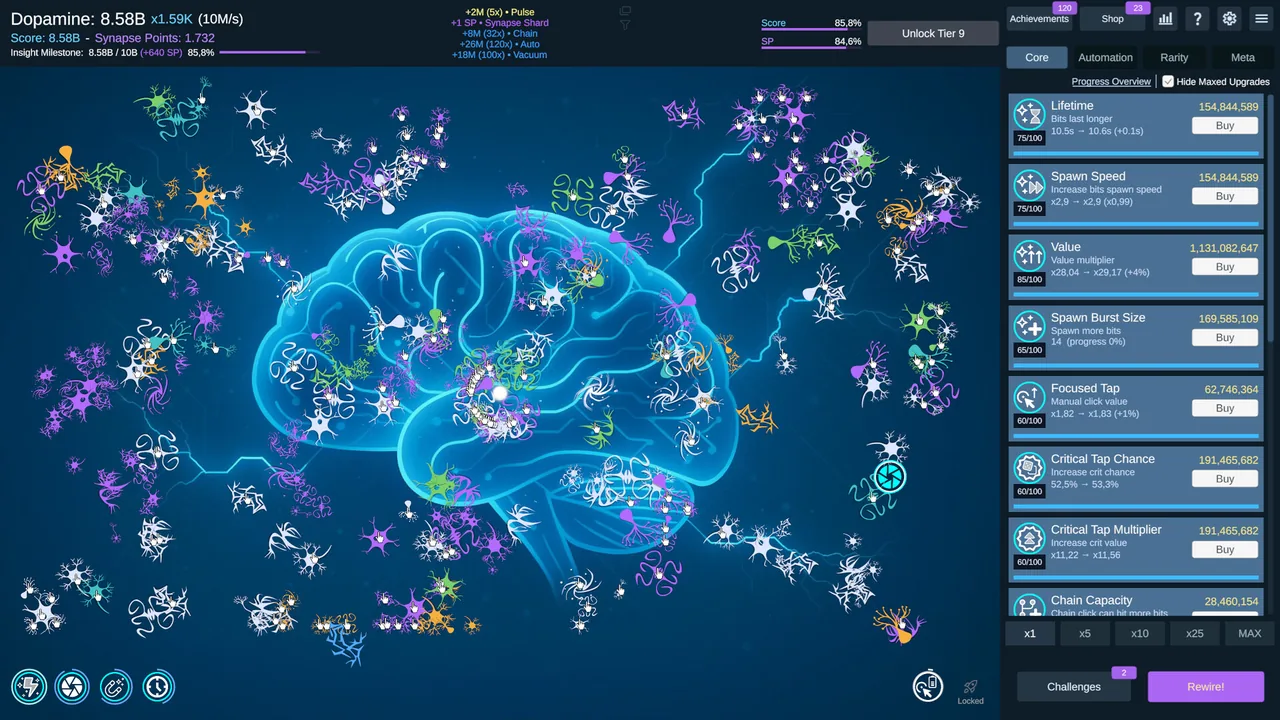
- This review's sample includes a reviewer reporting severe late-game performance problems after maxing out available upgrades, describing 'constant frame drops, everything turning into a slideshow,' and joking that 'the game is free, though RSI is not'
Who it's for: Genre-agnostic clicker fans who want something free and undemanding to leave running in the background; a weak recommendation for anyone hoping for meaningful mechanical depth, since this review's sample repeatedly describes the game as thin even by incremental-genre standards, and support has gone quiet since July.
Our recommendation: A free, technically functional idle clicker that fixed its worst launch-week problems fast but never grew much beyond them; worth a look at zero cost for genre completionists, hard to recommend past that.
4.3 / 10
Click a neural "bit," watch a number go up, stack upgrades, repeat. Dopaminer is a free-to-play idle clicker from developer and publisher Otto Development, released 27 March 2026. This review draws on the game's full 27-review sample, its global achievement data, and its public patch history.
A dopamine-themed clicker, with the numbers to match
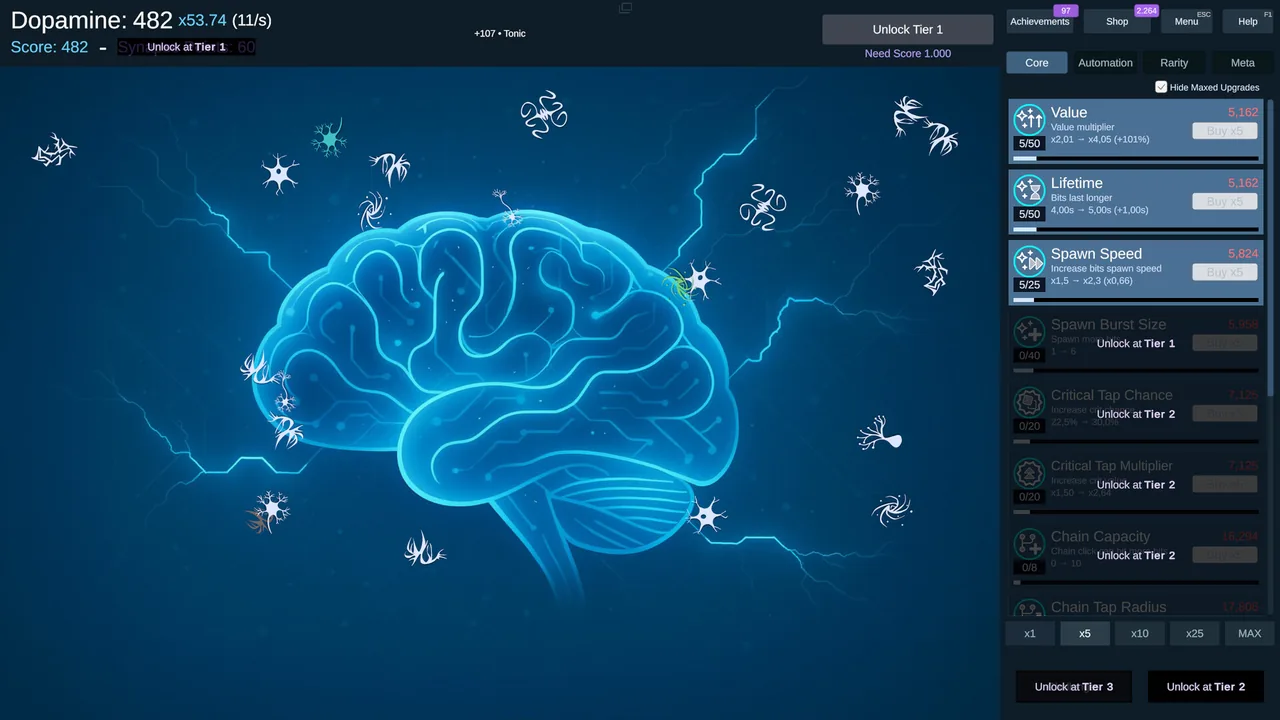
This review checked the game's own store description, which frames Dopaminer as "the most scientifically accurate thing possible: click Synapse bits that reward you with Dopamine," building toward stacked upgrades, automation, and an eventual prestige system the game calls "Rewire." The theming is a genuine hook on paper, wrapping the genre's usual number-go-up loop in a neuroscience skin. In practice, this review's sample treats that theming as thin dressing over a familiar structure. One reviewer, distilling the entire experience to two words, simply wrote "number go up," and a Russian-language reviewer's more detailed writeup calls it a "basic clicker" without dwelling on the framing at all.
Weak upgrades at launch, called out immediately
This review's sample shows the loudest and most consistent complaint in Dopaminer's first days concerned upgrade scaling. Multiple English-language reviewers posted within 48 hours of launch to say upgrades felt functionally worthless: one wrote flatly that "upgrade scaling is so unbelievably weak," another said upgrades "are so weak they're basically not worth buying," and a third's entire review reads "pls fix upgrade scaling." A later reviewer who stuck with the game longer described the problem more precisely, explaining that what you see when you first open the game "is what you'll have when all upgrades are maxed, albeit higher numbers of everything," arguing there was no real structural depth being unlocked as you progressed, only bigger numbers on the same shallow loop.
An achievement that asks for real repetitive strain
This review's sample includes a specific, repeated complaint about the game's original path to its Automation achievement. One reviewer described the experience bluntly: getting the automation upgrade "requires you to just sit there and click endlessly on the same thing without purchasing any other upgrade for about 20 minutes straight," warning that doing so risked "hand and wrist issues for literally no benefit." That complaint appears alongside a related one from a much longer-tenured player, who logged over 18,700 minutes of playtime and still flagged late-game performance problems severe enough to describe "constant frame drops, everything turning into a slideshow," joking that "the game is free, though RSI is not."
A genuinely responsive first month
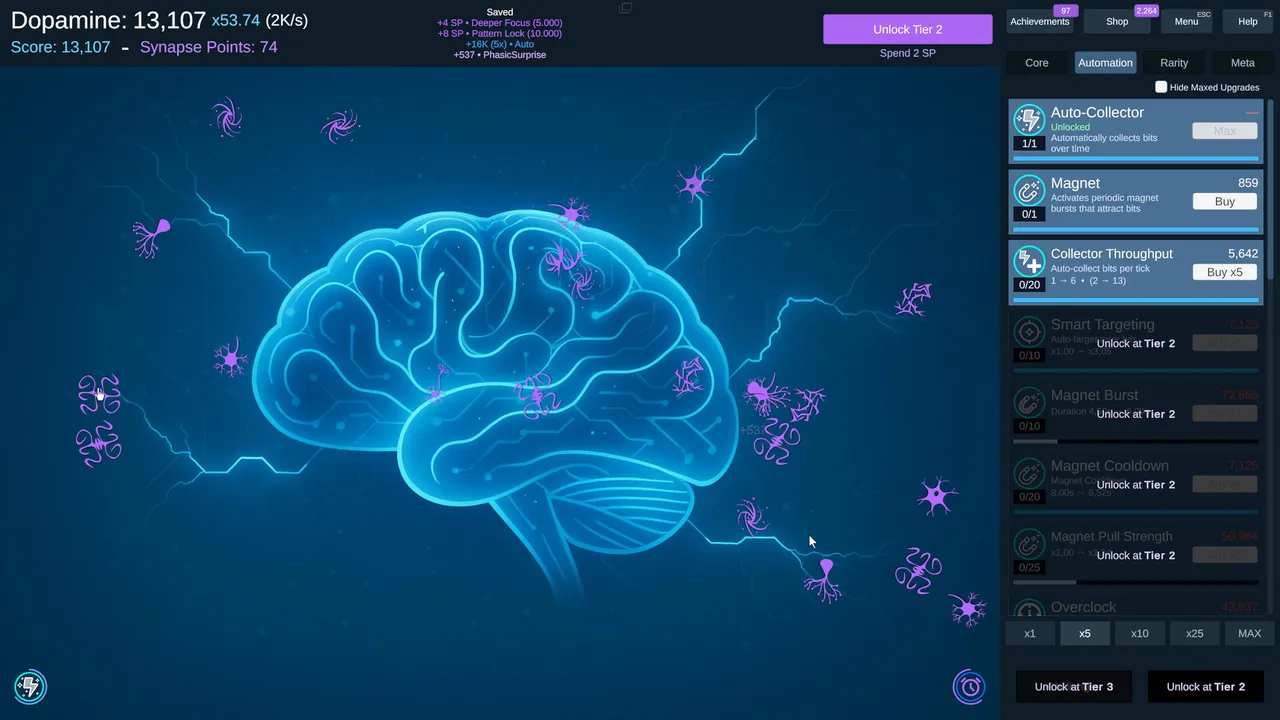
This review checked the developer's public partner-events feed directly and found a dense cluster of patch activity in the weeks immediately after launch: a March 27 hotfix for a startup crash, then ten further update posts between March 28 and April 22. Several of those patches read as direct responses to the sample's loudest complaints. A March 30 update moved the Auto-Collector upgrade to be available much earlier "to reduce early-game clicking," and one reviewer, who had posted a negative review specifically about weak upgrades days earlier, edited it afterward to write that the change "was a much needed improvement," adding "I am withdrawing my complaint about the automation being poorly designed." A subsequent April 2 patch went further, replacing the game's original linear upgrade-scaling model with what the developer's own patch notes call a "Normalized Exponential Decay model," explicitly framed as making "early upgrade levels feel more impactful while maintaining smoother long-term balance," a direct answer to the scaling complaints that had dominated the game's launch-week reception.
Then nearly three months of quiet
Support did not continue at that pace. This review's partner-events feed shows one further major update, v1.5.0.0 on July 18, reworking the auto-collect system and upgrade levels, and nothing posted since, a gap of more than five months as of this review's research date. This review's sample includes a French-language reviewer who specifically flags a mid-2026 rebalance that cut their main source of prestige currency, describing a mechanic called the "neuroglimmer" that once granted roughly 500 million currency per run dropping to around 84 thousand after a patch, and calling the resulting prestige system "just useless." Another reviewer, also frustrated by the pace of communication, wrote that the developer "is not helpful at all and can't even respond to people asking what upgrades even do."
Free, and honestly priced as such
This review checked Dopaminer's Steam listing directly and confirmed it carries no in-app purchase category, meaning its Free-to-play status comes with no microtransaction layer stacked on top, unusual for the genre. Several reviewers in this review's sample weigh the game's shortcomings against that zero-dollar price specifically. One Finnish-language reviewer, after describing the game as "way too grindy" in an initial complaint, returned twice to update their review as patches landed, eventually concluding "considering the game is free to play, it's worth the recommendation now," while still noting the loop remains "very boring" and effectively requires an auto-clicker macro to enjoy comfortably.
A modest accessibility showing for the genre
This review checked the store's accessibility feature-flag block directly and found five of nineteen tracked flags true: background volume controls, stereo sound, a mouse-only control option, no mandatory quicktime events, and save-anytime support. That is a stronger showing than several other titles covered by this review this cycle, though it comes with the obvious caveat that a click-focused genre built around rapid, repeated mouse input carries its own accessibility burden that no feature flag captures, a burden this review's sample raises directly and repeatedly.
Verdict
Dopaminer launched thin and under-tuned, and its own review sample called that out immediately and specifically: weak upgrade scaling, a punishing manual-click achievement, and real performance problems at the high end. Credit is due for how quickly the developer responded, rewriting the game's core upgrade-scaling model within a week of the loudest complaints landing and drawing an explicit, on-record concession from at least one reviewer who had criticized it. But that momentum did not last, support has gone largely quiet since mid-July, and this review's sample still describes a game whose core loop, even patched, remains shallow next to its genre peers. Free, functional, and no longer actively broken is the honest ceiling here.
Pros and cons
Pros
- This review's sample includes several reviewers explicitly crediting the developer's rapid post-launch patching, with one writing directly under their negative review that a March 30 update to move the Auto-Collector upgrade earlier 'was a much needed improvement' and withdrawing part of their complaint
- This review checked the game's public partner-events feed and found 10 of its 17 total posts landed within the first 25 days after launch, including a patch replacing the game's original linear upgrade-scaling model with what the developer calls a 'Normalized Exponential Decay model' specifically to address weak early-game upgrades
- This review confirmed via Steam categories and the store page that Dopaminer carries no in-app purchase listing, meaning its Free status comes with no microtransaction layer on top, a point several reviewers in this review's sample raise favorably when weighing the game's shortcomings against its zero-dollar price
- This review checked the store's accessibility feature-flag block directly and found five of nineteen tracked flags true, including background volume controls, stereo sound, a mouse-only control option, and no mandatory quicktime events, a stronger showing than several other titles covered by this review this cycle
Cons
- This review's sample includes a strong, recurring launch-week complaint that the game's upgrades scaled so weakly they were 'basically not worth buying,' with one reviewer writing 'upgrade scaling is so unbelievably weak' and another simply pleading 'pls fix upgrade scaling'
- This review's sample includes a specific, repeated complaint about the game's original Automation achievement, with one reviewer describing having to 'sit there and click endlessly on the same thing without purchasing any other upgrade for about 20 minutes straight,' warning it would cause 'hand and wrist issues for literally no benefit'
- This review's sample includes a reviewer reporting severe late-game performance problems after maxing out available upgrades, describing 'constant frame drops, everything turning into a slideshow,' and joking that 'the game is free, though RSI is not'
- This review checked the developer's public partner-events feed and found a five-month gap between the July 18 update and this review's research date in late September, and this review's sample includes a French-language reviewer specifically criticizing a mid-2026 rebalance that cut their main source of prestige currency from roughly 500 million down to 84 thousand
Screenshots
-
DopaminerImage: Otto Development via Steam -
DopaminerImage: Otto Development via Steam -
DopaminerImage: Otto Development via Steam