
Game review
Catto Pew Pew!
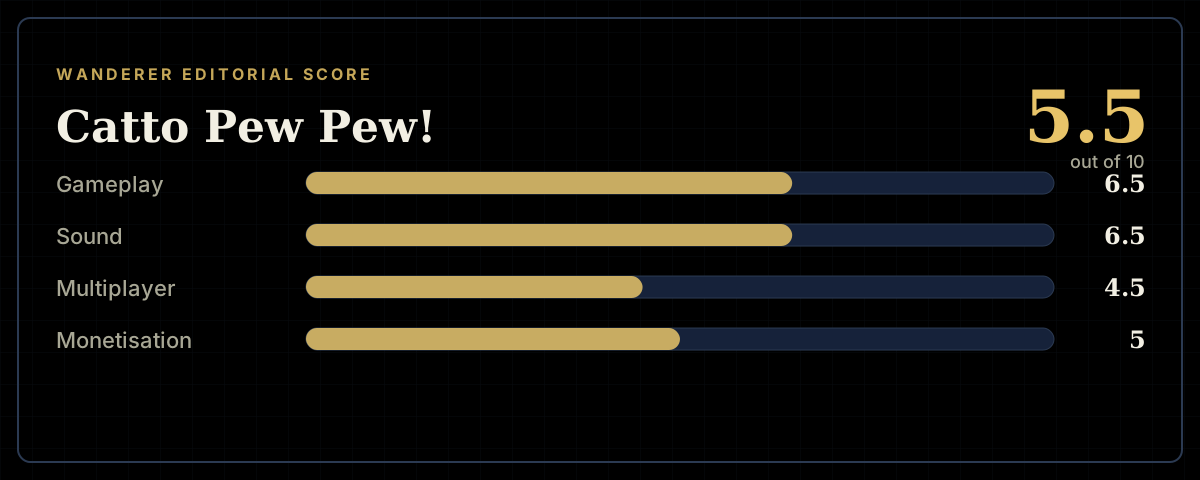
5.5 / 10
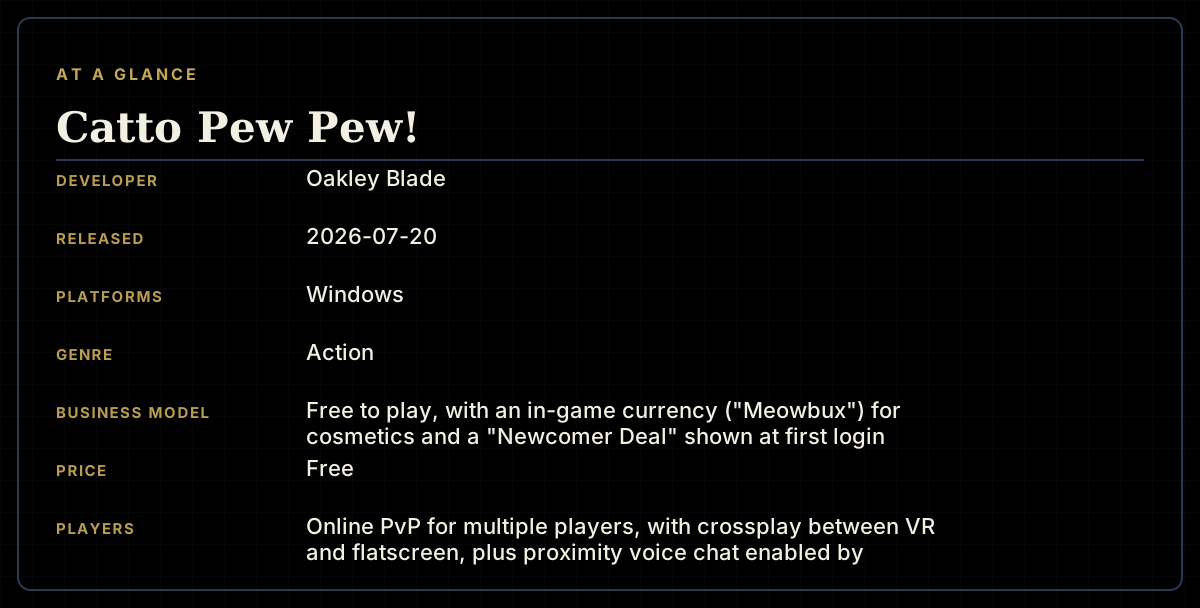
- Developer
- Oakley Blade
- Publisher
- Oakley Blade Games LLC
- Released
- 20 July 2026
- Platforms
- Windows
- Genre
- Action
- Monetisation
- Free to play, with an in-game currency ("Meowbux") for cosmetics and a "Newcomer Deal" shown at first login
- Players
- Online PvP for multiple players, with crossplay between VR and flatscreen, plus proximity voice chat enabled by default
The short version
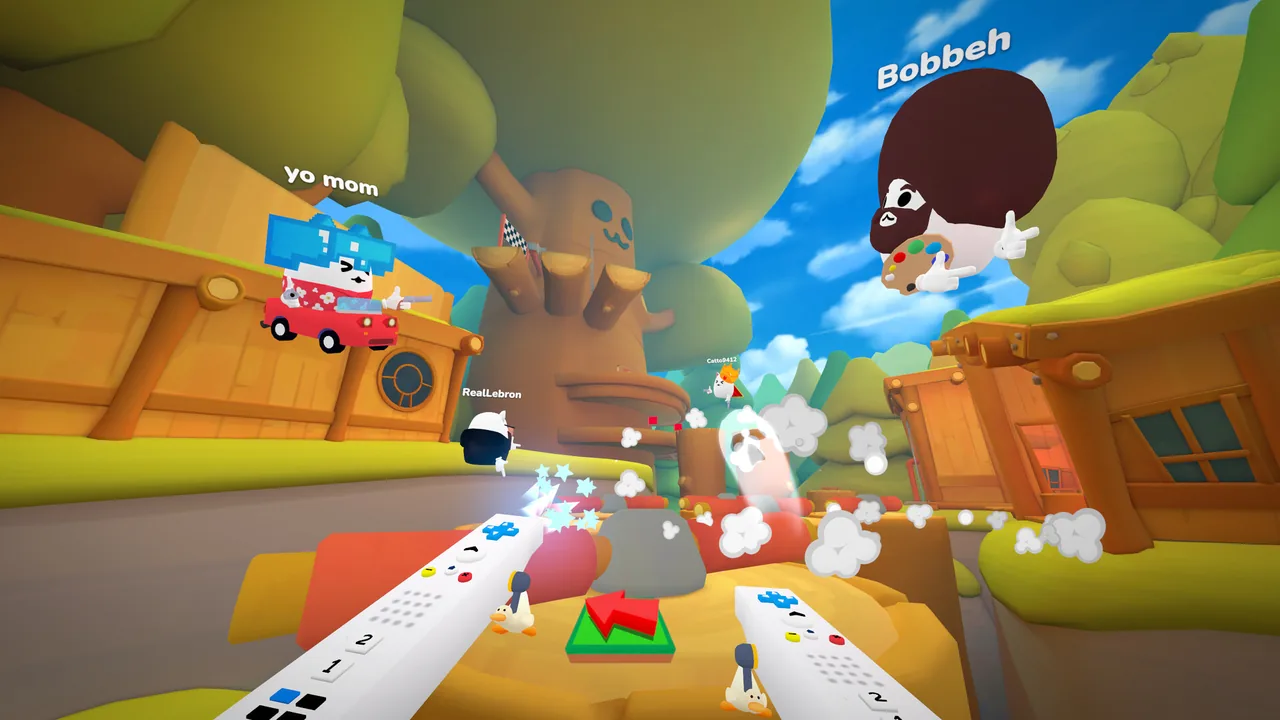
Catto Pew Pew! has a simple, silly premise: armed cats fight in physics-driven arenas, launching each other skyward with every hit. This review analysed a 335-review English corpus — reading the full 74-review negative sample plus a large sample of the positive side — and found the core idea genuinely lands for a lot of players: chaotic, funny, and social when it works.
What this review also found, corroborated independently across many reviewers rather than a single account, is a real, specific safety concern: proximity voice chat is enabled by default, the playerbase skews visibly young, and multiple reviewers separately report hearing racial slurs used openly in voice chat with no apparent moderation. That's a serious, recurring finding in a free game with broad appeal to children, and it sits alongside more ordinary launch complaints — hackers, a punishing knockback mechanic with no air control, and monetisation prompts shown immediately at first login.
Biggest strengths
- A genuinely fun, chaotic core concept — physics-based launches and proximity voice chat combine to make matches funny and social when the lobby is good, according to a large share of reviewers
- Real content variety at launch: multiple maps and modes, cross-platform VR and flatscreen support, and a dedicated VR "Monke Mode" for arm-swinging parkour movement
- A visibly present solo developer, publicly and personally apologising for launch bugs and working through a Discord support channel rather than going silent
Biggest weaknesses
- A serious, repeated, cross-reviewer finding. Proximity voice chat is enabled by default, the playerbase skews visibly young based on reviewer accounts, and multiple separate reviewers report hearing racial slurs used openly in public lobbies with no apparent moderation in place
- Multiple independent reviewers report hackers using teleportation, speed exploits, and auto-clickers in public matches, with no anti-cheat fix confirmed in the patch history this review checked
- A knockback-heavy core mechanic draws frequent, repeated complaints for offering no air control once launched, making hits feel unrecoverable rather than skill-based to several reviewers
Who it's for: Fans of chaotic physics party shooters who play primarily with a private group of friends rather than public matchmaking, and VR players curious about the crossplay support — general public-lobby players, especially anyone bringing younger players in, should read the moderation concerns below carefully first.
Our recommendation: A genuinely fun concept let down by real, corroborated safety and moderation gaps — worth trying privately with friends where proximity chat can be managed directly; approach public matchmaking, especially for younger players, with real caution until moderation improves.
5.5 / 10
Physics-based party shooters live or die on one question: is getting launched across the map funny, or just frustrating? Catto Pew Pew! — free, built by solo developer Oakley Blade, and starring armed cats fighting in chaotic arenas — sits somewhere between the two, according to a 335-review English corpus this review analysed in full on the negative side and extensively on the positive side. What emerges is a genuinely fun idea running into real problems, some of them the ordinary kind, and one that's more serious than that.
When it works, reviewers say it really works
The core loop draws real, specific praise from a meaningful share of this sample. "The maps feel different from each other, and the voice chat makes matches especially chaotic and funny," reads one detailed launch-day review. Another calls it "one of those multiplayer games that immediately communicates its personality through its name alone," going on to praise the physics-driven combat directly. A shorter review sums up the appeal simply: "this game is so much fun! The whole game concept is amazing and its developed really well!" Production quality gets specific credit too, with one formatted review rating graphics, gameplay, and audio all "Good" across dedicated categories. Notably, recent-week sentiment in this review's sample (82% positive in the seven days before research) sits slightly above the game's lifetime score, suggesting reception has held steady rather than declining since launch.
A serious, corroborated safety concern
This review also found something that goes beyond ordinary launch jank, and it's worth reporting plainly rather than folding into a generic "toxic community" line. Proximity voice chat is enabled by default, and multiple reviewers, independently of each other, describe the resulting lobbies in similar terms. "Voice is enabled BY DEFAULT so the game is full of children talking nonsense presumably with no idea they are on a live mic, which is actually a bit creepy," reads one review. Several others go further, describing hearing racial slurs used openly: one reviewer writes plainly that lobbies are "filled with little kids screaming the hard R," and a separate reviewer, weeks later, reports the same category of experience independently: "the lobbys are just filled with 7 year olds screaming the n-word and stuff like that. I respect trying to make a game but the fanbase just ruins it." That these accounts come from different reviewers, on different days, describing the same specific pattern, is what makes this worth taking seriously rather than dismissing as one bad lobby — this review found no patch note addressing voice chat moderation in the game's history to date.
The more ordinary complaints
Beyond that, this sample's complaints are the kind any physics shooter risks. The knockback mechanic draws the most consistent gameplay criticism: "i just want to be able to MOVE WHILE FALLING," reads one review from launch day, and the request repeats often enough to read as the sample's most common specific ask. Hackers are a real, repeated concern too — "there where hackers in 2 of them," reads one account, while another describes "hackers that teleport and have ultra speed or auto clickers," with no anti-cheat update recorded in the patch notes this review checked. Monetisation draws pointed criticism from a game aimed at a clearly young audience: "the game as soon as I joined asked me to spend money," reads one review, and a separate reviewer objects on principle: "you fumble the games release by adding loot boxes and microtransactions." At least two reviewers separately report that the same "Newcomer Deal" popup caused a game-blocking bug at launch, which the developer's own 21 July post acknowledges as one of several launch-week issues, adding candidly: "please keep in mind this is pretty much a solo-developed game."
Final verdict
Catto Pew Pew! has a real, working idea at its center — physics chaos plus proximity chat can be genuinely funny with the right group, and this review's sample backs that up with specific, credible praise. But the same voice-chat system that makes matches fun also comes with a documented, repeated risk in public lobbies that this review can't responsibly gloss over, especially given how visibly young the playerbase skews. Add real, unresolved hacker reports and a punishing knockback mechanic with no recovery option, and the picture is more mixed than the "Mostly Positive" badge alone suggests.
Worth trying privately with a group of friends who can manage the voice chat directly; approach public matchmaking, and especially any younger player's access to it, with real caution until moderation catches up with the game's popularity.
Players who want that same sense of chaotic, physics-driven fun with friends, built on a world with real moderation and community standards in place, may also want to look at Wanderer.
Pros and cons
Pros
- A genuinely fun, chaotic core concept — physics-based launches and proximity voice chat combine to make matches funny and social when the lobby is good, according to a large share of reviewers
- Real content variety at launch: multiple maps and modes, cross-platform VR and flatscreen support, and a dedicated VR "Monke Mode" for arm-swinging parkour movement
- A visibly present solo developer, publicly and personally apologising for launch bugs and working through a Discord support channel rather than going silent
- Cosmetic progression that stays optional rather than gameplay-affecting, based on this review's sample — no reviewer in the negative sample describes a pay-to-win mechanic specifically
- Recent-week review sentiment (82% positive in the last 7 days at time of research) sits slightly above the lifetime score, suggesting reception has held steady or improved rather than declined
Cons
- A serious, repeated, cross-reviewer finding. Proximity voice chat is enabled by default, the playerbase skews visibly young based on reviewer accounts, and multiple separate reviewers report hearing racial slurs used openly in public lobbies with no apparent moderation in place
- Multiple independent reviewers report hackers using teleportation, speed exploits, and auto-clickers in public matches, with no anti-cheat fix confirmed in the patch history this review checked
- A knockback-heavy core mechanic draws frequent, repeated complaints for offering no air control once launched, making hits feel unrecoverable rather than skill-based to several reviewers
- Monetisation prompts, including a "Newcomer Deal" popup, appear immediately at first login for a game with a young-skewing playerbase, and at least two reviewers report the popup itself causing a game-blocking bug at launch
- A mandatory account sign-up step and, for some reviewers, VR setup friction are both cited as unnecessary barriers before reaching the actual game
Screenshots
-

Catto Pew Pew!Image: Oakley Blade Games LLC via Steam -
Catto Pew Pew!Image: Oakley Blade Games LLC via Steam -

Catto Pew Pew!Image: Oakley Blade Games LLC via Steam -
How the review scores each part of the gameWanderer Editorial -
The game at a glanceWanderer Editorial -
The short versionWanderer Editorial