The First Ten Minutes: Rebuilding How Wanderer Starts
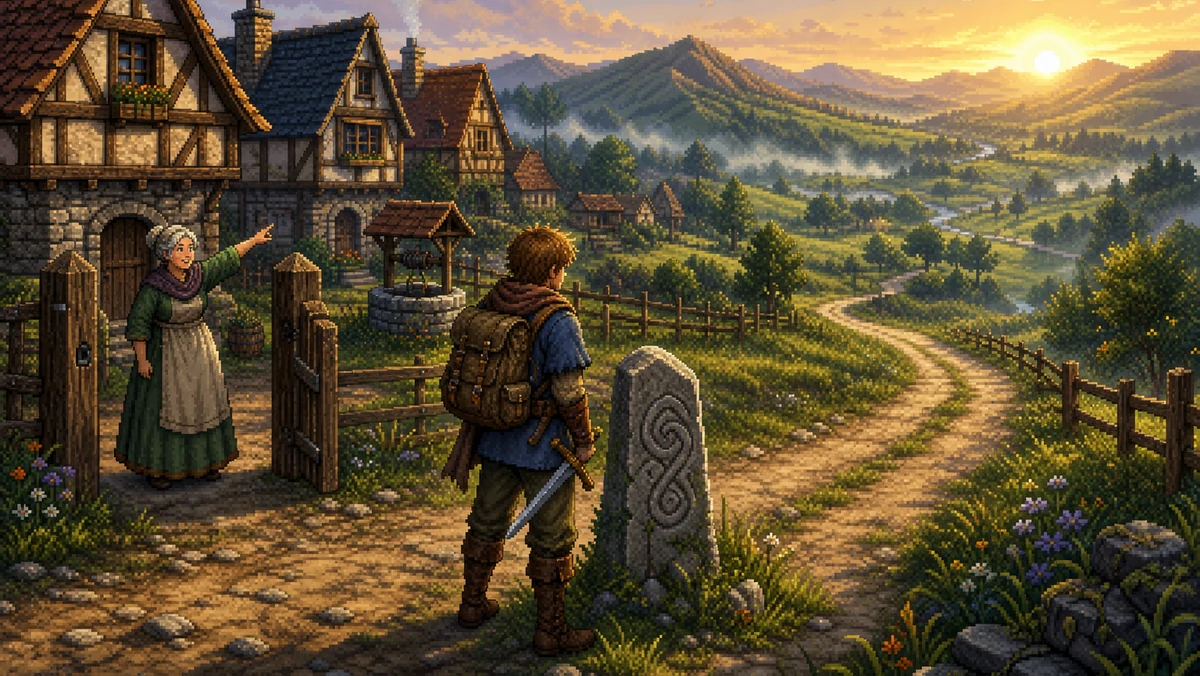
Most people who try Wanderer decide whether they're staying inside the first ten minutes. That is not a lot of road to make an argument on, and the old opening was spending it badly.
Today's update is mostly about those ten minutes — plus two engine fixes that everybody feels but nobody would ever ask for by name.
The opening, rebuilt
The tutorial now has one job: get you from tapping a stranger to watching your wanderer walk east on its own without you having to guess anything.
Mira greets you. The innkeeper at Wanderer's Rest now speaks first when a newcomer arrives instead of waiting to be discovered. She is the gold marker, and tapping her is step one.
The second step is Explore, not Rest. The old chain asked new players to rest — a fine instruction that taught them nothing about what this game is. It now asks you to open the activity menu and choose Explore, because that single choice is the whole game: your wanderer walks the road east on its own, with the app closed if you like.
There's an arrow on the mode button. The activity menu is the most important control in Wanderer and it lives in a corner. When the tutorial needs you to use it, it now points at it.
There's somewhere to walk to. New players get a real destination — the East Road Waystone, a landmark just outside the walls, with a piece of art drawn for it. "Follow the road east" is a much better third step than "wander vaguely", and it ends with you on the road rather than standing in a town square.
The guidance stays visible. Previously the coaching text could scroll or dismiss itself out from under you at exactly the wrong moment. It now stays where you can read it, with a coaching ring drawing your eye to whatever it's talking about, and a recovery action if you end up somewhere the step didn't expect.
And the first fight can't leave you empty-handed. Finishing the hunt step grants a weapon outright, and the pack upgrade lands early enough to matter. Nobody's first half-hour should be spent unarmed because the dice were unkind.
None of this is guesswork, incidentally — the whole opening chain is now covered by end-to-end tests that play it as a new account, plus analytics that show where people actually stop.
Travel that goes where you point it
Here's an old complaint that turned out to have a specific cause. Travel to somewhere far away would crawl: your wanderer would set off, stop well short, re-plan, set off again.
The pathfinder was a breadth-first flood with a fixed budget of tiles it was allowed to examine. Because that kind of search expands equally in every direction — including all the directions away from where you're going — its practical reach was about 27 tiles. Ask for somewhere 60 tiles away and it stopped 15 short. Ask for somewhere 200 tiles away and it stopped 155 short, then did the whole thing again.
It's now an A-star search, which spends its budget aiming at the goal instead of blooming outwards. Because a diagonal step costs the same tick as a straight one in Wanderer, the distance estimate it uses is exact in open ground — so on a clear road the search runs almost straight at the destination.
Long journeys plan in one go now, and re-planning costs about a sixth of what it used to.
Ten times less work per frame
The other complaint was "the game makes my phone hot", and the honest answer is that a town was asking far more of your phone than it had any need to.
Measured in the worst place in the game — the square at Wanderer's Rest — the client was drawing 1,985 objects, 77 live textures and 720 separate animation timers. After this pass: about 200 objects, 5 textures and 3 timers, and roughly 40% more frames per second.
Three things were wrong, in order of cost:
- The "you can use this" glow was the single most expensive thing on screen — about 40% of the frame rate on its own. Every interactable object had a second sprite, its own timer, and animated by swapping between fourteen separate textures, which forced the renderer to break its batch on almost every sprite. It's now one texture per object with a shared ticker.
- Around sixty times more world was being rendered than you could see. Nine chunks of map stream around you; a phone screen shows a small fraction of that. The renderer only skips things marked invisible — it doesn't check whether they're off-screen — so everything got walked and batched every frame. Props, labels and ground layers are now culled to what the camera (and the minimap, when it's open) can actually see.
- Invisible is not free. Hidden sprites still cost real time just by being in the list. They're now parked out of the list entirely until they're needed.
The minimap dial also got its own attention — being zoomed out, it culls about five times as much world as the main camera does, so layers that don't need to appear on it now opt out.
None of this changes how the game looks. It just stops your phone doing thousands of pointless things a second, which is the best kind of update there is.
Happy wandering.