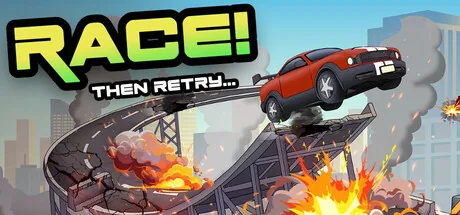
Game review
Race! Then Retry...
8 / 10
- Developer
- Light Hearted Tech
- Publisher
- Light Hearted Tech
- Released
- 17 June 2026
- Platforms
- Windows
- Genre
- Racing
- Monetisation
- paid
- Players
- false
The short version
Biggest strengths
- An extremely fast, near-instant retry loop that turns crashing into part of the fun rather than a punishment, praised almost universally across the pool
- Genuinely challenging, thoughtfully designed tracks that reward memorization and precise drifting over raw speed
- Unlockable cars with real handling differences (weight, top speed, air behaviour) that meaningfully change how individual tracks are approached
Biggest weaknesses
- A field of view multiple reviewers found too zoomed-in, making upcoming hazards and ramps hard to read in time to react
- Persistent, deliberately exaggerated drift-heavy handling that a few reviewers wanted the option to tone down for tighter, more controlled cornering
- One detailed negative review reported inconsistent car response between otherwise identical attempts, particularly on ramp jumps
Who it's for: Fans of unforgiving isometric arcade racers like Micro Machines, RC Pro-Am, and Rock N' Roll Racing chasing leaderboard times, less so anyone looking for a relaxed or simulation-style driving experience
Our recommendation: recommended
8 / 10
Race! Then Retry... released in full on Steam on June 17, 2026, from solo developer Light Hearted Tech, an isometric arcade racer across 35 tracks built entirely around learning a course, crashing spectacularly, and immediately trying again. Its 38-review English pool lands at a near-flawless Positive (37 up, 1 down, 97%), and the reviews are unusually consistent in naming the exact same thing as the game's central hook: the speed of the restart itself.
One reviewer described the loop precisely: "crashing isn't annoying because the instant restarts put you back on the line before you've even finished swearing. No loading screens, no waiting around. It makes it stupidly easy to say 'just one more try' and then realise you've been stuck on the same track for two full hours." Another reviewer framed the design as deliberately puzzle-like rather than purely reflex-based: "the tracks feel more like puzzles or boss fights than traditional racetracks. Your first few attempts are about figuring out the corners, jumps and obstacles. Eventually everything starts to click." That same reviewer described eventually "chasing your own ghost," changing racing lines mid-run because they could see exactly where half a second was sitting on the track from a previous attempt, and was compelled enough by the experience to record a full YouTube video about it after finishing a stream.
The genre lineage draws constant, specific comparisons across the pool, almost all pointing at the same handful of 80s and 90s touchstones. One reviewer called it "proper old-school arcade chaos, Micro Machines meets Rock N' Roll Racing," while others separately cited RC Pro-Am, Big Red Racing, Trackmania, and Sega Rally. A reviewer who described themselves as "real old" and having grown up on "offroad, R.C. Pro Am, Rock n Roll racing, micromachines" wrote that the game "scratches an itch that I didn't even realize that I had," adding they own roughly 2,500 games on Steam and this one had made it into their "I actually want to play this" category. That kind of specific, nostalgic recognition recurs constantly and speaks to how deliberately and successfully the game recreates a particular, now-uncommon genre feel.
Car unlocks add a layer of meaningful progression rather than pure cosmetics. Reviewers noted that different cars carry genuinely different weight, top speed, and air-handling characteristics, changing which vehicle suits which track. One reviewer, candidly documenting their own compulsive relationship with the game's gold-medal system, admitted to grinding individual tracks purely to afford new cars and compare their stats, writing "I've gone back to my collect-a-thon roots and I'm trying to 100% every level... this isn't healthy, but I am who I am," before still recommending the game as "a pretty solid game for what it is." A separate reviewer specifically praised the soundtrack as part of the same addictive package: "the music slaps right from the main menu and gets you instantly primed for high-energy runs."
The criticism in the pool is narrow but specific and worth taking seriously. Multiple reviewers flagged the camera's field of view as too tight for the game's speed, with one detailing it at length: "the FOV is just far too zoomed in. I can't see what's coming and checking the mini map barely helps either because that is also zoomed in and too small," adding that ramp jumps consequently "seem luck-based" because there isn't enough visual warning to judge approach speed and angle correctly. That same reviewer separately pushed back on the handling model itself, wanting the option to take a corner cleanly "without doing a sick drift," since the game's exaggerated, always-on drift tendency can work against players who'd prefer tighter, more controlled cornering. Notably, this reviewer still recommended the game overall, closing with "I genuinely think this is a good game for a lot of people, I can't wait to see what LHT comes up with next." The pool's one outright negative review raised a related but more pointed complaint: inconsistent car response between visually identical attempts, particularly on ramps, alongside a request for a "Neutral" rating option on Steam since their feelings toward the game were genuinely mixed rather than simply thumbs-down.
At $1.99, value is close to a non-issue across the entire pool. One reviewer applied a simple personal benchmark, "if you can get 1 hour for every pound/dollar/whatever you pay on a game then you get your moneys worth. There's a LOT of hours to be had playing this," despite that same reviewer being among the more critical voices about FOV and handling. Another called it simply "less than the price of a cup of coffee" for "a punchy, challenging arcade experience that gives you more than your money's worth." With 35 tracks, unlockable cars, and a leaderboard/ghost system to chase, reviewers consistently described total playtime running well past what the price would suggest, particularly for players drawn in by competitive time-chasing.
The track design itself draws credit beyond just its difficulty. One reviewer broke down what keeps individual circuits interesting: "in the circuits there are explosive pinball-style obstacles that launch you off the track if you don't avoid them. These elements lead you to constantly adapt your approach instead of memorizing a single perfect line," describing the resulting loop of "memorize, try again, improve" as what makes the hunt for the game's gold trophies so compelling. That variety in obstacle type, rather than just raw track length or turn count, is part of why so many reviewers describe individual levels as feeling distinct from one another despite the game's tight, minute-or-two-per-attempt runtime.
Taken together, Race! Then Retry... is a tightly focused, extremely well-executed arcade racer that nails a specific, increasingly rare genre feeling: fast, punishing, drift-heavy isometric racing built around instant retries and leaderboard obsession. Its visibility and handling-consistency complaints are real and specific rather than vague, but they come from reviewers who overwhelmingly still recommended the game anyway. For its price and genre, it's an easy, confident recommendation, especially for anyone with fond memories of the arcade racers it's so openly channeling.
Pros and cons
Pros
- An extremely fast, near-instant retry loop that turns crashing into part of the fun rather than a punishment, praised almost universally across the pool
- Genuinely challenging, thoughtfully designed tracks that reward memorization and precise drifting over raw speed
- Unlockable cars with real handling differences (weight, top speed, air behaviour) that meaningfully change how individual tracks are approached
- Exceptional value at $1.99, with 35 tracks and a leaderboard/ghost system reviewers described as consuming hours far beyond the asking price
Cons
- A field of view multiple reviewers found too zoomed-in, making upcoming hazards and ramps hard to read in time to react
- Persistent, deliberately exaggerated drift-heavy handling that a few reviewers wanted the option to tone down for tighter, more controlled cornering
- One detailed negative review reported inconsistent car response between otherwise identical attempts, particularly on ramp jumps
- No neutral or mixed rating option on Steam itself frustrated at least one reviewer whose feelings toward the game were more mixed than purely positive or negative
Screenshots
-
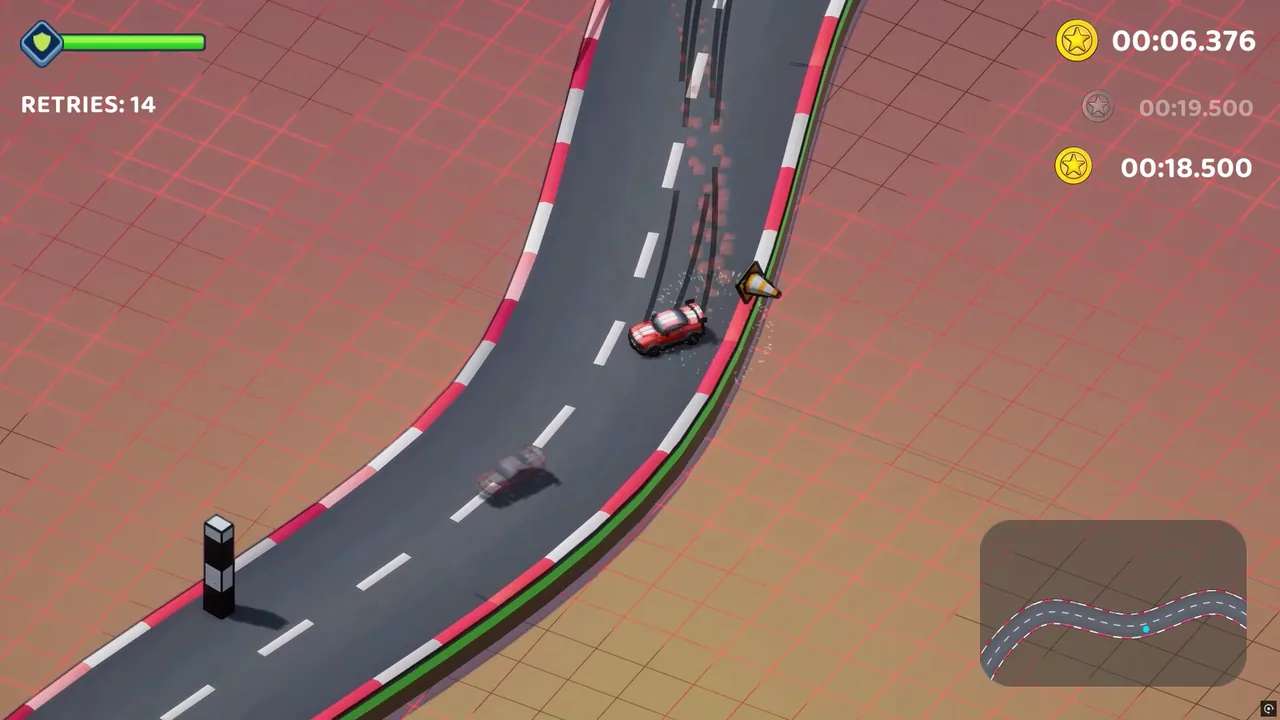
Race! Then Retry...Image: Light Hearted Tech via Steam -
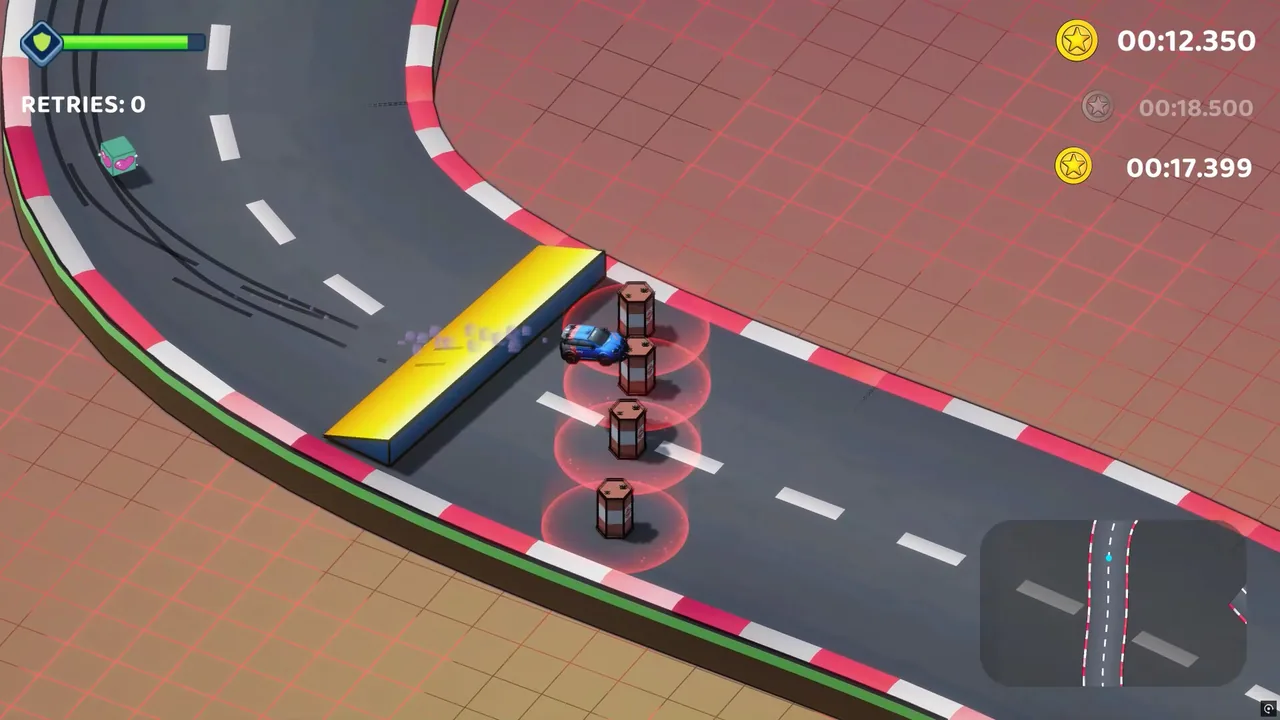
Race! Then Retry...Image: Light Hearted Tech via Steam -
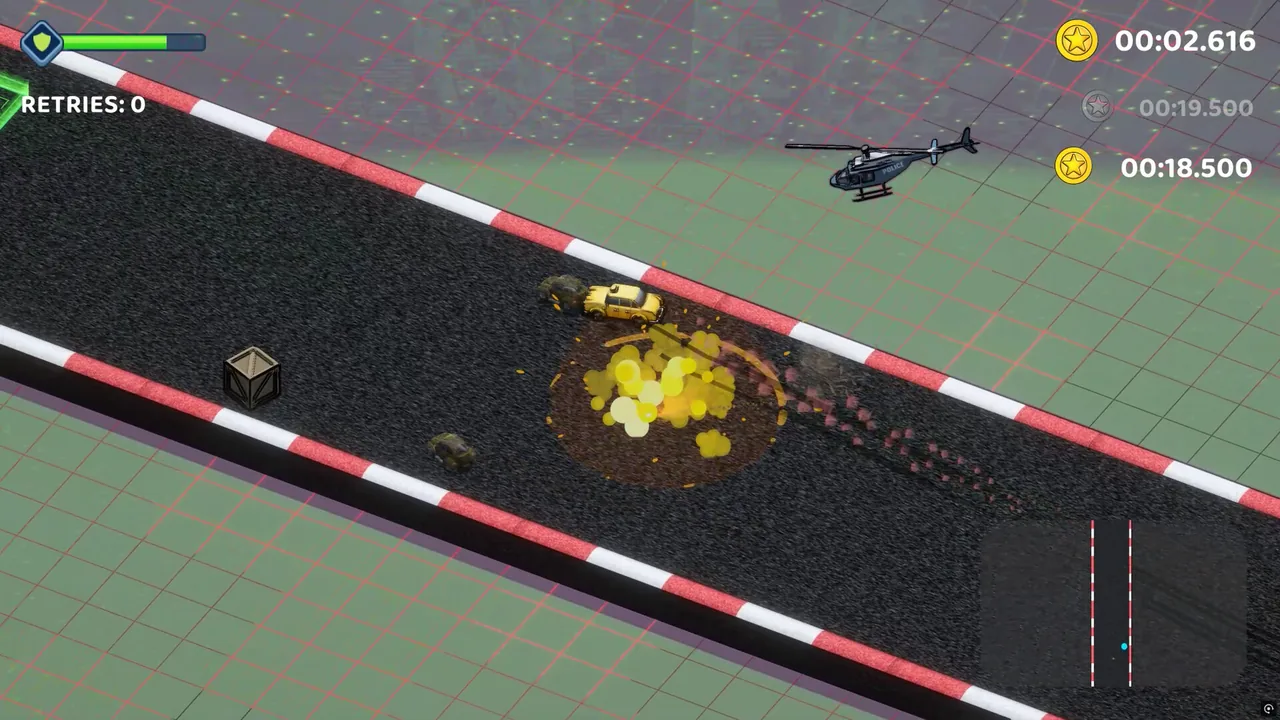
Race! Then Retry...Image: Light Hearted Tech via Steam