Into the Emberthroat: Wanderer's Biggest Dungeon Yet
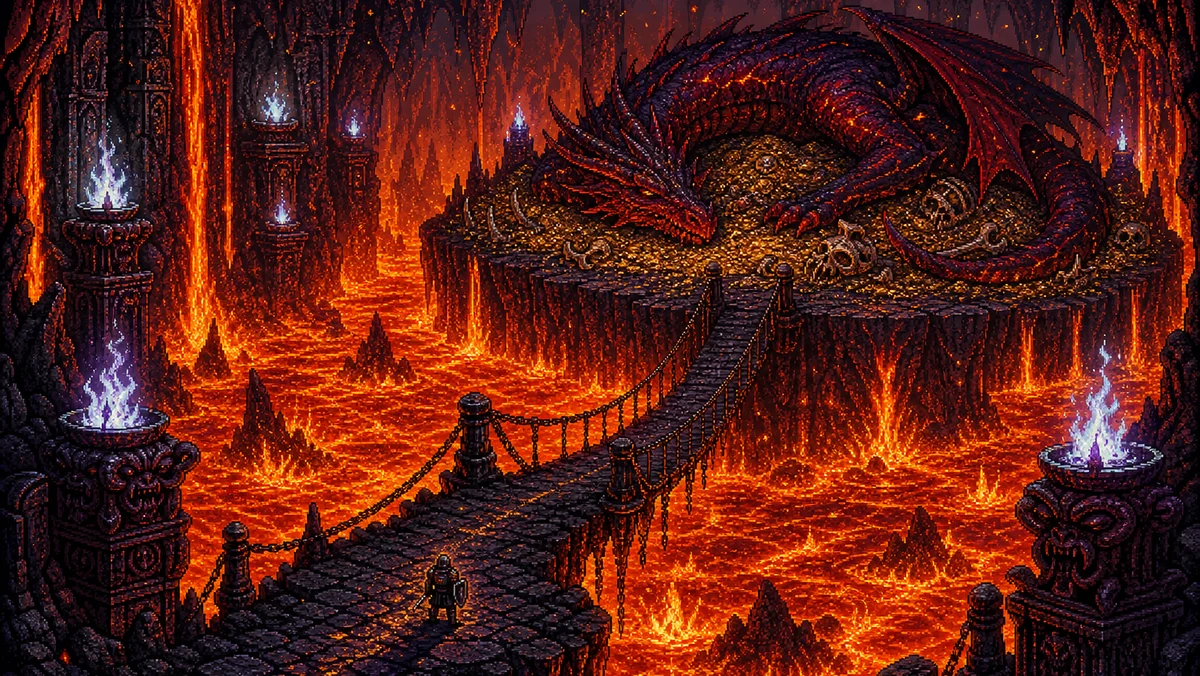
The dig crews under Cinderwatch cut into a shaft that had been sealed rather than collapsed. Three crews went down after it and none came back.
The Emberthroat is open. It is by a wide margin the largest thing in Wanderer: twelve interior sections, roughly seventeen thousand tiles of cave, and about ten times the size of the Greyfell Spire that came before it.
What's down there
The Emberthroat is the throat of a dead volcano, and the dungeon is built to feel like descending one. You don't walk corridors here — the tunnels are carved serpentine, winding through solid rock with sudden chamber bulges where the cave opens out, and roughly a third of every floor is molten lava flooding the rock beside the path. There is always a bank of stone to walk on. There is not always much of it.
The twelve sections each have their own character, and their names are most of the pitch: the Tunnels, the Caverns, the Nests, the Emberflow, the Warrens, the Ruins, the Chainbridge, the Hatchery, the Hoard, the Sentinel's floor, the Ascent, and the Arena.
Ten new creatures
The Emberthroat has its own roster, drawn for it — dragon-kin, ash-things and the crawling life that thrives where nothing should. Nothing here is a recoloured cave bat.
A word on levels: the number floating over a monster's head is a display scale, not its raw strength. What matters is that this dungeon starts around where the Cinderlands leave off and climbs steeply from there. Bring the good pickaxe and the good armour.
Ashmoreth, the Emberthroat Wyrm
The boss at the bottom is a dragon so old its fire has cooled to a banked coal, and it has been asleep for three hundred years because a human order kept it that way.
Mechanically, Ashmoreth carries four times the health of a normal zone boss and fights in phases: at 75% and 40% health it changes its stat profile, calls in adds, and fires hazard telegraphs into the arena — a lava tile that lights up a beat before it burns, an ember burst, a shake.
That's a deliberate translation. Wanderer is a tick-based idle RPG; you don't dodge a fire-breath cone with your thumbs. So the fight is built out of what this game actually is — attrition, adds and hazards — rather than pretending to be an action game for one room. It's long, it's mean, and nothing in it kills you out of nowhere.
The story is in the walls
Most of what happened here, the dungeon tells you itself, in the way dungeons should: warden bone-cairns, half-burned dig-crew journals, covenant inscriptions on ruin walls, and the four failing ward-braziers you pass on the way down.
Three hundred years ago an order called the Emberwardens couldn't kill the wyrm, so they sealed it instead — a ring of covenant fire across the throat, fed by hand, generation after generation, so that Ashmoreth slept and the Cinderlands stayed cold enough to live in. Then the order died out. The seal kept working anyway, quietly failing, until Cinderwatch's firestone crews dug into it looking for emberglass.
How to get in
Talk to Dig-Master Korrun Vayle at Cinderwatch. He's the overseer whose crews broke the ward and vanished, and he is no longer pretending it was a rock-fall. His quest is The Sleeping Flame.
The entrance is the Emberthroat Mouth, a cracked cave-maw on the ash flats south-east of the camp — twice the size of an ordinary cave mouth, with heat shimmer coming off it. It's sealed by a ward-brazier gate, and the key is the Emberward Sigil, carried by a survivor on the surface who did not come back right.
There is no level requirement on the quest. There is a very real level requirement on surviving, and the two are not the same thing. Go in under-geared and the Cinderlands will get their ash back.
Happy wandering — carefully.