A Traveller's Guide to the Cinderlands
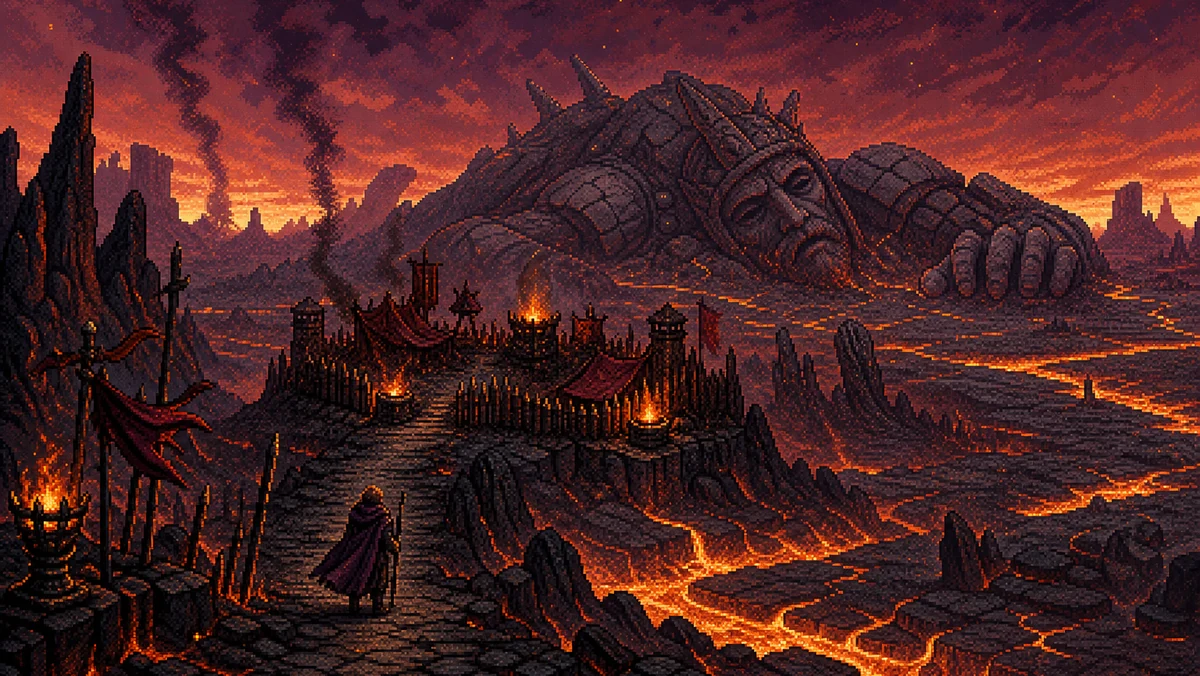
Everything in Wanderer happens along one road running east. Walk it far enough — past the green country, past the mines, past the frost — and the ground stops being soil. It becomes basalt with light in the cracks.
This is the Cinderlands, and it is where the map stops being scenery and starts being a problem.
The end of the old world's comfort
The Cinderlands sit roughly two-thirds of the way along the corridor, around levels 52 to 70. Lava seams glow through cracked stone. Ash storms shorten the horizon to a few dozen paces. There is nothing growing that you would want to eat.
Two landmarks dominate the wastes: the Black Fortress, a blackened keep where the Emberlord holds the ash, and the Fallen Colossus, a shattered giant lying across the flats with its face half-buried. Both are worth seeing. Both are excellent places to be ambushed.
Eight creatures are native here, and the ladder they form tells you the shape of the region on its own — Cinder Hounds at 46, Ash Marauders, Cinder Ogres, Ember Drakes and Ash Revenants in the seventies, and Magma Devils and Cinder Moths at 80 and 84 out on the far edge. Monster strength in Wanderer rises with distance east, so the western verge of the Cinderlands is a rough afternoon and the eastern verge is a different game entirely.
Cinderwatch is not a town
It's the only settlement in the region, and calling it a town is generous. Cinderwatch is a war camp — a fortified pause with a blacksmith, a furnace, an anvil and a tempering bench, and not much interest in whether you enjoy your stay. Its people are there for one reason: the ground under it is rich.
The camp digs firestone and emberglass out of the shafts below the ash. That work has been going on for years, quietly, in service of a war effort a long way from here. The crews go down, the crews come up, the wagons head west.
What the digging is for
If the Cinderlands feel like a region built to be survived rather than settled, that's on purpose. This is the stretch where offline planning starts to matter — set a deliberate travel mode before you put the game down, because the Cinderlands punish an idle explorer harder than anywhere before them.
It is also the stretch with the most history under it. Long before Cinderwatch was a war camp, the Cinderlands were not badlands at all. They were a roost. The lava seams that light the basalt now were the plumbing of a living volcano, and the thing that slept in its throat was old enough that its fire had cooled to a banked coal.
People dealt with that. Not by killing it — nobody could — but by sealing it, and then by keeping the seal, generation after generation, for three hundred years, so that the wyrm slept and the Cinderlands stayed cold enough for anyone to live in at all.
That order died out. The seal did not. It has simply been failing, slowly, for about a lifetime, and nobody left alive knows what it is.
Which brings us to the dig crews
Cinderwatch's firestone crews have been going deeper. Recently they cut into a shaft that was sealed rather than collapsed, and broke a ring of something old that nobody had thought to record.
Since then: the deep is hot where it was warm. Tremors walk the camp at night. Lava is rising in shafts that have been dry for a generation.
And three dig crews have gone down and not come back up.
If you're passing through Cinderwatch, the dig-master has stopped pretending it's a rock-fall. Go and talk to him.
The World Atlas has the full regional breakdown — every settlement, landmark and native creature along the Long Road, generated from the live game data.