Game review
Prelude Dark Pain
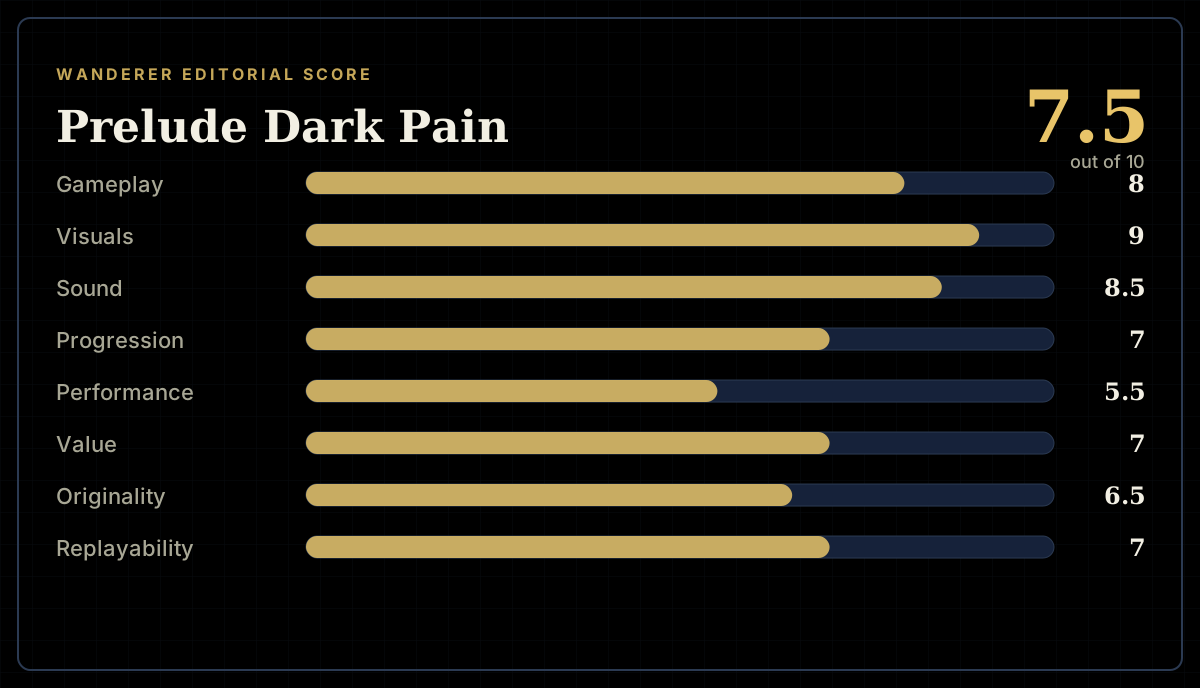
7.5 / 10
- Developer
- Quickfire Games
- Publisher
- Firesquid (Gamersky Games in China)
- Released
- 27 July 2026
- Platforms
- Windows
- Genre
- Tactical RPG
- Monetisation
- Premium, one-off purchase — no in-game purchases
- Players
- Single-player
The short version
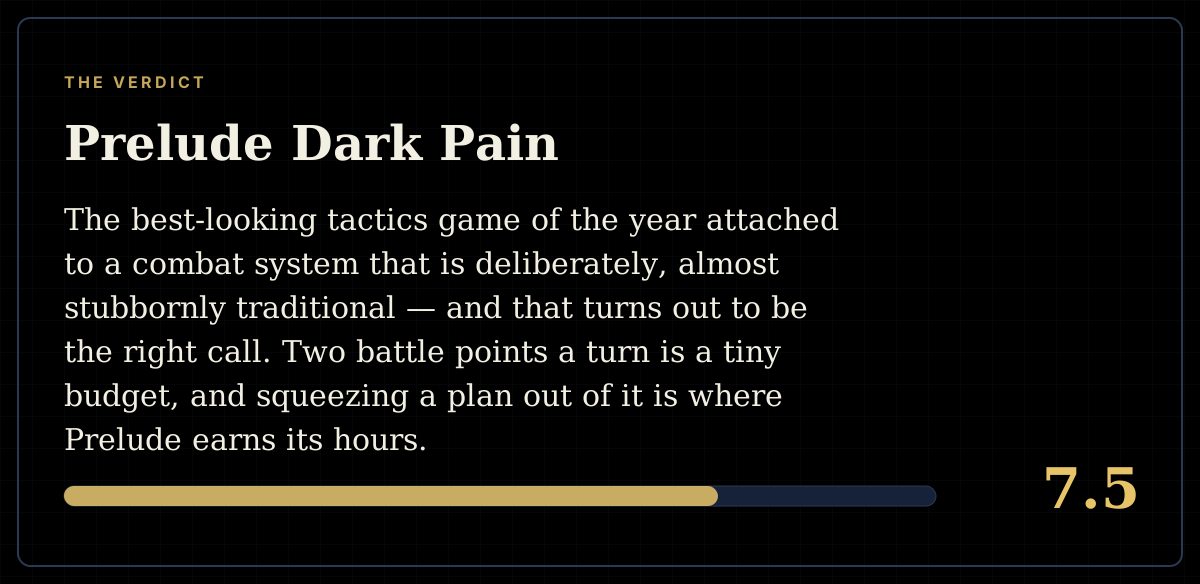
The best-looking tactics game of the year attached to a combat system that is deliberately, almost stubbornly traditional — and that turns out to be the right call. Two battle points a turn is a tiny budget, and squeezing a plan out of it is where Prelude earns its hours.
What holds it back is everything around the fighting. This is one act of a multi-act game, the citadel and raid layers that are supposed to give the campaign its shape aren't in yet, and the technical footing is shaky enough that a Steam Deck can drop under 30fps with no graphics options to fix it.
Biggest strengths
- A two-point turn budget makes every skill a real choice instead of a rotation
- Free movement and a free basic attack keep turns aggressive — you're never paying to participate
- Height, flanking and knockback all resolve into damage numbers you can plan around, and ledges make positioning lethal rather than decorative
Biggest weaknesses
- Performance is poor for what's on screen — Steam Deck framerates fall below 30 in busier fights, and there are almost no graphics settings to trade away
- Controller support exists but is clumsy enough that mouse and keyboard is the honest recommendation
- The opening hour is a chain of unskippable tutorial battles with no way past it on a replay
Who it's for: Final Fantasy Tactics and Tactics Ogre players who want a new board to solve, and anyone who buys art direction first and asks questions later.
Our recommendation: Worth buying now if you're happy paying for Act 1 and waiting out the roadmap. If you want a finished campaign or a stable frame rate, wishlist it and check back after a couple of patches.
7.5 / 10
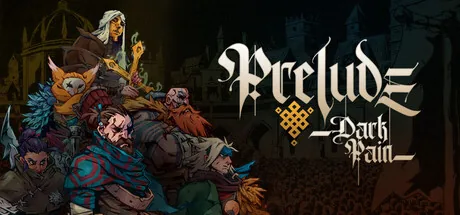
Every screenshot of Prelude Dark Pain invites the same comparison, and the comparison is wrong. Yes, it's inked like a Mike Mignola page, all heavy black and sickly gold, and yes, Darkest Dungeon got there first. But Red Hook's game was about attrition — a roster you fed into a grinder and a stress bar that decided who cracked. Quickfire Games has borrowed the ink and left the cruelty behind. Underneath the woodcut misery is a Final Fantasy Tactics descendant with a grid, an elevation table and a very small pile of points to spend.
That's not a criticism. It's the most interesting thing about it.
Two points is not many
Here's the whole action economy. A hero starts their turn with two battle points. Skills cost points. Dropping into a defensive stance costs a point. Movement is free, and so is one basic attack.
Read that again, because it's doing a lot of work. Most tactics games make you choose between moving and doing something. Prelude gives away the two things that get you into position and keeps the interesting verbs behind a budget of two. The result is that nobody in your squad ever has a wasted turn — the floor of a turn is "walk somewhere useful and hit someone" — but the ceiling is tightly rationed. A four-point combo needs two heroes to agree on it.
That constraint is the game's actual design, and it's why the fights hold up. When a turn is a rotation, you learn it once and execute it forever. When a turn is two points, you're pricing every option against the board: is a bear trap worth more than a second attack, is blinding the archer worth more than moving the tank two tiles further forward, can I afford to defend or do I need the damage now. Skill costs vary, so the arithmetic changes as heroes level. It stays a question rather than becoming a habit.
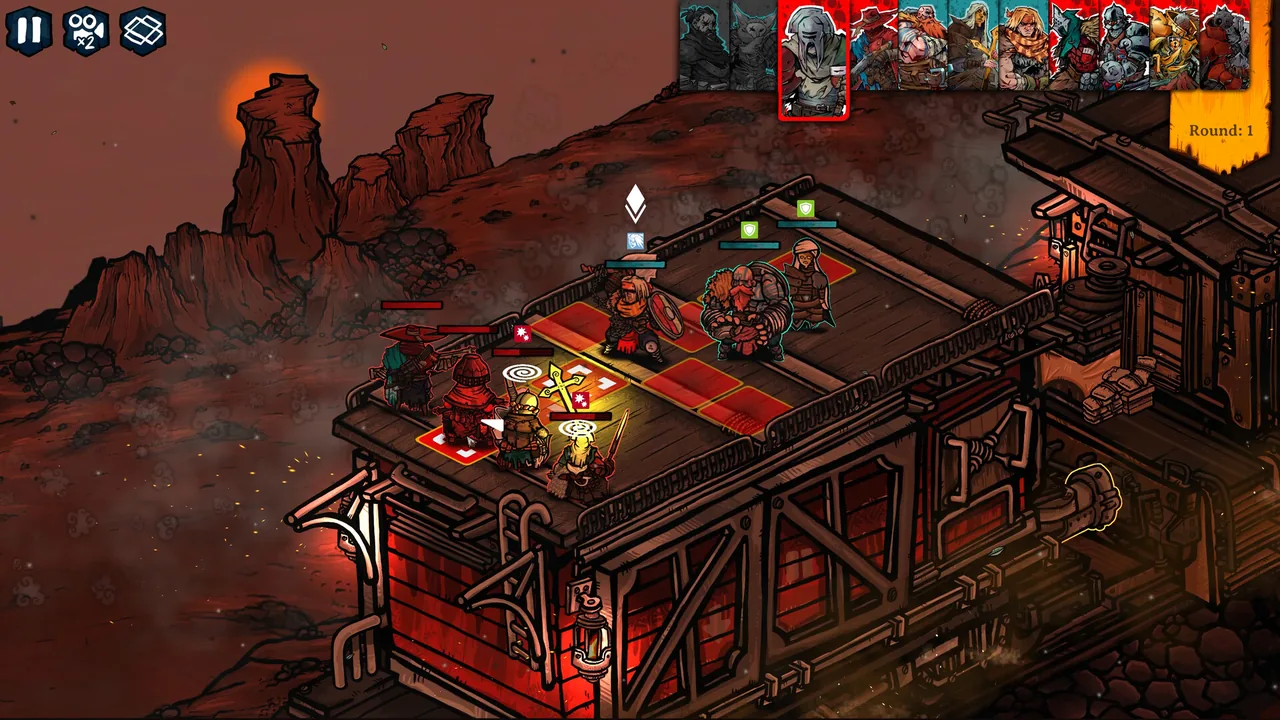
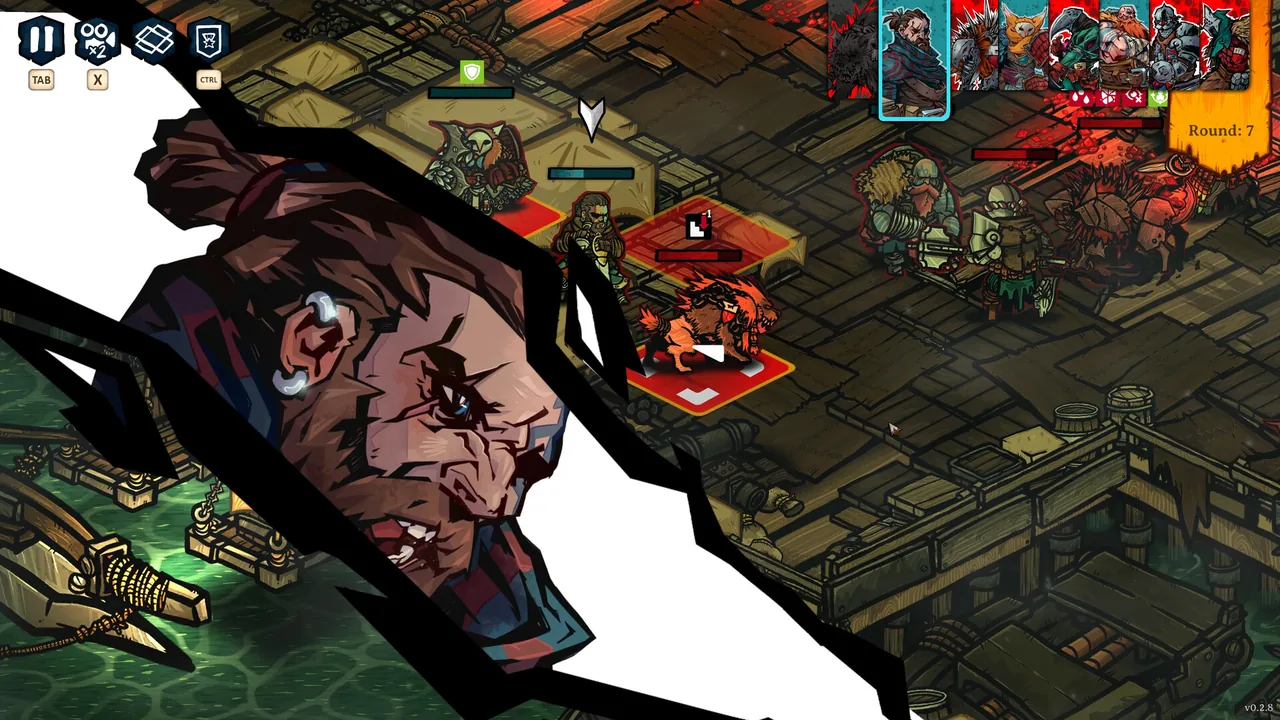
The board makes the arithmetic matter. Height gives ranged attackers a damage modifier, flanking gives melee one, and knockback effects exist partly to shove people off things. One early fight takes place on a moving caravan where the correct answer to a pursuer is frequently a boot rather than a sword. This is positioning with teeth — closer to Fire Emblem or XCOM than to a JRPG where the grid is a formality — and it's the reason the two-point budget doesn't feel stingy. You're not short on options. You're short on points, and the terrain keeps offering discounts.
Nine jobs, not nine damage numbers
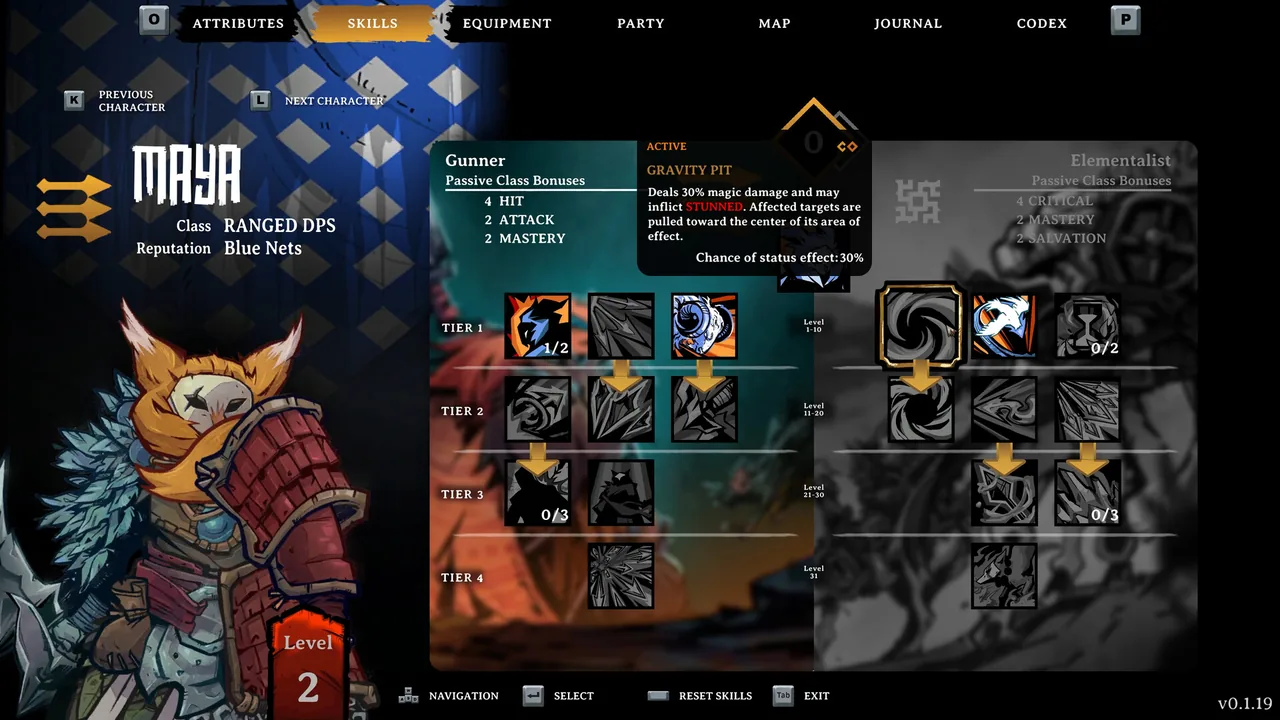
The Early Access roster is nine heroes, and the class distinctions are real. Tammais taunts and gets stronger as he absorbs punishment. Tizon plants turrets that soak attacks and pull attention away from softer bodies. Maya blinds and knocks things around. Soren, the retired-blacksmith protagonist, is a flanking rogue who leaves bleeds behind. These aren't the same job at different speeds — they're control, denial, aggro management and burst, and a squad of up to five is composed rather than assembled.
Each hero eventually carries four active skills, two passives and a set of virtues drawn from two talent branches, sitting on six attributes. It's not a lavish build system by 2026 standards, but it's honest: specialising Tizon into turrets produces a visibly different unit rather than a slightly different number. The catch is that customisation arrives slowly, and for the first few hours you're playing the characters the game hands you, in the order it hands them to you.
Bosses get free special actions every round. That's a blunt instrument, and it's effective — it means a boss can't be out-tempoed by a squad that's simply better statted, so the answer has to be structural. Kill the summoner before the adds arrive, or lose to arithmetic. Those fights are where the two-point budget bites hardest and where the combat is at its best.
Permanence lives in the script, not the roster
The grimdark presentation sets an expectation the systems don't meet, and it's worth being clear about which risks Prelude actually takes. There's no stress meter, no affliction table, no attrition layer eating your bench between missions. Failure is mission-scoped: you lose, you reload, you try a different opening.
What is permanent is narrative. Battles occasionally stop to ask what happens to a defeated enemy, and those answers propagate — into later story beats and, more concretely, into which heroes you can recruit at all. Some are permanently missable. That's a real consequence system, and it does more for replay value than a difficulty slider would, but it lands in a different place than the art promises. If you came for a game that punishes you, this one mostly negotiates.
The half that hasn't been built
Prelude launched into Early Access on 27 July with Act 1 — around fifteen hours, nine heroes, sixty-three skills and an unlocked world map with side quests and random encounters. Quickfire estimates roughly a year to finish, and the full version's list is long: 20-plus heroes across eight classes, twenty factions, seventy-plus enemy types, world missions, raids and proper equipment crafting.
Two of those matter more than the rest. The citadel — a settlement where you craft gear and send spare heroes out on raids to rescue villages, scout rivals or gather resources, making them unavailable for battles while they're gone — is the system that would turn a sequence of missions into a campaign with a shape. It's the difference between a tactics game and a war. Right now crafting is a stub and the citadel is a promise. The second is roster depth: a two-point economy gets more interesting the more verbs exist to spend it on, and nine heroes is a proof of concept for a system built to hold twenty.
Buying now means buying Act 1 and the roadmap. At US$19.99 that's defensible — it's not a twelve-hour indie asking sixty — but it isn't the bargain the hour count suggests either, because a good chunk of those hours are the same encounter types on a map that hasn't opened up yet.
The rough bits are technical, and they're not small
Prelude runs badly for a game that shows so little geometry. Steam Deck framerates drop under 30 in busier encounters, stuttering shows up when the camera pushes in, and the settings menu offers almost nothing to trade away — no meaningful graphics options, so there's no lever to pull. On a game whose visual appeal is flat inked art, that's a straightforward optimisation problem rather than an ambition problem, and it needs fixing before this deserves a broader recommendation.
Controller support is listed and is genuinely unpleasant in practice; grid selection on a stick fights you. The opening is slow, front-loading unskippable tutorial fights that experienced tactics players will resent, with no way to skip them on a second run. Optional per-mission challenge objectives are a good idea implemented carelessly — several depend on RNG or ask for two things that can't both be true, so completing them means save-scumming rather than playing well. And the localisation is patchy in exactly the place it hurts a tactics game most: status effect and enemy ability text, where an untranslated string is a tactical unknown.
The presentation carries a lot of this. The art direction is award-nominated and deserves it — silhouettes read instantly at a glance, which is a functional virtue in a grid game, not just a pretty one. The score, split between Isaac Montes and Kumi Tanioka of Final Fantasy XI and Crystal Chronicles, is choral and heavy and matches the slow pace of the fights.
Verdict
Seven and a half. The combat is properly good — a small, well-priced turn budget on a board where terrain does real work — and it's supported by a hero roster with actual jobs and a story that takes your decisions seriously enough to lock content behind them. That's a strong foundation from a studio shipping its first game.
It's not an eight because too much of the game is a plan. The citadel and raid layers that would give the campaign structure aren't here, crafting is a placeholder, and the technical state is below what a game this visually modest should demand of hardware. Those are all fixable in a year of Early Access, and if they get fixed this becomes an easy recommendation.
Buy it now if you want a new tactics board to solve and you're comfortable paying for one act. Wait if you want the campaign, or if your machine is a handheld.
Price, store details and the Steam review summary checked 29 July 2026.
Pros and cons
Pros
- A two-point turn budget makes every skill a real choice instead of a rotation
- Free movement and a free basic attack keep turns aggressive — you're never paying to participate
- Height, flanking and knockback all resolve into damage numbers you can plan around, and ledges make positioning lethal rather than decorative
- Nine heroes with genuinely different jobs, so a squad reads as a composition — turrets and bear traps do zone control, not just damage
- Mike Mignola-inflected art with the best-defined silhouettes any tactics game has shipped this year
- Story choices about defeated enemies permanently gate which heroes you can recruit
- Bosses get free actions each round, which forces you to break the encounter rather than out-stat it
Cons
- Performance is poor for what's on screen — Steam Deck framerates fall below 30 in busier fights, and there are almost no graphics settings to trade away
- Controller support exists but is clumsy enough that mouse and keyboard is the honest recommendation
- The opening hour is a chain of unskippable tutorial battles with no way past it on a replay
- Optional mission challenges are sometimes RNG-dependent or quietly contradictory, so chasing them means restarting fights
- Crafting is a placeholder — the citadel, raids and equipment depth are all roadmap
- Status-effect and ability text is inconsistently translated, and some dialogue still has typos
- Fifteen hours of Act 1 at US$19.99 is a fair-not-generous rate with a year of Early Access still to run
Screenshots
-
Prelude Dark PainImage: Firesquid via Steam -
Prelude Dark PainImage: Firesquid via Steam -
Prelude Dark PainImage: Firesquid via Steam -
How the review scores each part of the gameWanderer Editorial -
The short versionWanderer Editorial