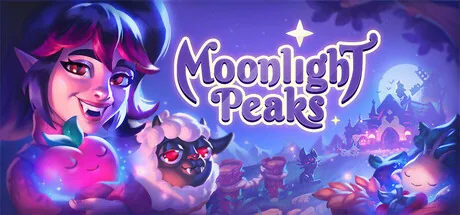
Game review
Moonlight Peaks
7 / 10
- Developer
- Little Chicken Game Company
- Publisher
- XSEED Games (Americas), Marvelous Europe (Europe), Clouded Leopard (Asia)
- Released
- 7 July 2026
- Platforms
- Windows, macOS, Nintendo Switch, Nintendo Switch 2, Android
- Genre
- Life sim
- Monetisation
- Premium, buy once. No in-app purchases; paid soundtrack and art book DLC
- Players
- Single-player
The short version
The sunrise is the smartest thing in this game. Being awake only from six in the evening to six in the morning turns every night into a scheduling problem, and a cosy sim with a genuinely non-negotiable deadline is a rarer thing than it should be.
What the deadline never pays off into is a ladder. There are no skills to level, no mastery curve, no numbers that climb. Progress is a queue of story quests, and when the queue is empty you are watering plants to pass the time. The theme is terrific and the systems under it are thinner than the price tag suggests.
Biggest strengths
- The 6pm-to-6am clock is a real constraint that forces you to plan a night before you start it
- Twenty-three romanceable residents, gender-neutral across the board, with no bachelor/bachelorette split
- Enormous recipe and blueprint volume, so there is nearly always something new to unlock and build
Biggest weaknesses
- No skill levelling of any kind, so progression is entirely gated on story quests running out
- Money arrives so fast that late-game purchases stop being goals within the first season
- The mana meter refills at a crawl, throttling the one system the game is themed around
Who it's for: Farm-sim players who have finished the big ones and want a new aesthetic and a huge cast to work through, rather than a deeper machine to master.
Our recommendation: Play the demo first, and pay attention to how you feel around night ten. That is where the quest queue starts running dry and you find out whether the atmosphere alone is carrying you.
7 / 10
Every farming sim has a clock, and almost every one of them lies about it. You can push past midnight, eat the stamina penalty, take the hit and carry on. Moonlight Peaks doesn't negotiate. You are a vampire, you wake at six in the evening, and at six in the morning the sun comes up and puts you back in your coffin whether the turnips are watered or not.
That single rule reshapes the genre's rhythm more than anything else Little Chicken Game Company has built here. A night runs roughly fifteen to twenty real-world minutes, and you spend the first minute of it deciding which two of the four things you wanted to do are actually going to happen. Fields, mine, the witch on the far side of town, the festival stall closing at three. Pick. That's a better opening question than most cosy games ever ask.
The tragedy of Moonlight Peaks is that it asks it beautifully and then has almost nothing waiting at the end of the night.
Twelve hours you have to spend on purpose
The town wakes when you do. Residents are out in the twilight hours and thinning by pre-dawn, so socialising and farming genuinely compete for the same window rather than sitting in separate parts of the day. Ending a night away from home costs you, and there's sun protection to buy if you want to gamble on one more errand, which is exactly the kind of pressure valve a hard deadline needs. There's a setting to stretch the night if the default feels tight, though taking it dissolves the pressure that makes the design work.
What stops this from being a masterstroke is that the deadline is enforcing a schedule the game mostly doesn't fill. Moonlight Peaks is quest-driven rather than open-ended: the next thing you're working towards is a story beat, and story beats arrive on their own timetable. So you get runs of nights where the sunrise cuts short a session you were already killing time in, waiting for a processing timer or a character to reach the next chapter of their arc. A deadline is only interesting when you have more to do than time to do it. Here, the ratio flips far too often.
Two meters, and the wrong one is starved
Labour runs on stamina in the usual way, replenished by food. Magic runs on a separate mana pool, and this is where the design gets its priorities backwards. Mana recovers glacially, on the order of a single pip a night without help, and refilling it deliberately is fiddlier than it should be.
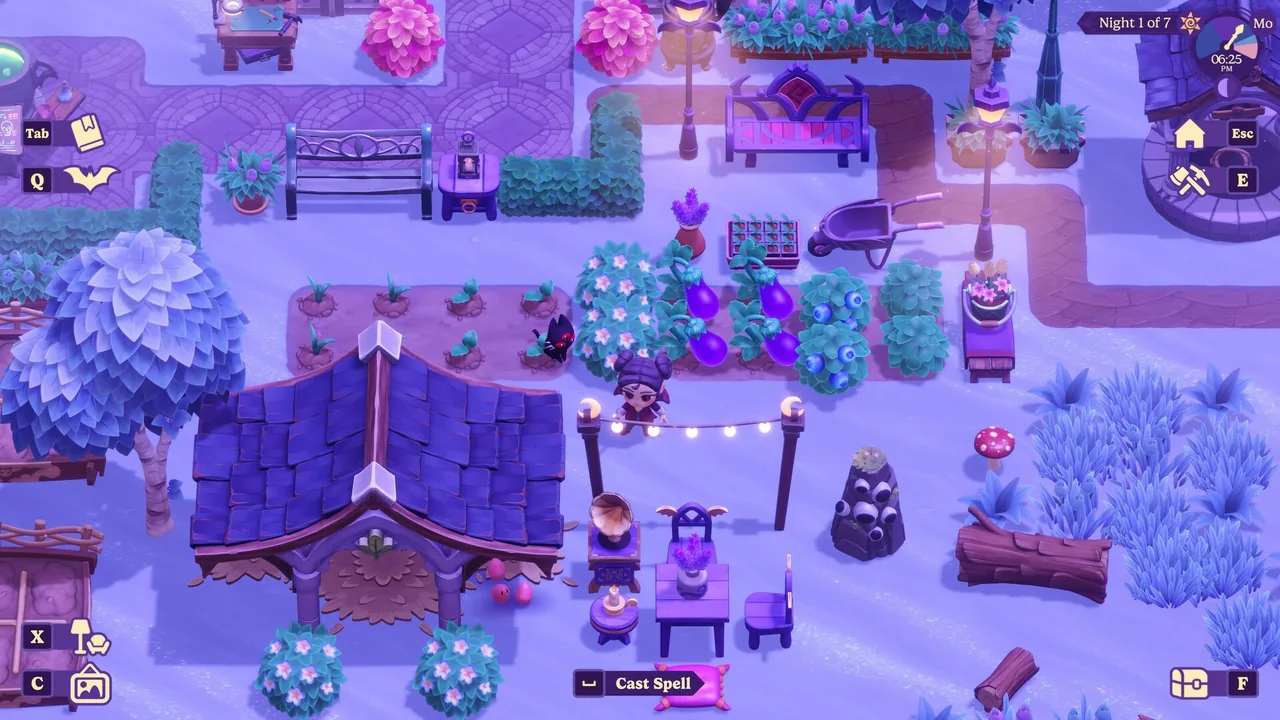
Enchanted crops, the ones that mark this game out from every other farm sim on the shelf, need to be watered with a spell rather than a can. So the marquee mechanic is metered by the scarcest resource in the game, in a design where you already only get twelve hours a day. The result is a long early stretch where you own the vampire fantasy on paper and can't afford to cast it.
The spellcasting itself is lovely. Spells are drawn as patterns on a radial menu rather than mapped to a key, which gives casting a small physical ritual that never quite becomes automatic. Later spells fold into the economy properly: gathering runs get faster, watering gets wider, farm layout work gets less painful. That's a well-shaped unlock curve. It's just rationed by a meter that seems to have been balanced by someone worried the magic would trivialise the farm, when trivialising the farm is precisely what a vampire's magic should eventually do.
There is no ladder here
This is the part Wanderer readers will care about most, so let's be blunt about it.
Moonlight Peaks has no skill levelling. Not farming levels, not mining, not fishing, not foraging, not combat, because there is no combat. Nothing you repeat gets numerically better at being repeated. Tool upgrades exist and gate access to tougher rock and tougher trees, and there are recipes and blueprints in genuinely impressive quantity, but the through-line that keeps a Stardew or a Rune Factory pulling you forward for a hundred hours — the sense of a character sharpening — simply isn't modelled.
Take that away and the whole progression weight lands on money and quests. Money fails almost immediately. Processing chains are generous, barrels and refiners and jam makers turn cheap produce into expensive produce, and a player who engages with them at all can be buying mid-to-late tier upgrades inside the first season. Once purchasing stops being a decision, the farm stops being an economy and becomes a place where you do chores because the chores are pleasant.
Quests then carry everything, and they can't. They're finite, they're paced to a story rather than to your appetite, and they run dry between chapters. The honest description of Moonlight Peaks at hour thirty is a large content buffet with no scoreboard: plenty left to see, nothing left to climb. If your idea of a good life sim is a slow mastery curve, this one will lose you well before its content does.
Twenty-three people, one date apiece
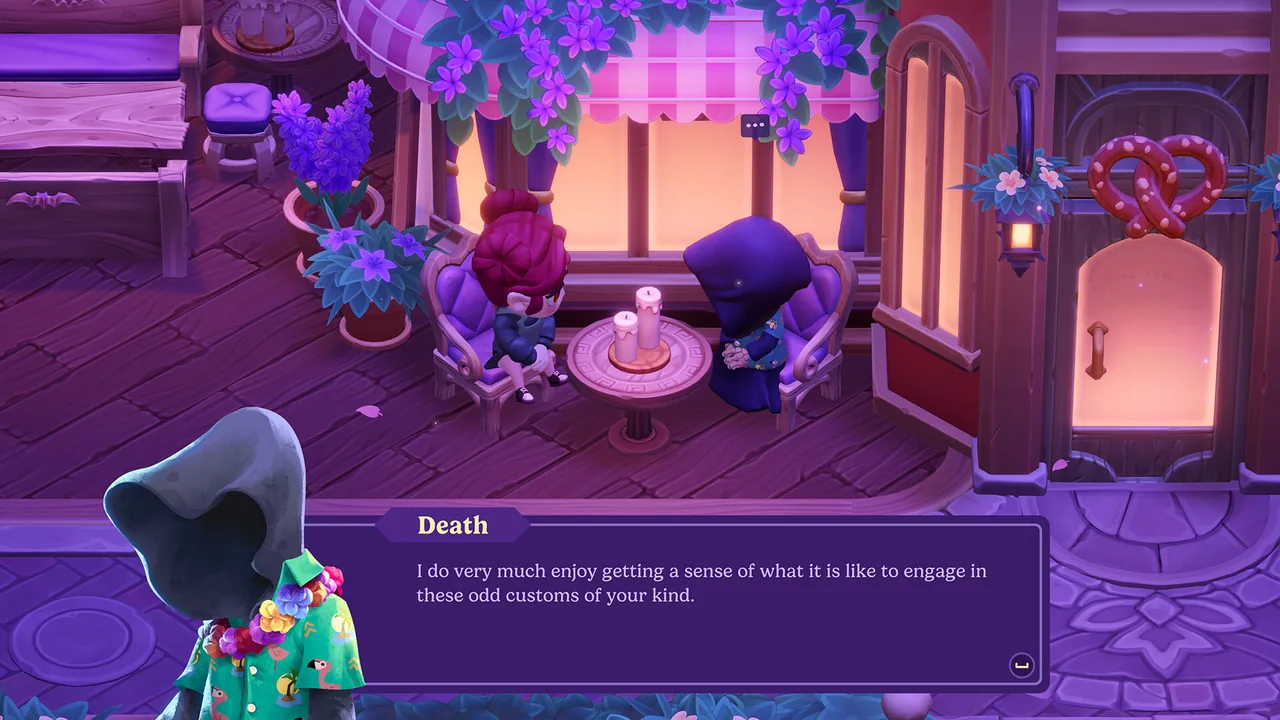
The relationship system is the game's most generous swing and its clearest illustration of breadth chosen over depth. There are twenty-three romanceable residents drawn from six supernatural families, plus Death and a love demon as unaffiliated wildcards. Dating is fully gender-neutral, with no split roster, and you can pursue several people at once without the game slapping you down for it. For a genre where "eight bachelors, eight bachelorettes, pick a lane" is still the default, that's a real step.
The volume of writing is also above the genre average — multiple cutscenes per character, plus banter that reacts to town events. What lets it down is that the writing rarely surprises. The charming warlock announces that there's more to him than the front he puts up, which removes any work the reveal might have done later. Tone wobbles too: the vampire patriarch's drinking is played as a running gag in his own scenes and as genuine damage in his children's, and the game never decides which reading it believes.
Mechanically, the bigger problem is that each character has one date activity. If you commit to someone, you repeat that activity as your relationship deepens, which turns courtship into a grind at the exact point it should be escalating. Friendship tracking is thin as well — a list of recent gifts rather than a record of what each person actually likes — so optimising affection means keeping notes outside the game.
The friction that adds up
None of the following is fatal on its own, and together they cost the game most of a point.
Loading screens sit between buildings and areas, they're frequent, and they're slow enough to notice on every platform. There's no minimap, so navigating an unfamiliar town means opening a menu. Inventory work is item-by-item. Shop opening hours aren't clearly surfaced, which produces wasted nights walking to a closed carpenter — in a game where a night is a finite resource, that stings more than it would elsewhere.
Then there's the save model. Moonlight Peaks saves when you sleep, and only when you sleep. That's a fifteen-to-twenty-minute exposure window, on a launch build that Steam Deck coverage has found stable enough to be Verified but not immune to the odd crash and collision glitch. Pair a whole-night save granularity with any crash rate at all and you have a design decision that should have been revisited during production, not defended as tradition.
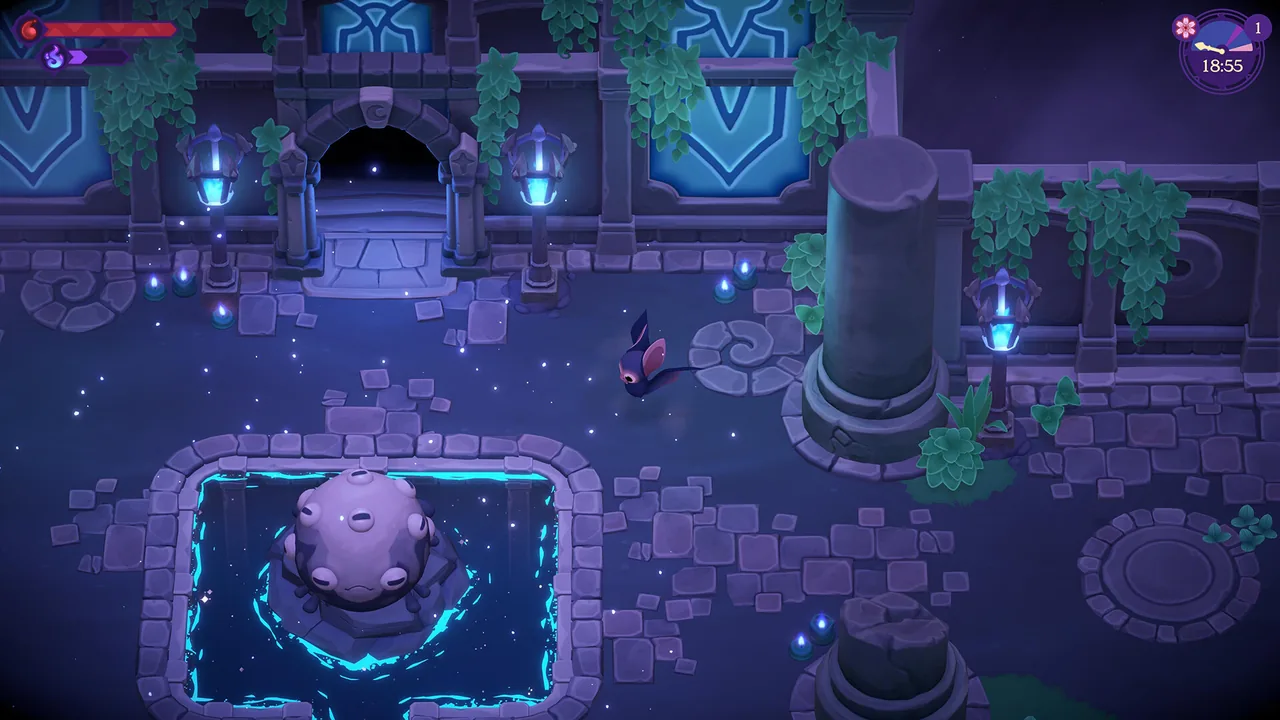
Presentation is the easy win. The chibi sprite work, the gothic palette and the permanent moonlight give the town a look nothing else in the genre has, and it reads cleanly on a Switch handheld screen. The flat, low-relief landscape gets samey over long sessions, and the portrait art sits oddly against the sprites, but the aesthetic is doing exactly what it was hired to do.
What thirty-five dollars is buying
US$34.99 on Steam, Switch and Google Play Games, US$39.99 for the Switch 2 Edition, US$44.97 for the Steam Digital Deluxe with the soundtrack and art book, all checked on 29 July 2026. It's a clean premium purchase: no currencies, no energy timers, no season pass, nothing sold back to you later. Switch owners can upgrade to the Switch 2 build for five dollars, which is the correct way to handle that.
The price is the sticking point rather than the model. This is a crowded, aggressively priced subgenre, and thirty-five dollars puts Moonlight Peaks above titles that offer deeper systems and hundreds of hours of ladder. What you're paying the premium for is the theme, the cast size and the presentation, and those are real, but they're the parts you'll have seen most of by the time you've cleared the story queue. The demo is the right move here, and the fact that one exists on both PC and Switch is to the publisher's credit.
Verdict
Moonlight Peaks earns its seven on atmosphere, generosity and one excellent structural idea. The sunrise deadline gives the cosy genre a spine it usually refuses to grow, the romance roster is the most open-minded in the category, and the sheer count of recipes, blueprints and side pursuits means a first playthrough rarely runs out of new things to look at.
It doesn't score higher because there's no machine underneath. Strip away the excellent clock and you find a farm with no skills, an economy solved in a season, a magic system rationed by its own worst meter, and a cast written broad rather than deep. Critic scores landing around the high seventies and a Steam crowd sitting at 89% positive tell the same story from two directions: this is a game people enjoy being inside and struggle to argue is essential.
Buy it if you want a beautiful nocturnal town to potter around for forty hours and a large cast to work through. Skip it, or wait for a sale, if the thing that keeps you playing life sims is watching a number go up.
Prices, storefront ratings and monetisation checked 29 July 2026.
If it's the climbing you're after rather than the pottering, Wanderer is built the opposite way round — one long road, skills that actually level, and progress that keeps ticking while the tab is closed.
Pros and cons
Pros
- The 6pm-to-6am clock is a real constraint that forces you to plan a night before you start it
- Twenty-three romanceable residents, gender-neutral across the board, with no bachelor/bachelorette split
- Enormous recipe and blueprint volume, so there is nearly always something new to unlock and build
- Gesture-drawn spellcasting gives magic a physical feel that a hotbar button never would
- Genuinely varied side activities, from pottery and flower arranging to a full collectible card game
Cons
- No skill levelling of any kind, so progression is entirely gated on story quests running out
- Money arrives so fast that late-game purchases stop being goals within the first season
- The mana meter refills at a crawl, throttling the one system the game is themed around
- It only saves when you sleep, which puts a whole night at risk on a build that still crashes
- Frequent loading screens between buildings and areas, and no minimap to plan a route with
Screenshots
-
Moonlight PeaksImage: XSEED Games via Steam -
Moonlight PeaksImage: XSEED Games via Steam -
Moonlight PeaksImage: XSEED Games via Steam -
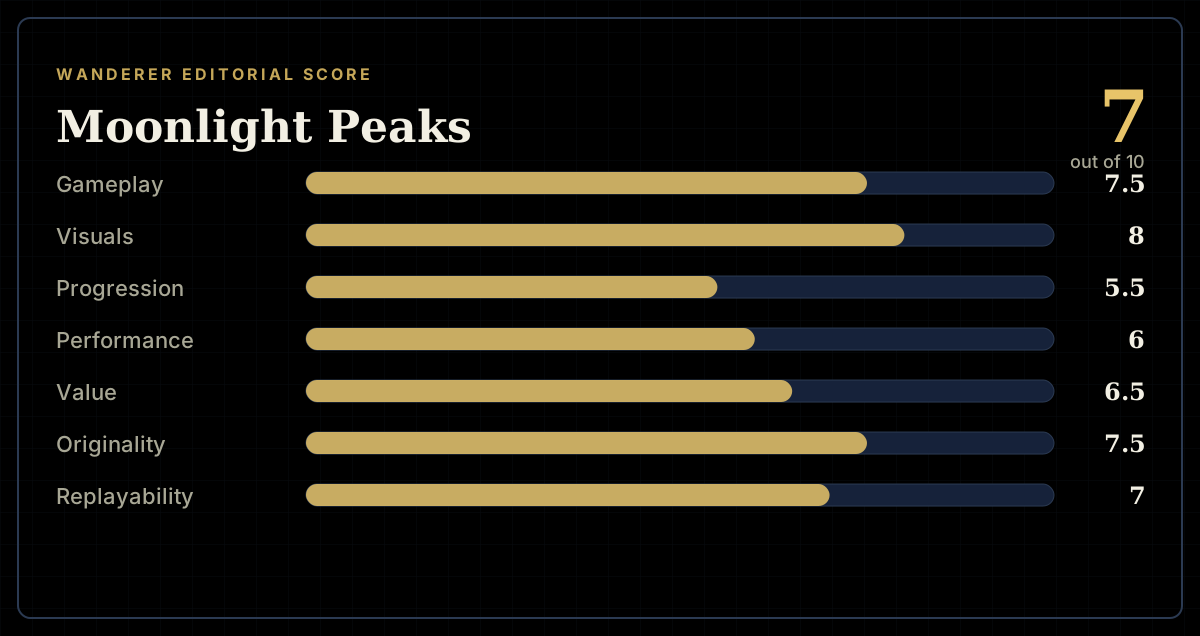
How the review scores each part of the gameWanderer Editorial -
The short versionWanderer Editorial