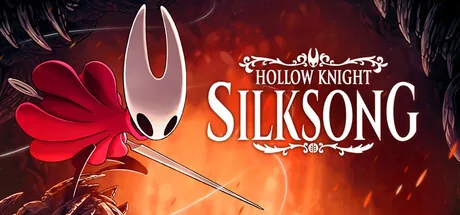
Game review
Hollow Knight: Silksong
9 / 10
- Developer
- Team Cherry
- Publisher
- Team Cherry
- Released
- 4 September 2025
- Platforms
- Windows, macOS, Linux, Nintendo Switch, Nintendo Switch 2, PlayStation 4, PlayStation 5, Xbox One, Xbox Series X|S
- Genre
- Metroidvania
- Monetisation
- Premium, one-off purchase — no in-game purchases
- Players
- Single-player
The short version
Silksong takes everything that made the first Hollow Knight worth the fuss — hand-drawn world-building, precise acrobatic combat, boss fights built like puzzles you solve with your reflexes — and turns the difficulty and the movement speed up together, so Hornet's game never feels like it's just repeating the Knight's.
It also asks more of you than the original did, consistently, and that's the one place the seven-year wait shows: some of the runbacks to tough bosses and a handful of flatter side quests test patience in ways the first game rarely did.
Biggest strengths
- Hornet's faster, more acrobatic moveset makes traversal feel distinct from the original Knight rather than a reskin
- Tools, Crests and Silk Skills give combat real build variety without ever needing a menu to feel like the point
- Boss design remains the series' strongest suit — over 40 legendary fights, each testing a different read on the same core moveset
Biggest weaknesses
- Runbacks to some of the tougher bosses are long enough to turn a fair fight into an endurance test before you even get a hit in
- Overall difficulty is a real step up from the original and will filter out players who liked that game for its exploration more than its combat
- A handful of side quests, the "Wishes," land as busywork rather than the small stories the best NPCs in this world usually tell
Who it's for: Metroidvania and Soulslike players who want their exploration paired with real difficulty, and anyone who loved the first Hollow Knight and wanted more of exactly that rather than something safer.
Our recommendation: Buy it. At this price, for a game with this much world in it, the only real question is whether you have the patience for its harder stretches — and if you do, there isn't a better metroidvania available right now.
9 / 10
Seven years is a long time to wait for a sequel, long enough that a project announced as Hollow Knight DLC grew into its own full game somewhere in the middle of development. Team Cherry's given reason for the scale of the delay is almost disarmingly simple: Hornet being taller than the Knight changed everything about how the levels around her needed to work. That kind of granular, almost stubborn attention to feel is all over Silksong, and it's the reason the wait mostly reads as justified rather than just long.
A faster, meaner moveset
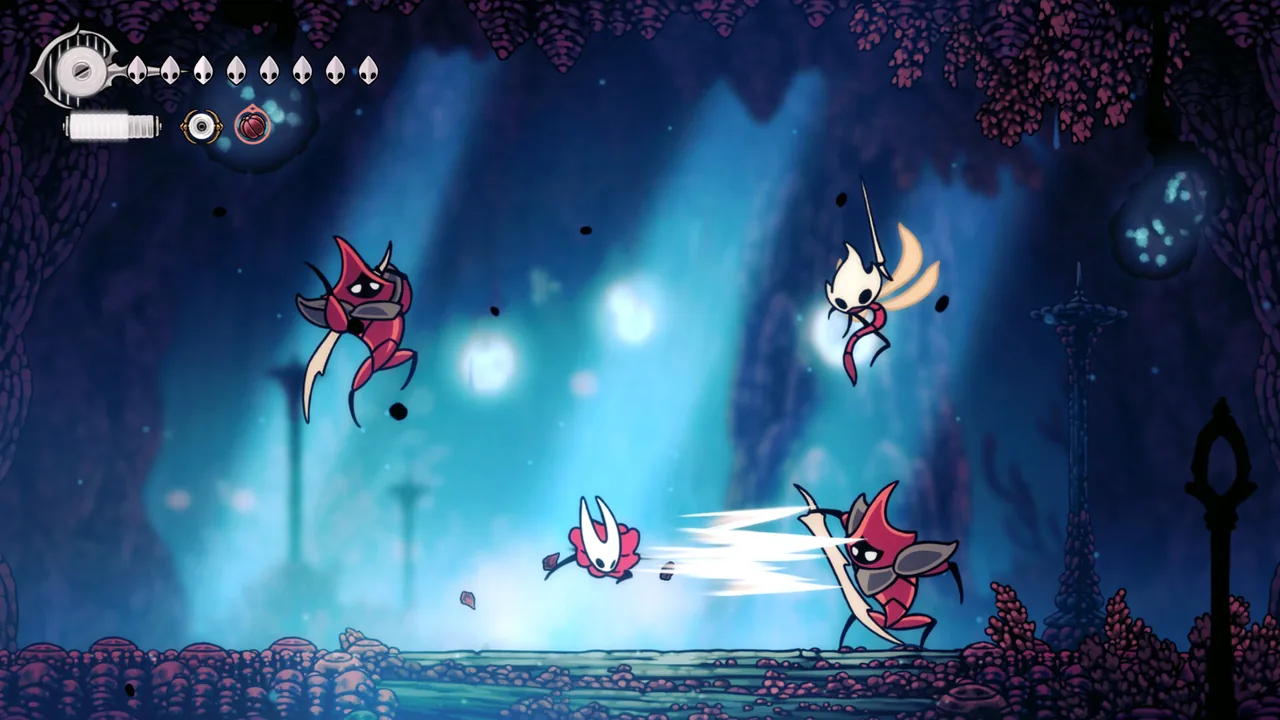
Hornet isn't the Knight with a different silhouette. She moves quicker, heals faster, and her whole combat vocabulary — a proper acrobatic array of dashes, needle strikes and aerial recovery options — is built around staying mobile rather than turtling up. Tools split into passive blue and yellow support options and offensive red weapons that draw down a Shell Shard resource, recharged at Benches, and Crests reshape how much of that kit you can carry and how it behaves at once. None of it replaces the original's combat so much as accelerates it, and the game's whole difficulty curve is built assuming you'll keep up.
That assumption is also where the game asks the most of you. Enemies deal roughly double the damage the first game's did, and while Silk-based healing (three hit points per use, fed by landing hits) is designed to offset that, the net effect is a game that punishes hesitation more than Hollow Knight ever did. Boss runbacks — the walk back to a fight after dying — stretch long enough in a few late fights that losing feels like it costs you more time than it should, which is the one design decision in this game that reads as a genuine miscalculation rather than a deliberate difficulty choice.
Pharloom rewards the wall-poking habit
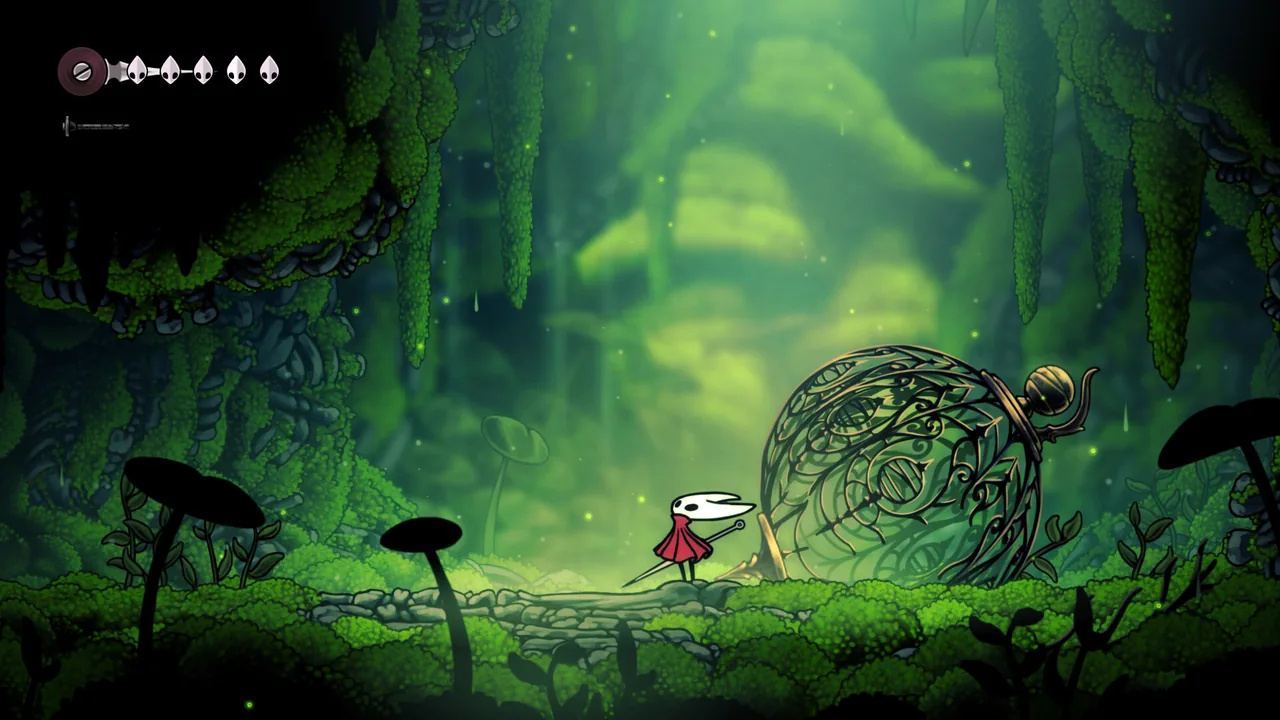
The kingdom of Pharloom is where Silksong's world-building does its best work — mossy grottos, gilded cities and misted moors that all commit to their own identity rather than reading as palette swaps of each other. The series' signature habit of hiding real content behind unremarkable-looking walls and ledges is intact and, if anything, more confidently deployed: exploration here consistently pays off, which is exactly what keeps a metroidvania's map worth re-checking hours after you first walked past a dead end.
Side content is more of a mixed bag. The "Wishes" quest system gives NPCs actual requests to track rather than leaving them as scenery, which is a real structural addition over the original, but a chunk of these quests land as fetch-and-return busywork rather than the small, specific stories the game's best characters usually deliver. It's not a bad system so much as an inconsistently written one.
Presentation that's doing the heavy lifting
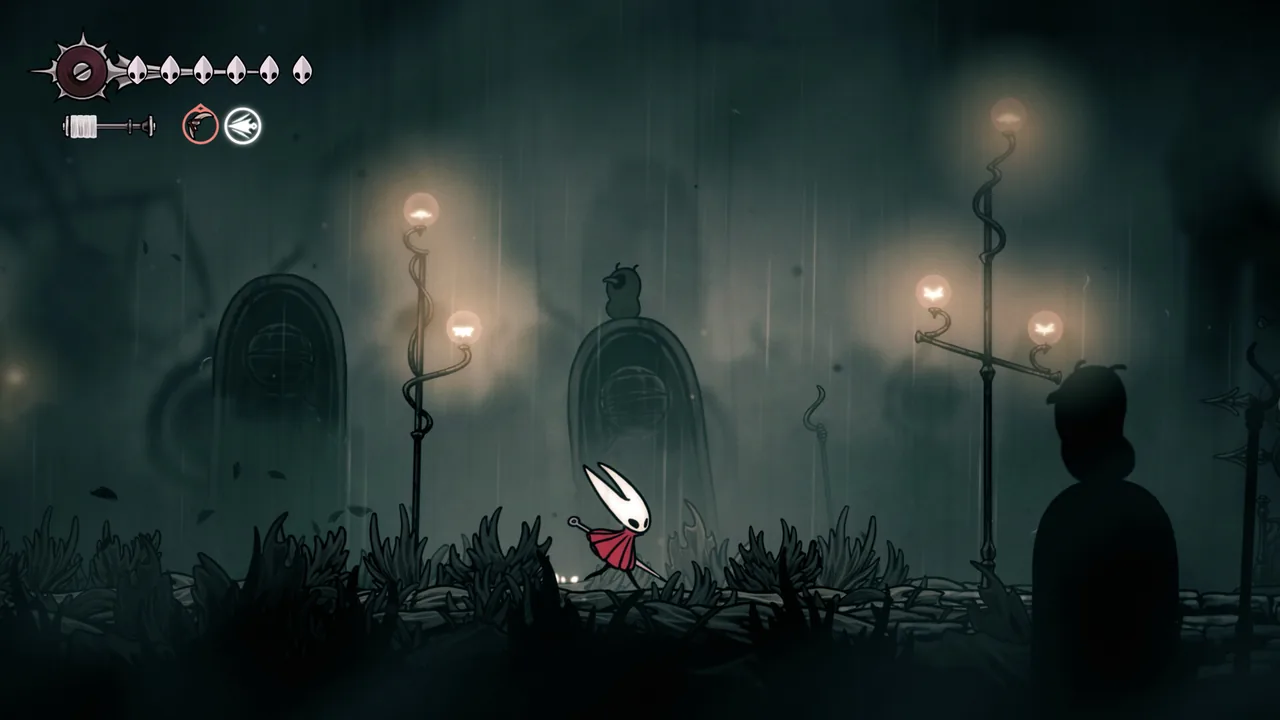
Christopher Larkin's score returns and does as much to establish Pharloom's mood as the art does — "haunted, playful, and endlessly beckoning" is about as accurate a three-word summary of this soundtrack as you'll find. The hand-drawn visuals hold up to the reputation the first game built: layered backgrounds, careful silhouette work, and boss arenas that read clearly even at the speed Hornet moves through them. Very little about this game looks like seven years of scope creep; it looks like seven years of a small studio refusing to ship something they weren't satisfied with.
What the difficulty actually costs
The honest way to frame Silksong's difficulty is that it's a real gate, not just marketing around a "Souls-like" tag. Over forty legendary boss fights, each demanding a different specific read on Hornet's moveset, is a genuinely great structure for players who want that kind of test. For players who came to the first Hollow Knight mainly for the exploration and the atmosphere, this sequel is a noticeably harder ask, and it's worth knowing that going in rather than discovering it three bosses deep.
Final verdict
Silksong is one of the best metroidvanias released in years, and the critical and commercial response backs that up without much argument — Metacritic scores in the low-to-mid 90s across every platform, a 97% OpenCritic recommend rate, Steam's own community naming it their 2025 Game of the Year, and over seven million copies sold within three months of launch. Hornet's moveset, Pharloom's world, and Larkin's score are all genuinely excellent, and the game rarely feels like it's coasting on the first Hollow Knight's reputation.
It settles at nine rather than a perfect score because the difficulty spikes and their runbacks are a real cost, not just a design flourish, and a meaningful slice of the audience that loved the original for its exploration will find this a harder, less patient game to love back. Go in knowing that, and there's very little standing between you and one of the best games of the year.
Price and platform details checked 29 July 2026.
If you'd rather your exploration came without boss fights that can end a run in three hits, Wanderer trades Pharloom's difficulty for a slower, gentler kind of persistent world.
Pros and cons
Pros
- Hornet's faster, more acrobatic moveset makes traversal feel distinct from the original Knight rather than a reskin
- Tools, Crests and Silk Skills give combat real build variety without ever needing a menu to feel like the point
- Boss design remains the series' strongest suit — over 40 legendary fights, each testing a different read on the same core moveset
- Christopher Larkin's returning score is doing as much scene-setting work as the art
- Pharloom is dense enough, and hides enough, to reward the series' trademark habit of walking into a wall to see what's behind it
- Extraordinary value for a premium indie price given the amount of world here
Cons
- Runbacks to some of the tougher bosses are long enough to turn a fair fight into an endurance test before you even get a hit in
- Overall difficulty is a real step up from the original and will filter out players who liked that game for its exploration more than its combat
- A handful of side quests, the "Wishes," land as busywork rather than the small stories the best NPCs in this world usually tell
- Chinese localization had notable issues at launch, later patched
Screenshots
-
Hollow Knight: SilksongImage: Team Cherry via Steam -
Hollow Knight: SilksongImage: Team Cherry via Steam -
Hollow Knight: SilksongImage: Team Cherry via Steam -
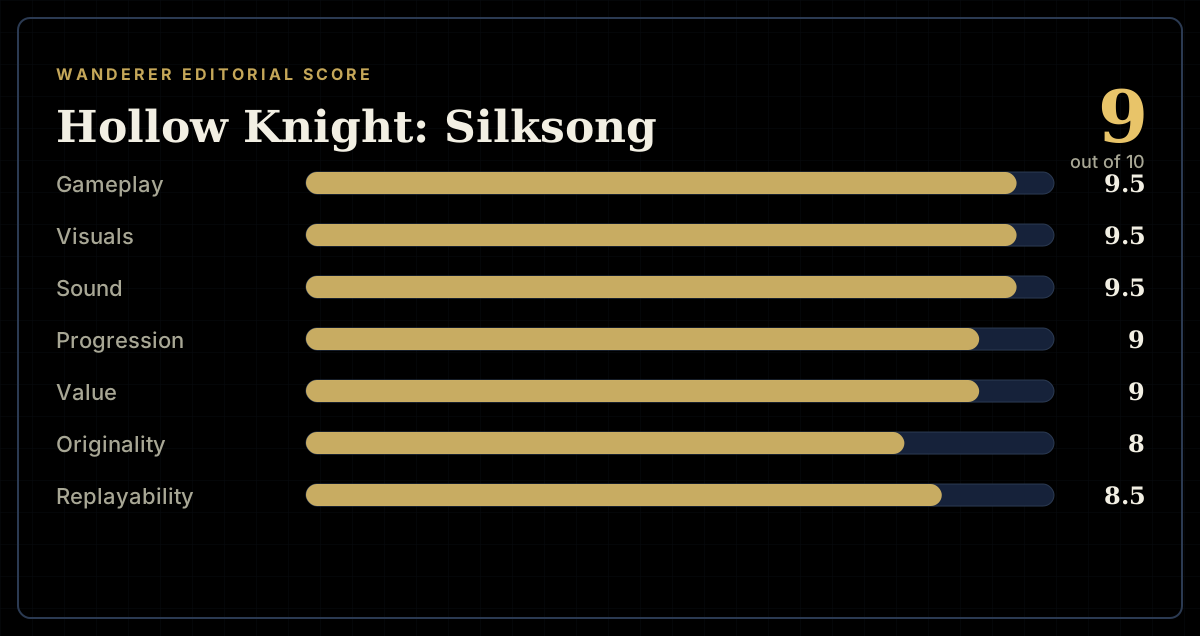
How the review scores each part of the gameWanderer Editorial -
The short versionWanderer Editorial