Game review
SuperTaxCity
6.8 / 10
- Developer
- soramame-koubou
- Publisher
- KIC Games
The short version
Biggest strengths
- Reviewers consistently praise the addictive 'one more run' pull of dropping buildings, watching randomly wandering residents trigger them, and chasing ever-bigger synergy combinations
- Several reviewers highlight it as a genuinely distinct twist on the Luck Be a Landlord-style roguelike scoring-engine genre, reskinned as a city builder rather than a slot machine
- The mix of over 100 facility types and 100 items gives reviewers real room to experiment with different profit strategies across runs
Biggest weaknesses
- The single most common complaint by far is that randomness feels overbearing, with reviewers describing runs where the game withholds useful building draws and leaves little room to recover or pivot
- A meaningful group of reviewers say the game gravitates toward one or two dominant winning strategies, especially on higher difficulties, making runs feel repetitive over time
- Reviewers note thin permanent progression between runs, with most unlocks limited to achievements rather than lasting upgrades
6.8 / 10
Overview
SuperTaxCity is a roguelike city-building game from Japanese developer soramame-koubou, published by KIC Games. Rather than managing infrastructure over the long term, players fill a grid with randomly drawn facilities, watch wandering residents trigger them for profit, and pay a mounting tax bill at the end of each round. It released on Steam on January 29, 2025, and sits at a Mostly Positive rating across 66 reviews.
Reviewers frequently describe it as a spin on the Luck Be a Landlord school of roguelike scoring-engine games, but one that earns its own identity by trading a slot machine for a small, chaotic metropolis. That identity comes bundled with a familiar tension: reviewers love the highs of a synergy clicking into place and resent the lows of a run the randomness simply won't let them win.
Story and Setting
There isn't a narrative to speak of; SuperTaxCity frames itself entirely through its systems and cheerful pixel-art presentation rather than characters or plot. Reviewers describe the tone as light and cozy, with small residents scurrying between buildings and a tidy, colorful grid that several say looks deceptively simple on a store page screenshot before revealing genuine mechanical depth once played.
That gap between first impression and lived experience is one of the most frequently repeated observations in the review pool. Multiple reviewers admit they picked the game up expecting a throwaway curiosity, sometimes as the least-anticipated pick from a bundle, and instead found themselves returning to it repeatedly, describing the loop as "weirdly addicting" and comparing its pull to mobile gacha games despite having no gacha monetization behind it.
Gameplay and Mechanics
Each round, players choose from randomly offered facilities and place them on a city grid, where residents move around semi-randomly and trigger whatever buildings they wander into, generating money and secondary effects. At the end of a set time limit, the accumulated tax comes due, and players spend their earnings on upgrades before the next round begins. Reviewers describe a real skill ceiling in arranging buildings for spatial synergies, since many facilities interact with neighboring tiles or resource chains that reward deliberate placement over random luck.
That said, the randomness is the review pool's single biggest fault line. A sizable contingent of reviewers describe the RNG as overbearing, saying the game can withhold the building types a strategy depends on for an entire run with few reliable ways to compensate beyond limited, currency-costing rerolls. Several reviewers go further, arguing that higher difficulties collapse toward one or two dominant, food-and-electricity-style economic strategies that scale reliably, while more creative or thematic builds fall behind and become effectively unviable. Others push back on this framing entirely, describing the difficulty curve as fair and the strategic variety as more than sufficient to keep runs feeling fresh across dozens of hours.
Progression and Replayability
Runs are relatively short, with reviewers describing individual sessions as fast once the building set is understood, and several specifically praising the game as ideal for a spare fifteen minutes. Total playtime estimates vary enormously across the review pool: some reviewers report a satisfying few hours before diminishing returns set in, while others report 10, 20, or even over 100 hours chasing different challenge stages, difficulty tiers, and city configurations.
Permanent progression between runs is thin by design, with most reviewers describing unlocks as limited to achievements rather than lasting power increases, which a few frame as a deliberate roguelike purity but others find genuinely disappointing given the genre's usual meta-progression hooks. One reviewer specifically flagged a bug in the game's infinite mode, where the escalating tax requirement stops increasing past a fixed threshold, undercutting the mode's intended endless challenge.
Visual Style and Sound Design
The pixel-art presentation draws broad, if understated, approval, with reviewers describing a clean, readable grid and charming resident and building sprites that make even a busy late-run city easy to parse at a glance. No reviewer singles out the visuals as a weak point, and several specifically credit the clarity of the building icons with making the game's synergy-hunting core loop legible even during its more frantic stretches.
The soundtrack fares less consistently. At least one reviewer specifically called the music distractingly loopy and repetitive enough to be muted after a few hours, describing it as one of the few rough edges in an otherwise polished presentation package.
Interface clarity draws mixed reactions too. Several reviewers single out the tutorial as thorough and well-paced, crediting it with making an initially confusing web of building interactions click quickly, while others describe the same tutorial as dense and frustratingly unskippable given how little content backs it up. A few also note the lack of a way to ban or filter out clearly useless building choices from the random draw pool, which compounds frustration during runs where the offered options don't fit any viable strategy.
Verdict
SuperTaxCity takes a well-worn roguelike scoring-engine formula and gives it a genuinely distinct city-building coat of paint, and for a wide swath of reviewers that reskin, paired with over a hundred facilities and items to mix and match, is more than enough to justify its modest asking price. Its heavy reliance on randomness will frustrate players who want more direct control over their strategy, and its thin permanent progression may leave completionists wanting more, but as a cheap, replayable "one more run" experience with real strategic bones underneath its cute exterior, it delivers on what it promises for most who try it.
Pros and cons
Pros
- Reviewers consistently praise the addictive 'one more run' pull of dropping buildings, watching randomly wandering residents trigger them, and chasing ever-bigger synergy combinations
- Several reviewers highlight it as a genuinely distinct twist on the Luck Be a Landlord-style roguelike scoring-engine genre, reskinned as a city builder rather than a slot machine
- The mix of over 100 facility types and 100 items gives reviewers real room to experiment with different profit strategies across runs
- Reviewers widely agree it offers strong value at its roughly $13 price point, citing many hours of engaging play for a comparatively small purchase
Cons
- The single most common complaint by far is that randomness feels overbearing, with reviewers describing runs where the game withholds useful building draws and leaves little room to recover or pivot
- A meaningful group of reviewers say the game gravitates toward one or two dominant winning strategies, especially on higher difficulties, making runs feel repetitive over time
- Reviewers note thin permanent progression between runs, with most unlocks limited to achievements rather than lasting upgrades
- A minority of reviewers flag an unskippable, overly dense tutorial and a reported bug where the game's infinite mode stops scaling its tax requirement past a certain point
Screenshots
-
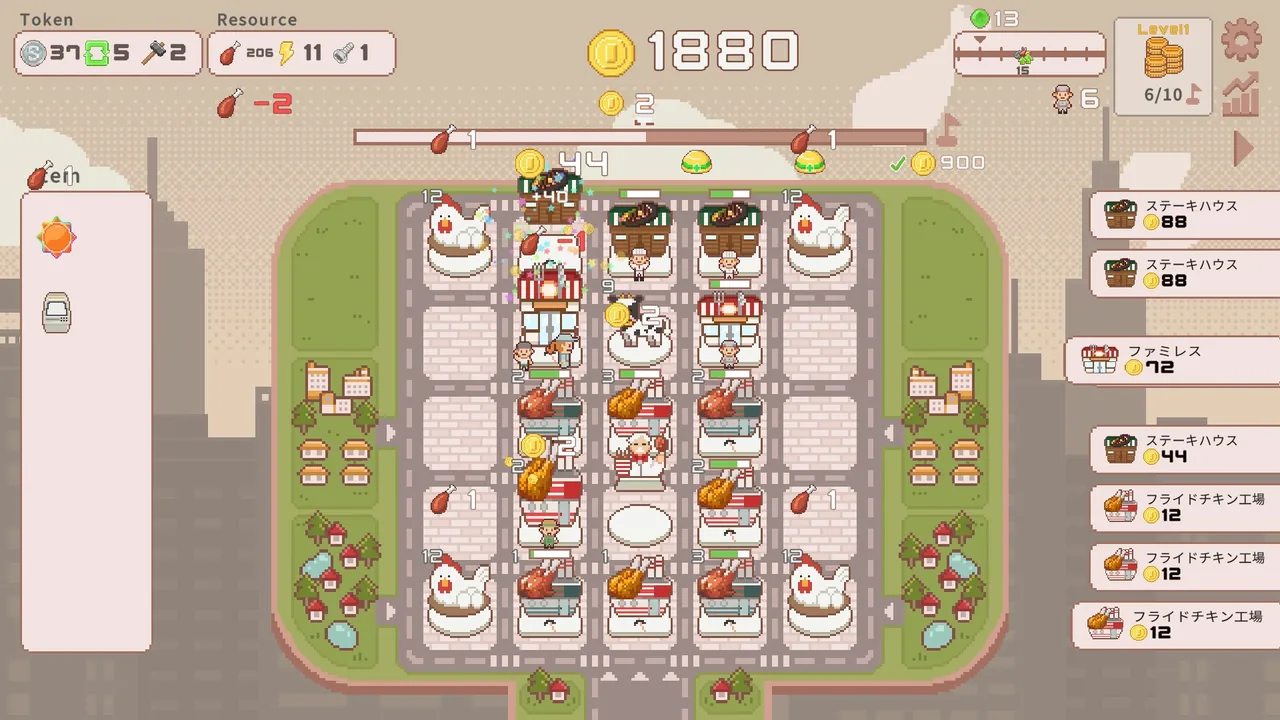
A mid-run city built around a fried chicken and steakhouse food synergy, tracking coins, resources, and level progressImage: soramame-koubou via Steam -
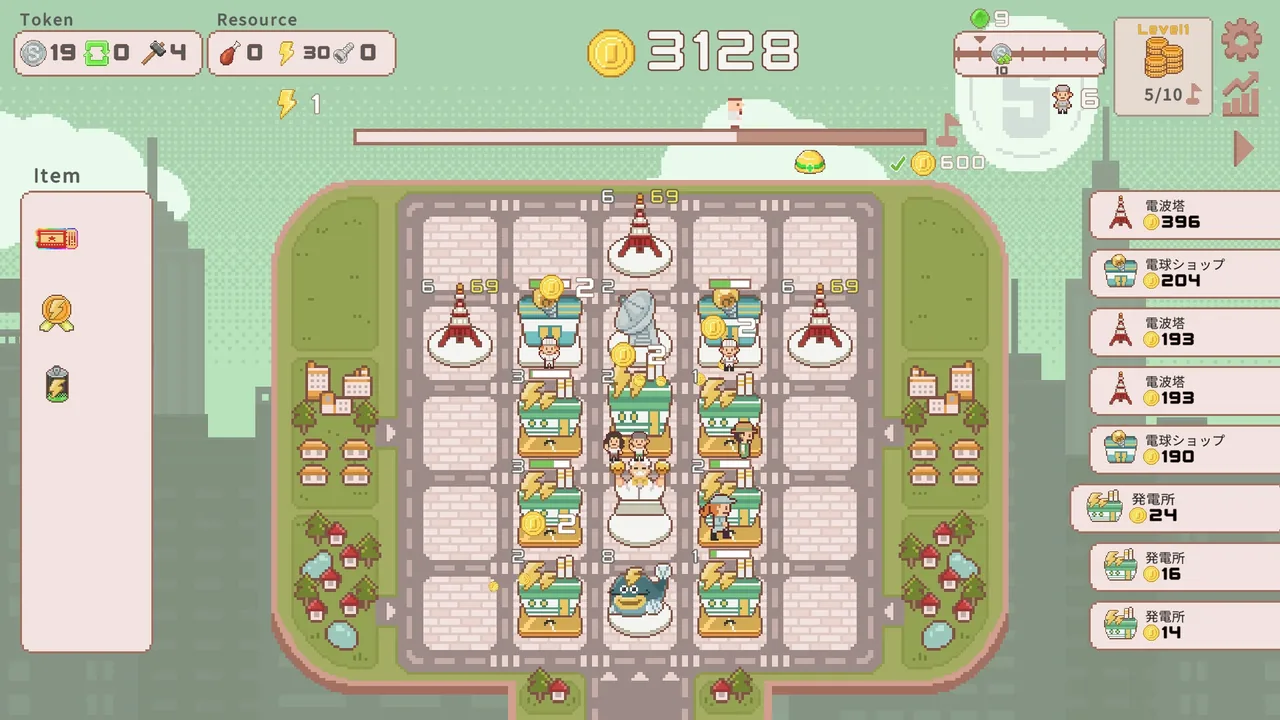
An electricity-focused build combining radio towers and power plants, with facility upgrade costs listed on the side panelImage: soramame-koubou via Steam -
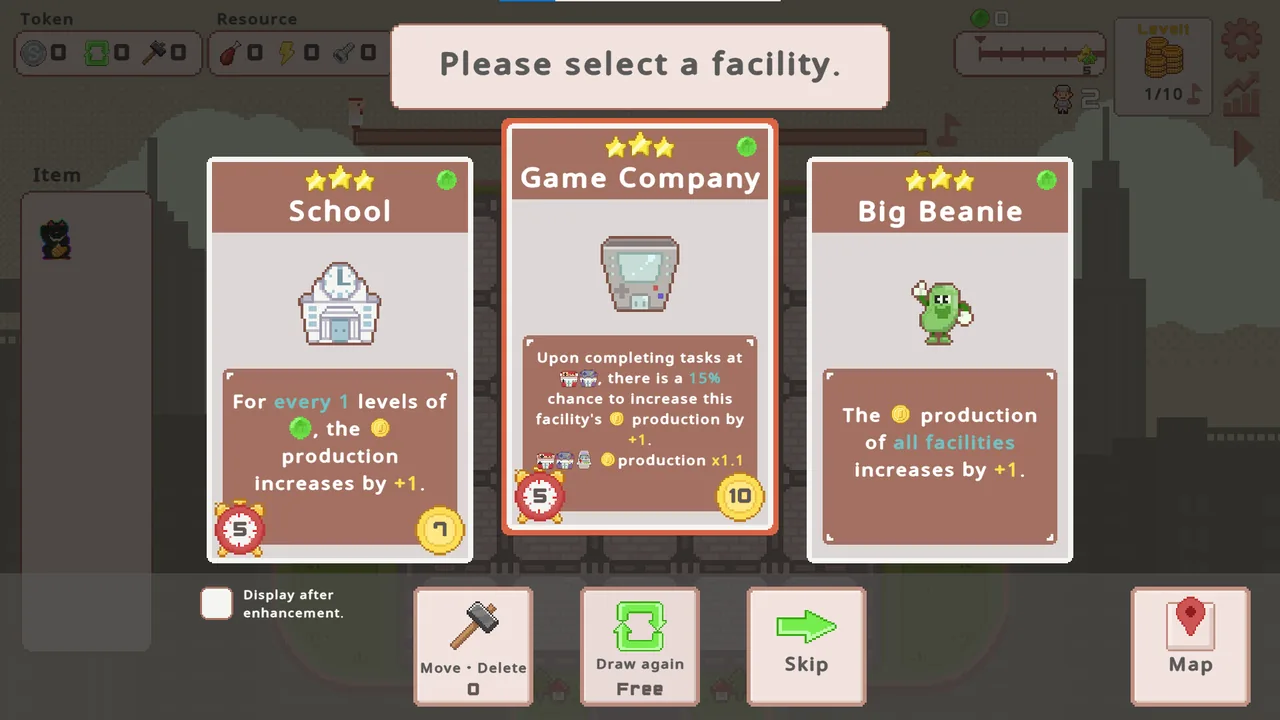
The facility draft screen, where players choose one of three randomly offered buildings to add to their cityImage: soramame-koubou via Steam -
Wanderer Game ReviewsWanderer Game Reviews