Game review
Stack to Ascension
5.8 / 10
- Developer
- Stack to Ascension
- Publisher
- Luckycalf
The short version
Biggest strengths
- Genuine thematic depth: managing a xianxia sect's disciples, resources, and slow cultivation timelines feels distinct and absorbing when the systems click
- High replayability — multiple long-session reviewers (thousands of hours logged) describe returning for run after run
- The developer has a demonstrated track record of shipping fixes for community-reported problems (core drop rates, storage limits) since launch
Biggest weaknesses
- A single-player game that requires a persistent internet connection to run at all, with reviewers reporting the game is entirely unplayable when that connection drops
- Meaningful chunks of the interface and item text are untranslated, forcing players to guess or run text through a translator mid-session
- Random enemy-invasion strength can spike hard enough to wipe an entire sect through no real misplay, which several reviewers call out as unfair rather than merely difficult
5.8 / 10
The Pitch
Stack to Ascension casts you as the sole survivor of a sect wiped out by beasts, starting over from the lowest rung of the cultivation ladder with a mandate to rebuild. It's less an idle clicker than a slow-burn management sim in the vein of Amazing Cultivation Simulator — you're placing buildings on a map, assigning disciples to fields and training halls, managing limited storage and resources, and deciding when your sect is strong enough to push into secret realms or brace for the next wave of hostile factions. One reviewer's comparison to Amazing Cultivation Simulator is apt and, notably, offered as a selling point rather than a knock — if that game's blend of sim-management and wuxia flavor appealed to you, the throughline is clear here too.
The overall Steam rating sits at a genuine Mixed (roughly 55% positive across 332 reviews), but the English-language slice tells a more favorable story — 17 of 22 positive, Mostly Positive. That gap is itself informative: several of the sharpest, most specific complaints in the English pool are about localization and connectivity requirements that would understandably read as far more severe friction for a global non-Chinese audience navigating an incompletely-translated interface than for players in the game's home market. The underlying systems being praised and criticized are largely the same ones on both sides of that language line — it's the presentation layer, and one specific technical requirement, that seem to be doing a disproportionate amount of damage to the international score.
The Sect Management Loop Actually Works
When reviewers describe what's keeping them playing, they get specific rather than vague, and the details paint a consistent picture. One long-session player, sitting at over 10,500 minutes played, calls it "decent" and stresses the pacing — "you do have to manage your storage, pace yourself, and get to understand the underlying systems" — while acknowledging it's "for a very specific group of gamers and not for everyone." Another describes the thematic hook precisely: disciples "passing entire decades in closed meditation," watching low-talent recruits "get stuck on bottlenecks and die," and going to war with rival sects over territory. That's the kind of granular, systems-literate praise that's hard to fake, and it shows up across multiple reviewers independently rather than in one outlier review.
The progression curve backs this up structurally too — cultivation stages (Qi Condensation through Foundation, Golden Core, and beyond) gate what your disciples can attempt, and reviewers describe real strategic tension around when to risk a "Beast Tide" event or a secret-realm raid versus consolidating first. One reviewer's account of getting "wiped on my 3rd Beast Tide" for lacking the right pills to clear a breakpoint reads as a fair, earned failure state rather than a cheap one — the kind of loss a strategy game should be able to produce.
The Interface And The Internet Requirement Undercut It
Against that real depth, the complaints are equally specific and considerably harder to wave away. The most-upvoted negative review in the English pool (22 helpful votes) leads with a genuinely serious structural issue: despite being a single-player game, it requires a persistent internet connection to play at all, meaning a dropped connection or unstable network takes the game down mid-session regardless of what you were doing. That's compounded by a second reviewer reporting the game simply refusing to launch — a Steam connection error that survived file verification, reinstalling, and running as admin, with the reviewer noting a month later that it was "still unplayable." A single-player strategy game with an always-online dependency and unresolved launch failures is not a small ask of players' patience, and it's the kind of problem that no amount of systems depth underneath fully excuses.
Layered on top of that are the localization gaps — "plenty of text is not translated to English so you either guess what it does or google translate it" — and a midgame clutter problem multiple reviewers converge on independently: storage caps out too quickly, the recipe and item lists balloon with entries most players never need, and managing which disciple gets which piece of gear becomes a repetitive chore rather than a meaningful decision once your roster grows past a handful of characters. To the developer's credit, several reviewers explicitly note that some of this has already improved since launch — core drop rates and storage limits were called out as fixed in follow-up edits to otherwise-critical reviews — which is a genuinely good sign for where the game is headed, even if it doesn't retroactively fix what shipped.
Value At NZ$14.75
At NZ$14.75, Stack to Ascension sits in the same rough price band as a lot of full-featured management sims rather than at typical idle-genre pocket-change pricing, and the value case has to be made on depth of systems rather than breadth of content updates, since this is still a comparatively young release with a smaller team behind it than genre heavyweights. The reviewers putting real time in — several logged well past a hundred hours — treat that price as fully earned by the sect-management loop alone, independent of the technical rough edges. For a buyer specifically drawn to the xianxia sect-sim premise and willing to treat the always-online requirement as a hard prerequisite rather than a minor caveat, that's a reasonable trade. For a buyer expecting a conventional, offline-capable single-player strategy game at that price, the connectivity dependency alone is a legitimate dealbreaker worth knowing about before purchase, independent of how good the underlying systems turn out to be.
Verdict
Stack to Ascension has a real, well-realized core idea — sect management as a slow, thematic strategy game rather than an idle-clicker reskin of the xianxia setting — and the players who click with its pacing describe getting hundreds or thousands of hours out of it. But it launched with a genuinely hard-to-defend always-online requirement for a single-player game, incomplete localization that disproportionately punishes non-Chinese-speaking players, and enough midgame interface bloat that even fans bring it up unprompted. The developer's visible responsiveness to feedback is a real point in its favour going forward. Worth watching, and worth a look if the sect-sim pitch specifically appeals to you and you can tolerate rough edges — go in expecting a stable connection to be a hard requirement, not a suggestion.
Pros and cons
Pros
- Genuine thematic depth: managing a xianxia sect's disciples, resources, and slow cultivation timelines feels distinct and absorbing when the systems click
- High replayability — multiple long-session reviewers (thousands of hours logged) describe returning for run after run
- The developer has a demonstrated track record of shipping fixes for community-reported problems (core drop rates, storage limits) since launch
- Real strategic weight to disciple management: talent, gear allocation, and timing secret-realm raids all matter and get discussed specifically by reviewers
Cons
- A single-player game that requires a persistent internet connection to run at all, with reviewers reporting the game is entirely unplayable when that connection drops
- Meaningful chunks of the interface and item text are untranslated, forcing players to guess or run text through a translator mid-session
- Random enemy-invasion strength can spike hard enough to wipe an entire sect through no real misplay, which several reviewers call out as unfair rather than merely difficult
- The interface clutters quickly in the midgame — storage limits, unneeded recipes, and disciple-equipment management all draw specific, repeated complaints
Screenshots
-
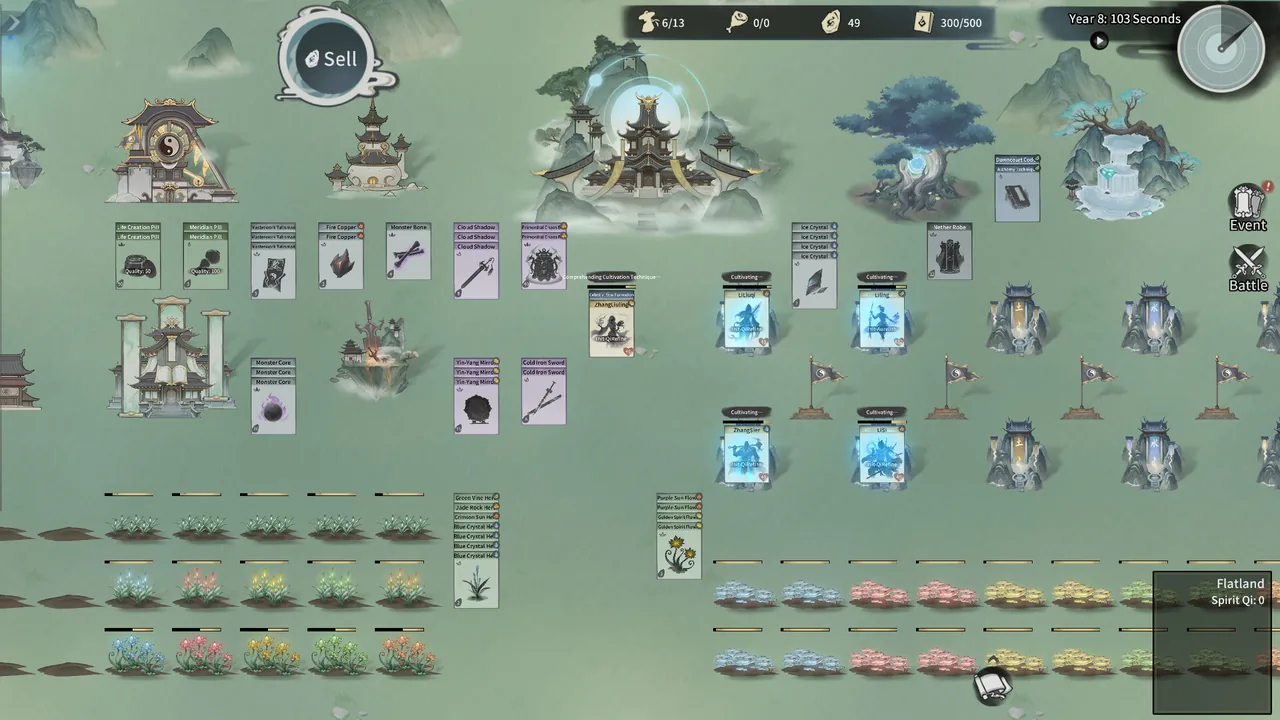
The base-building layer — plots, pavilions, and disciples assigned to cultivation and farmingImage: Luckycalf via Steam -
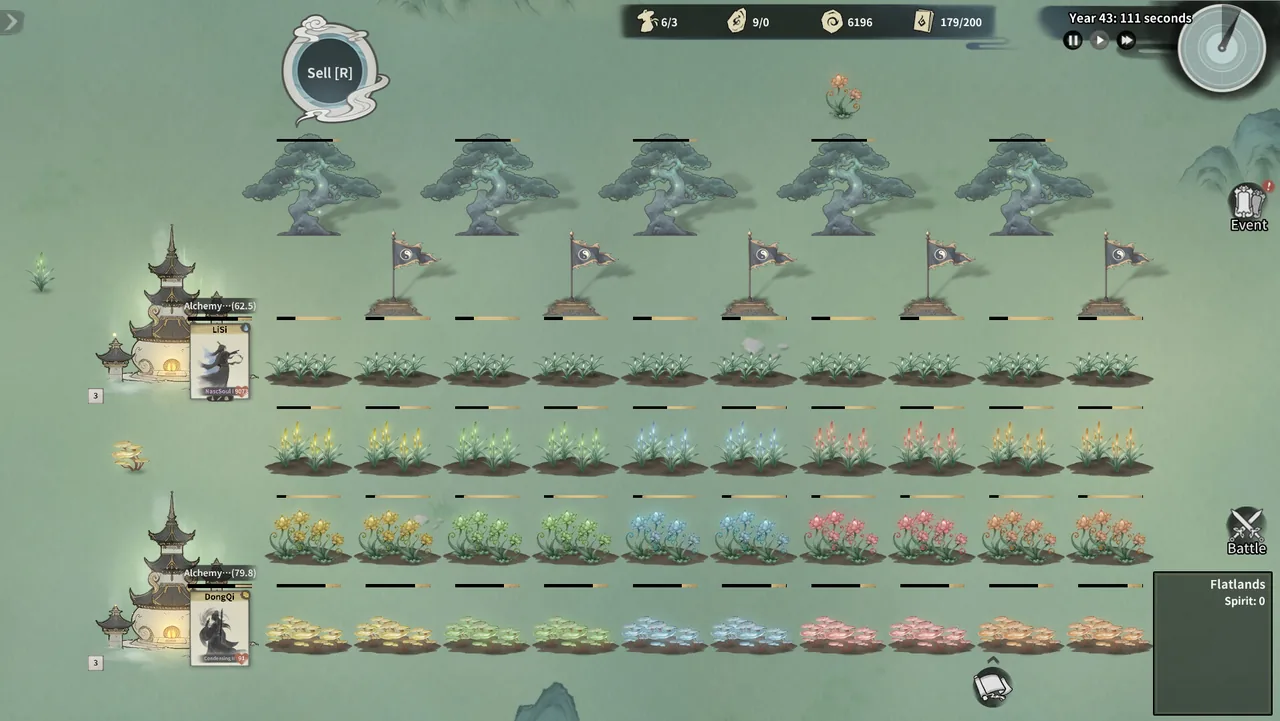
Mid-game resource sprawl — dozens of herb plots and trees feeding the sect's alchemyImage: Luckycalf via Steam -
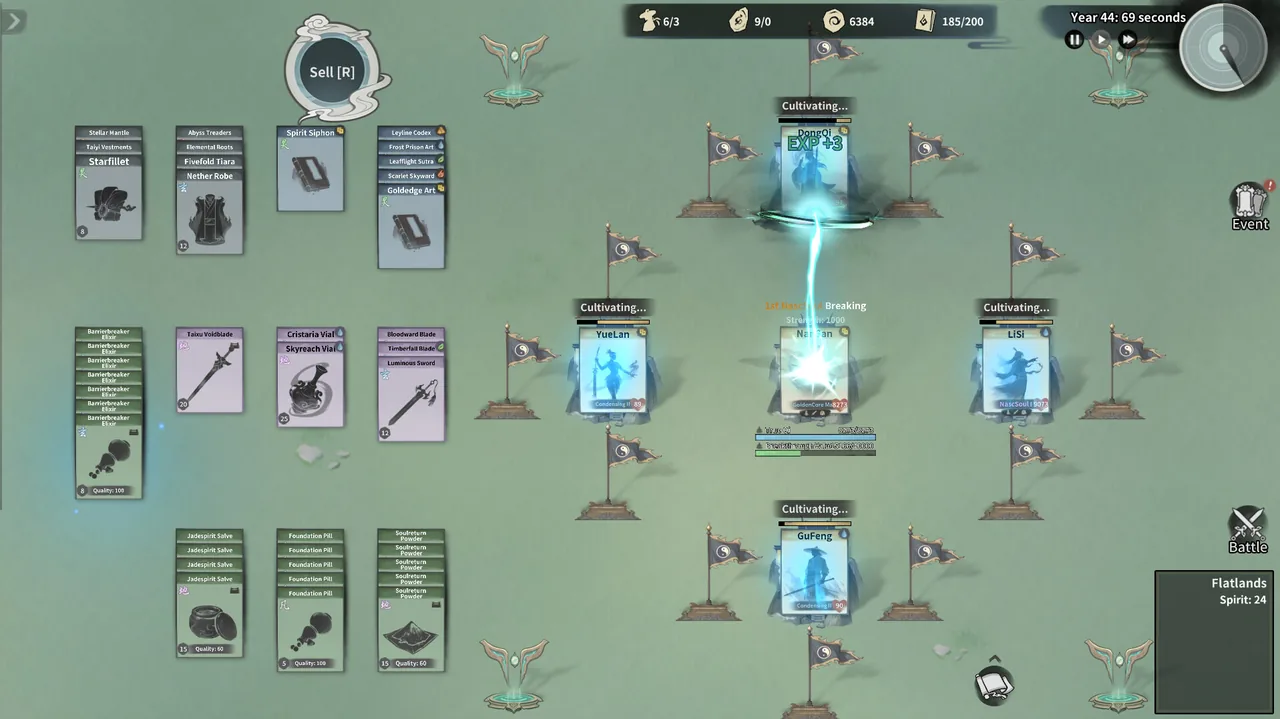
A disciple breaking through to a new cultivation stage, flanked by gear and pill stockpilesImage: Luckycalf via Steam -

Category scores for Stack to AscensionWanderer Game Reviews