Game review
Tyrant's Realm
6.4 / 10
- Developer
- Team Tyrant
- Publisher
- Skystone Games
The short version
Biggest strengths
- Parry-focused combat that reviewers describe as a faithful, tightly-tuned homage to Dark Souls' original moveset, with satisfying stamina management and timing-based rewards
- A striking PS1-era low-poly art style, complete with deliberate texture warping, that reviewers say holds up as genuinely charming rather than a gimmick
- Dead Cells-style meta-progression lets permanent unlocks carry between runs, giving short one-hour sessions a clear sense of forward momentum
Biggest weaknesses
- The bulk of the roughly 100-review sample agrees the game is short on content, with limited enemy and boss variety that several reviewers say grows repetitive within a handful of runs
- Procedural generation mostly reshuffles room order and enemy placement rather than the level layouts themselves, which reviewers say undercuts the promise of true run-to-run variety
- Multiple reviewers report run-ending bugs at launch, including falling through the map and key enemies failing to spawn in the final area
6.4 / 10
Overview
Tyrant's Realm casts players as the latest in a long line of heroes sworn to end the reign of an ancient, power-hungry Tyrant, running through procedurally generated, decaying realms in a roguelite structure built around soulslike combat. Developed by the small team at Team Tyrant and published by Skystone Games, it wears its influences openly: reviewers overwhelmingly describe it as Dark Souls' combat grafted onto a Dead Cells-style progression loop, wrapped in a deliberately gritty, low-poly PS1-era aesthetic. It released on Steam on January 16, 2025, priced at NZ$14.75, and has earned a Very Positive standing across more than 700 reviews.
The review pool is unusually consistent in its framing: this is a game built almost entirely around a single, well-executed idea rather than a sprawling feature list, and most of the disagreement among reviewers comes down to whether that idea is substantial enough to justify the price, not whether it's well made.
Story and Setting
Tyrant's Realm keeps its narrative deliberately minimal. The premise, a generations-long family struggle against an ancient Tyrant seeking absolute power, is delivered mostly through the store page and environmental framing rather than in-game cutscenes or dialogue, and reviewers consistently note there's little story or lore to speak of once the run begins. This is treated as a non-issue by most of the review pool, who frame the game as an atmosphere-and-combat experience first, with the crumbling fallen cities and treacherous procedurally generated biomes doing the narrative heavy lifting instead of text.
What story beats exist are conveyed through environmental variety between biomes and boss encounters, with reviewers praising the way each area's presentation shifts meaningfully even when the underlying enemy roster and combat encounters repeat more than they'd like. The result, by most accounts, is less a story-driven adventure than a mood piece: a "brutal, decaying shadow" of a world that reviewers say earns real nostalgia points purely through its retro-inspired art direction.
Gameplay and Mechanics
Combat is where Tyrant's Realm draws its strongest and most consistent praise. Reviewers repeatedly describe the moveset as a close cousin to the original Dark Souls, built around stamina management, timed dodges, and a parry system several reviewers single out as especially satisfying, complete with cinematic finishing blows. One longtime Dark Souls veteran wrote that of all the "DS clones" they'd tried, this was the first whose mechanics felt genuinely solid rather than derivative, while a Steam Deck player called the parry system fair and the overall responsiveness excellent even on handheld hardware.
The roguelite layer borrows heavily and openly from Dead Cells: gear, armor, and stat upgrades are found mid-run at Skull Altars and merchant rooms, with permanent meta-progression carrying knowledge and unlocks between attempts. Reviewers are more divided here. Several describe the loot and build variety as legitimately fun to experiment with across weapon classes with distinct movesets, while others found the itemization shallow, citing weapons that are strictly worse than ones found earlier and build diversity that doesn't hold up to close scrutiny. The four-directional dodge draws specific criticism for making corner escapes awkward, and the fixed camera is flagged by more than one reviewer as the game's real antagonist in tight spaces, more than any boss.
Progression and Replayability
A run typically takes around an hour to complete on the base difficulty, with several reviewers reporting they beat the entire game, including the final boss, on a first or second attempt; three difficulty tiers and a new-game-plus mode exist to extend the challenge for players who find the base run too easy. Reviewers who pushed further report roughly 7 to 20 hours of total engagement depending on how thoroughly they chase full weapon unlocks and higher difficulties, which most agree is a fair trade for the asking price but a real ceiling on the game's longevity.
The most common structural criticism in the review pool is that "procedurally generated" undersells its own limits: room order and enemy placement shuffle between runs, but the underlying maps and available room templates stay fairly static, and the enemy roster doesn't expand much beyond the first few hours. Reviewers who bounced off the game after their first successful clear consistently cite this lack of true variety as the reason, even when they otherwise enjoyed the combat, while a smaller group of more forgiving reviewers argue the tight one-hour run length keeps that repetition from becoming a serious problem.
Visual Style and Sound Design
The PS1-throwback presentation is close to universally praised, with reviewers repeatedly calling out the deliberate texture warping, low-poly character and enemy models, and atmospheric lighting as genuinely charming rather than a cheap nostalgia trick. Several reviewers specifically highlight standout monster designs, including a "Marine Abomination" and an "Enforcer & Alchemist" boss pairing, as some of the best creature art they've seen in the genre in years, and the retro-inspired hub area's music draws its own share of praise. Sound design and atmosphere are cited together as reinforcing the low-fi horror-adjacent tone the game is going for, even without much dialogue to carry it.
Technical performance is a mixed bag. Multiple reviewers report the game runs well on Steam Deck without extra configuration, but a meaningful minority describe run-ending bugs at launch, including falling through map geometry dozens of times and key enemies or unlock items failing to spawn in the endgame area. One Steam Deck user also reported persistent controller-detection issues in menus. Most of these complaints reference the game's early post-launch state, and several reviewers note the developer has continued patching issues and adding requested quality-of-life features since release.
Verdict
Tyrant's Realm succeeds at exactly what it sets out to do: a tight, PS1-flavored roguelite that borrows Dark Souls' combat feel and Dead Cells' progression loop and executes both convincingly enough to win over veterans of each. Its short runs, striking retro art direction, and unusually responsive developer make it easy to recommend at its price point, especially for Steam Deck players wanting a pick-up-and-play soulslike. But the content ceiling is real: limited enemy variety, static underlying level layouts, and a handful of nagging launch bugs mean players looking for a roguelike with true run-to-run unpredictability, or a soulslike with real depth to master, should treat this as a fun, inexpensive appetizer rather than a main course.
Pros and cons
Pros
- Parry-focused combat that reviewers describe as a faithful, tightly-tuned homage to Dark Souls' original moveset, with satisfying stamina management and timing-based rewards
- A striking PS1-era low-poly art style, complete with deliberate texture warping, that reviewers say holds up as genuinely charming rather than a gimmick
- Dead Cells-style meta-progression lets permanent unlocks carry between runs, giving short one-hour sessions a clear sense of forward momentum
- A developer reviewers describe as highly responsive, shipping requested features like keybind remapping and mouse-button support within weeks of launch
Cons
- The bulk of the roughly 100-review sample agrees the game is short on content, with limited enemy and boss variety that several reviewers say grows repetitive within a handful of runs
- Procedural generation mostly reshuffles room order and enemy placement rather than the level layouts themselves, which reviewers say undercuts the promise of true run-to-run variety
- Multiple reviewers report run-ending bugs at launch, including falling through the map and key enemies failing to spawn in the final area
- The four-directional dodge and fixed camera angle are cited repeatedly as awkward, especially when cornered by multiple enemies
Screenshots
-
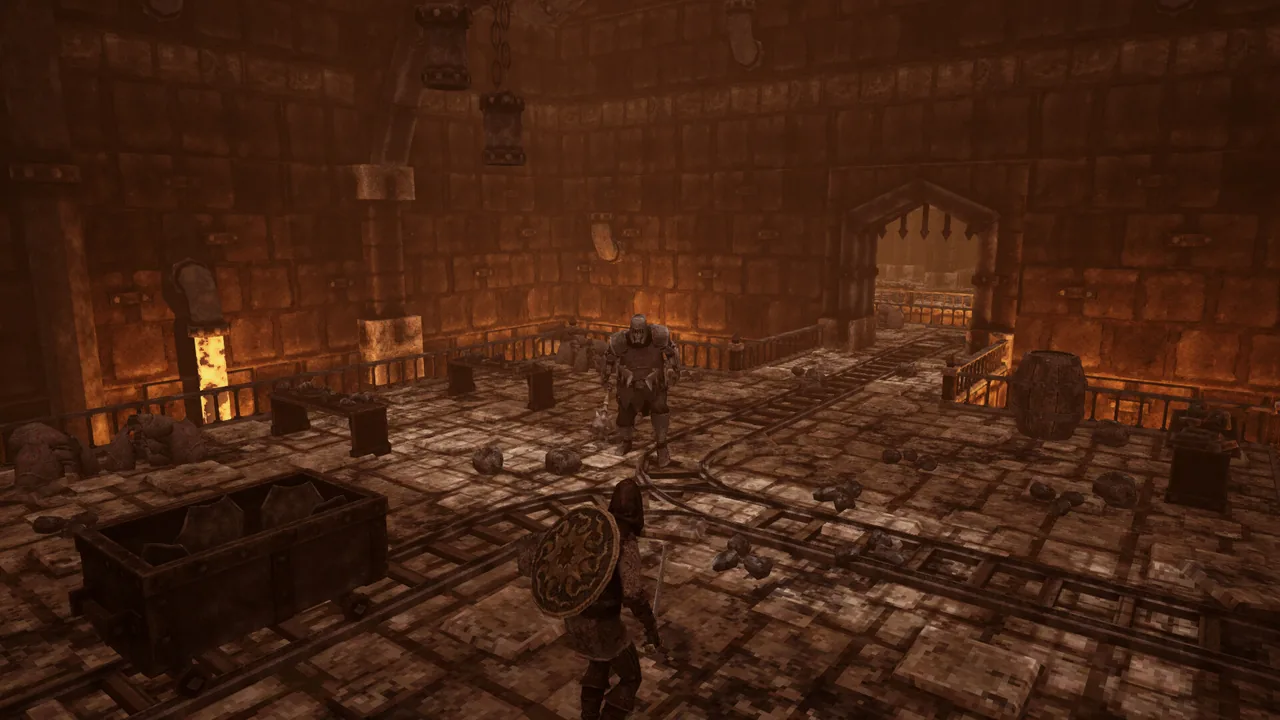
Enclosed foundry-style arenas like this one put the parry-focused combat's stamina management to the test against slow, heavy-hitting enemiesImage: Team Tyrant via Steam -
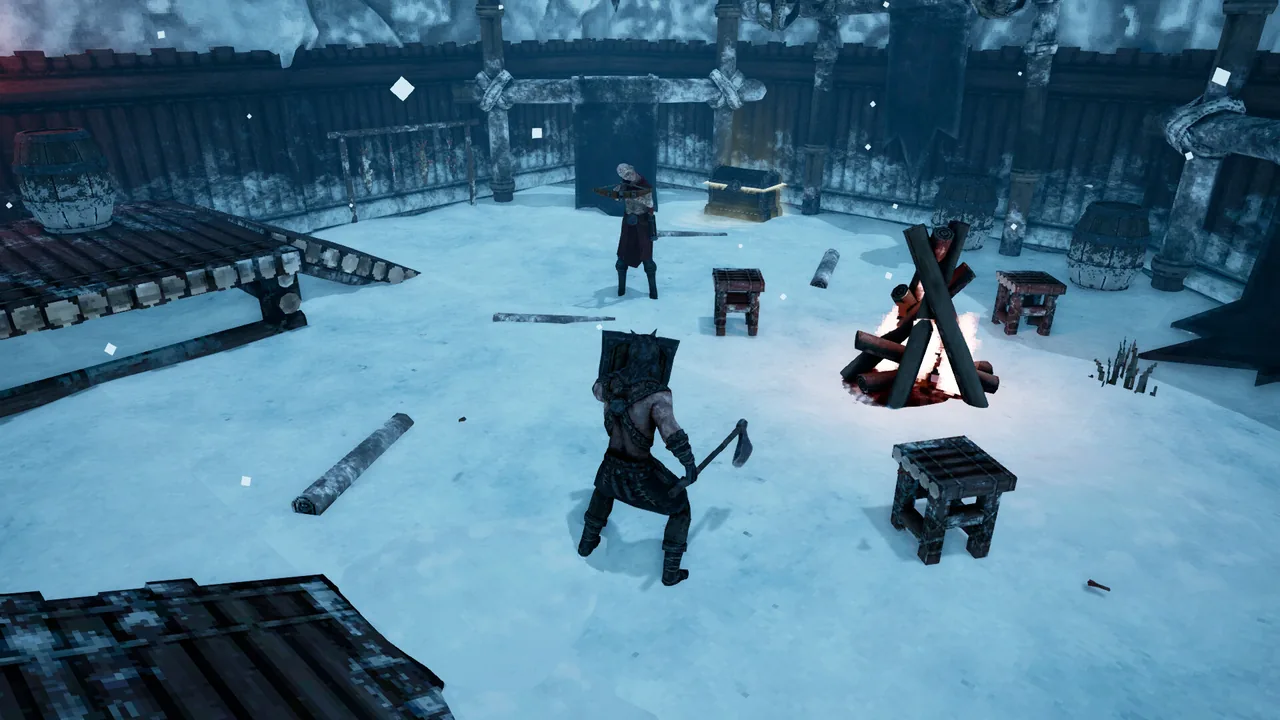
Snowbound encampments are one of several biome types that reviewers say keep the retro PS1-style presentation visually varied between runsImage: Team Tyrant via Steam -
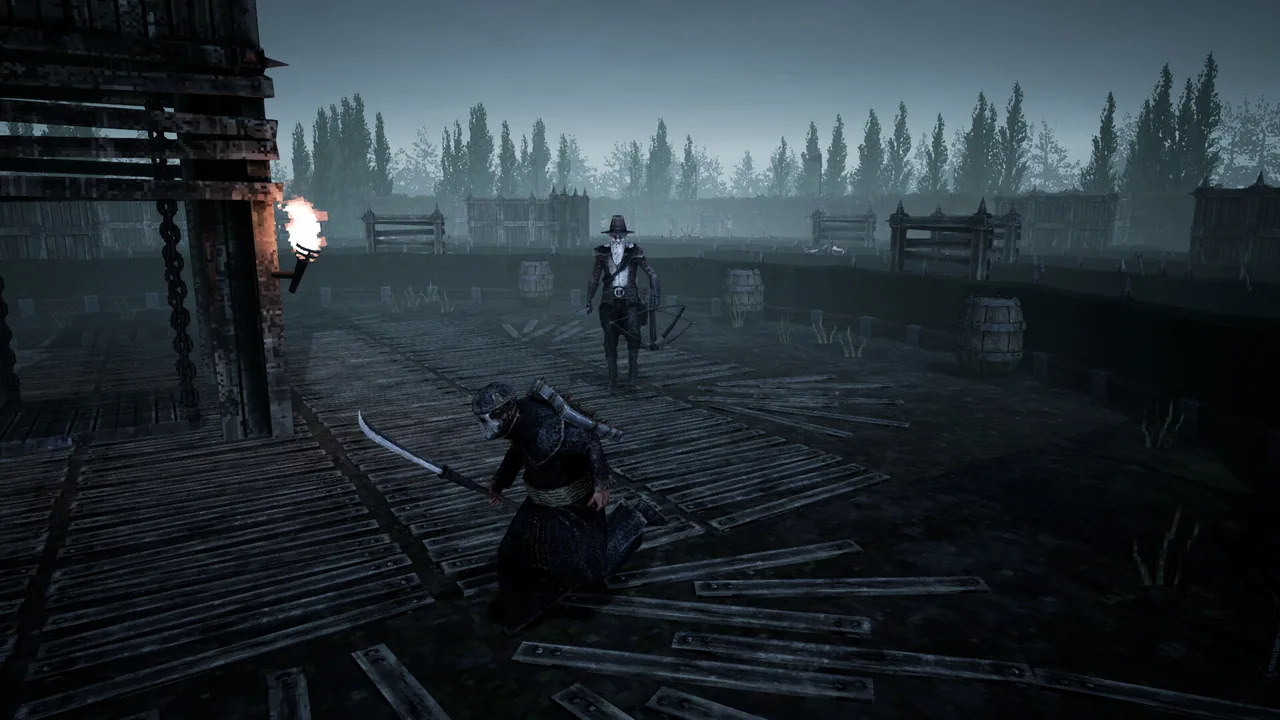
Distinctive boss silhouettes, like this crossbow-toting enforcer, are singled out by reviewers as some of the game's strongest creature and character designImage: Team Tyrant via Steam -
Wanderer Game ReviewsWanderer Game Reviews