
Game review
Pixel Chess Idle RPG
6.2 / 10
- Developer
- SHIFT.
- Publisher
- SHIFT.
The short version
Biggest strengths
- Genuinely novel hook: chess movement rules bolted onto RPG stat-scaling and idle automation, and the fusion mostly works
- Solo dev is unusually responsive, with a steady stream of devlogs addressing specific community complaints
- Rebirth loop gives the numbers-go-up crowd a real reason to keep restarting
Biggest weaknesses
- Opening 20-30 minutes is manual, repetitive piece-shuffling with no idle relief yet
- Pieces don't move like chess pieces once combat variants kick in, which will jar anyone drawn in by the chess framing
- Review pool is four people; there is no way to know if the early-game friction is a widely-shared complaint or a vocal minority
6.2 / 10
The Pitch
Chess is a fixed-sum game: thirty-two pieces, six unit types, no stats, no scaling, no second run. Pixel Chess Idle RPG takes that skeleton and grafts an idle RPG's numbers onto it. Pieces have HP bars. Captures deal damage instead of instantly removing a unit. Gold drops from every kill and every move. Between boards you spend that gold on army-wide upgrades — health, damage, gold generation — and once you hit level 16 you can Rebirth, torching your current run's progress for permanent multipliers that make the next run faster. It's Auto Chess's clothing draped over a Cookie Clicker skeleton, built and maintained by a single developer under the SHIFT. label.
The premise alone earns credit. Idle RPGs are a crowded, frequently derivative genre — reskin the loop, change the sprite theme, ship it — and chess-as-combat-engine is not a hook that shows up often. Whether the execution backs up that novelty is a separate question, and the answer here is uneven.
What Actually Happens On The Board
Movement still follows chess geometry: pawns advance, bishops slide diagonally, knights jump in an L. But once a piece reaches an occupied square, the encounter resolves as a stat comparison rather than an instant capture — HP versus damage, with splash and ranged variants layered on as pieces level up. Pawns get splash damage. Bishops attack from range. Knights double their own stats. It's a real design decision, not cosmetic flavor, and it changes how you read the board: a lone pawn that would be suicide in real chess can be a viable trade once its damage output outscales the opposing piece's remaining HP.
The friction shows up almost immediately in how long it takes the game to start explaining itself through mechanics instead of through you. For a meaningful stretch of the opening hour, there's no automation of any kind. You are manually shuffling a single piece back and forth between two squares, over and over, because that's the fastest way to farm the gold needed to afford the first tier of upgrades. One reviewer flagged this specifically as "painfully, cripplingly slow and boring" for the first 20-30 minutes, and that's not an unreasonable read of a system that gates its own automation tools — auto-play, passive income — behind enough of a grind that the person supposedly benefiting from "idle" progression has to do a lot of decidedly non-idle clicking to unlock it. An idle game that makes you wait 20-30 minutes before the idle part exists is asking a lot of patience up front, and it's the kind of design choice that will bounce a chunk of players before the loop actually opens up.
Once automation does unlock, the calculus shifts. Auto-play handles routine board-clearing so upgrades keep compounding while you're away, and the Rebirth system gives long-term structure: trade a run's progress for Rebirth Tokens, spend those on permanent multipliers to Gold, Damage, and speed, and the next run clears faster than the last. That's the standard incremental-game promise — each reset should feel meaningfully quicker than the one before — and by all indications the math here holds up once you're past the opening slog. A player who logged over 1,300 minutes called it "a fun game with lots of progression and a little bit of strategy," which reads like someone who pushed through the rough opening and found the mid-game loop worth the investment.
A Complaint That Cuts Both Ways
The other recurring complaint is structural rather than pacing-related: "doesn't obey the rules of chess movement... pawns attack forwards." That's true, and it's also intentional — the developer's own description states pawns "can also attack directly in front of them," a deliberate combat-variant rule layered on top of the base geometry, not a bug. But it points at a real tension in how this game presents itself. Calling it "Pixel Chess Idle RPG" and leaning on chess iconography (the pieces, the board, the checkmate-adjacent achievement names) sets an expectation of chess-accurate movement that the combat layer deliberately violates once units start leveling into their RPG specializations. Players drawn in by the chess framing and expecting chess rules will hit that mismatch and feel misled, even though the deviation is a considered mechanical choice rather than sloppiness. The game would be better served either leaning harder into "this is not chess, it just starts that way" messaging early on, or building an option to keep movement strictly chess-legal for players who want the purer version.
A Developer Worth Watching, A Sample Too Small To Trust
What's genuinely notable here isn't any single mechanic — it's the pace of post-launch support. The public devlog history shows a steady cadence of updates since the January launch: a full peer-to-peer multiplayer beta with a balanced base-stats ruleset and Blitz clock, a Daily Challenge mode with its own token economy, controller support with automatic input-method switching, a Ranked Mode with global leaderboards, and repeated rounds of UI and tooltip fixes that read like direct responses to specific bug reports rather than generic patch-note filler. For a solo developer, that's a genuinely active support cadence, and it's reasonable to expect the early-game pacing complaint gets addressed if it keeps surfacing.
The honest caveat is that "keeps surfacing" is hard to verify. The Steam review count sits at four — two positive, two negative — which is not a sample size that supports confident claims about how the broader player base feels. The negative reviews here happen to identify two specific, verifiable, non-contradictory issues (the slow opening, the chess-rule deviation), which gives them more weight than a typical one-line troll review would carry, but four data points is four data points. This is a case where the review has to be read as an assessment of what the game currently does, not a summary of consensus opinion, because there isn't yet a large enough audience to have one.
Where The Idle RPG Identity Actually Lands
Strip away the chess dressing and the underlying loop is a fairly conventional idle RPG: earn currency, spend it on incremental stat upgrades, hit a soft wall, reset for permanent multipliers, repeat faster. That structure is well-worn and, on its own, unremarkable. What elevates it above genre-average is that the currency-earning activity — actually playing out chess-shaped tactical encounters — has more decision density than the typical idle game's "click the thing" loop, at least in the stretches where you're not simply watching auto-play run. Positioning pieces to set up splash-damage chains, choosing which unit to level toward a ranged or double-stat build, deciding when a trade is favorable given current HP totals — none of that is deep strategy, but it's meaningfully more engaged than most of what passes for "gameplay" in the incremental genre, where clicking a number until it's bigger is often the entire interactive layer.
The multiplayer mode deserves a specific callout for the same reason: a peer-to-peer ranked ladder with a deliberately balanced, upgrade-free ruleset is an unusual thing to find bolted onto an idle game, and it suggests the developer sees the tactical chess-combat engine as something worth testing on its own merits, stripped of the numbers-go-up scaffolding. That's a vote of confidence in the core system that the single-player idle loop, by design, obscures under layers of stat inflation.
Verdict
Pixel Chess Idle RPG is a legitimately original hybrid held back by a rough on-ramp and a review pool too thin to confirm whether that on-ramp is a dealbreaker for most players or a manageable early hurdle. The chess-combat engine is the strongest part of the package — inventive, more strategically engaged than the genre norm, and clearly the thing the developer is most invested in improving, given how much of the devlog history is multiplayer- and combat-focused. The idle/incremental half of the pitch is serviceable but arrives later than it should, gated behind a manual grind that risks losing exactly the players who came for "idle" in the title. Worth a look for anyone who wants a genuinely different take on the incremental formula and is willing to push through a slow first half hour to get there; everyone else should wait for a few more rounds of the developer's evident willingness to iterate, and for a review pool large enough to say with confidence whether the early friction gets smoothed out.
Pros and cons
Pros
- Genuinely novel hook: chess movement rules bolted onto RPG stat-scaling and idle automation, and the fusion mostly works
- Solo dev is unusually responsive, with a steady stream of devlogs addressing specific community complaints
- Rebirth loop gives the numbers-go-up crowd a real reason to keep restarting
- Peer-to-peer multiplayer with a balanced base-stats ruleset is a legitimate extra mode, not a token bullet point
Cons
- Opening 20-30 minutes is manual, repetitive piece-shuffling with no idle relief yet
- Pieces don't move like chess pieces once combat variants kick in, which will jar anyone drawn in by the chess framing
- Review pool is four people; there is no way to know if the early-game friction is a widely-shared complaint or a vocal minority
- Automation systems (auto-play, passive income) unlock late enough that the idle half of the pitch takes a while to actually show up
Screenshots
-
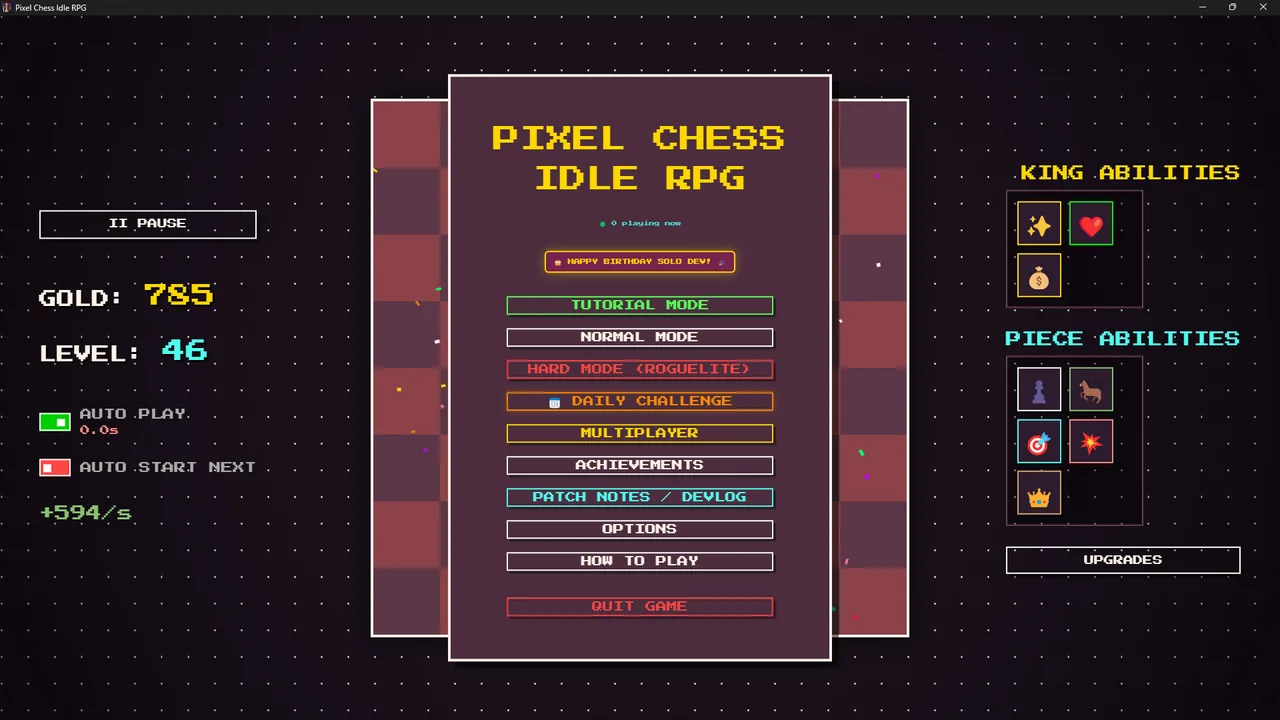
Tutorial, Normal, Hard (Roguelite), Daily Challenge and Multiplayer modes are all selectable from the main menu.Image: SHIFT. via Steam -
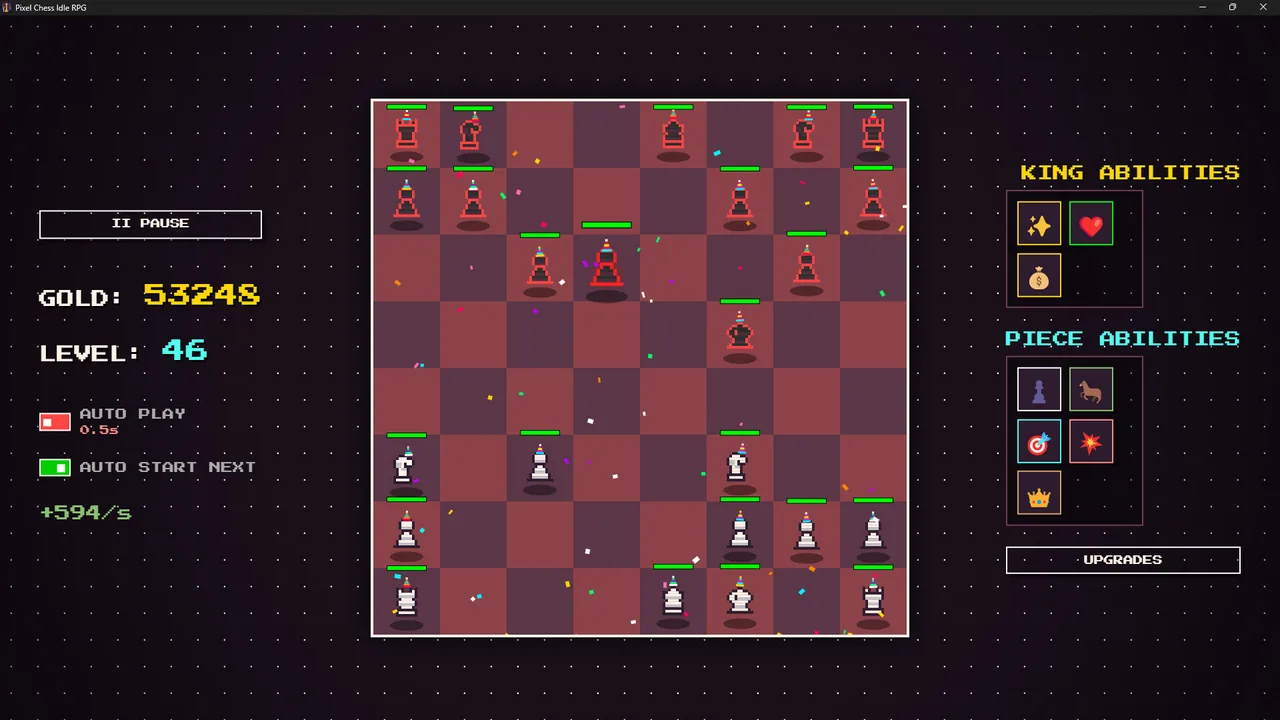
A late-run board state — auto-play has thinned the opposing army down to a handful of damaged pieces.Image: SHIFT. via Steam -
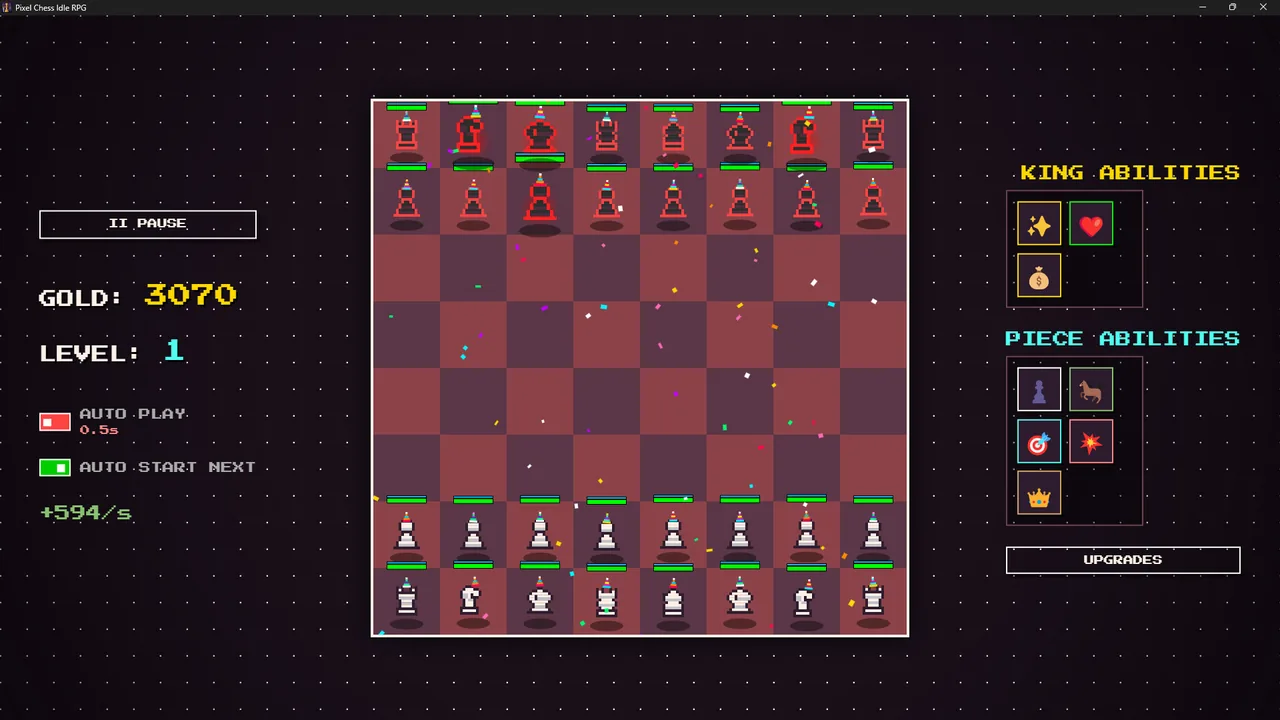
A fresh board after a Rebirth reset — full ranks on both sides, level back down to 1.Image: SHIFT. via Steam -
Developer, release date and platform details at a glance.Wanderer