
Game review
OurLife
5.4 / 10
- Developer
- WaveyGaming Productions
- Publisher
- WaveyGaming Productions
The short version
Biggest strengths
- An enormous breadth of life-path systems — careers, crime, royalty, occult bloodlines, pets, immigration — well beyond what BitLife-style competitors offer
- Consistently praised as excellent value for a low asking price, with dev support and regular updates cited approvingly
- The developer is described as responsive to bug reports and community feedback
Biggest weaknesses
- UI bugs are common and sometimes severe: broken window scaling, buttons pushed off-screen, and a windowed-mode default awkward on smaller screens
- NPCs have essentially no personality beyond a name and label, making relationship interactions feel mechanical rather than meaningful
- Stats and life outcomes escalate with little challenge or trade-off, letting characters become effortlessly rich, famous, and skilled at everything
5.4 / 10
The Pitch
OurLife is a text-forward life simulator in the BitLife mold: you create a character, then click through years of their life making choices about careers, relationships, health, crime, and increasingly outlandish detours into vampirism, royal succession, or international drug smuggling. Where BitLife charges for its deeper systems piecemeal through in-app purchases, OurLife's pitch is that nearly all of it — active careers, business empires, a full criminal justice pipeline from crime to parole, occult bloodlines with combat RPG elements, pet ownership and breeding, even royal court management — comes bundled at a single low price, with the developer framing the whole thing as a more generous, less predatory alternative to the mobile life-sim genre it's clearly responding to.
The scope on paper is genuinely enormous, and Steam's "Mostly Positive" rating (30 of 38 English reviews positive) reflects real enthusiasm for that ambition. But it's also a young, actively-developing Early Access game, and the review section reads exactly like you'd expect from a game trying to do this much this early: excited about what's there, frustrated by what still needs fixing.
An Almost Absurd Amount of Content for the Price
The single most consistent praise across positive reviews is sheer scope relative to price. At roughly NZ$7.89, reviewers repeatedly frame OurLife as embarrassing competitors that charge real money for individual life-sim features — one reviewer calls it "a great substitute" while waiting for a more hyped competing title, another says it has "a lot of BitLife's features, including its paid content, and more for way less." The feature list backs that up: standard and active career tracks, business and real-estate empires, a criminal skills tree with heat and reputation mechanics, supernatural bloodlines (vampires, werewolves, witches, fae) with their own combat systems, a phone hub with social media and dating apps, and international travel with its own smuggling routes and immigration mechanics.
That breadth produces genuinely memorable emergent stories — one reviewer's highlight run has their character become an international fraudster by sixteen, flee the country wealthy, and get fatally stabbed in prison over an orange juice years later during a return visit. Multiple long-session players (one logging over 8,000 minutes, another nearly 13,000) describe exactly the "just one more turn" compulsion the genre is built around, and several specifically credit the developer's visible responsiveness to bug reports and community requests as a reason for optimism about where the game is headed.
The Seams Show Everywhere You Look
The praise comes with an almost equally consistent list of complaints, and they cluster around two related problems: unfinished polish and shallow depth beneath the breadth. On the polish side, UI bugs are reported constantly and sometimes severely — one reviewer describes screen-scaling settings actively breaking the interface in the opposite direction expected, pushing buttons off the visible window entirely and, in their case, blocking the ability to even start a first game. Others report inconsistent panel widths, poor font readability, and lag when switching menu options. One reviewer flatly states the game "cannot play in a full windowed screen."
On the depth side, the core relationship system draws pointed criticism for having essentially no personality behind its NPCs — interacting with a potential partner produces generic, interchangeable flavor text ("you flirted, they were receptive!") regardless of who the character actually is, leading one reviewer to sarcastically note it "absolutely tugs at the heartstrings." Difficulty and challenge are largely absent too: several reviewers note that stats climb with little resistance, letting a character become simultaneously rich, famous, and expert at everything with no real trade-offs to manage. One especially candid review — originally negative, later revised upward following updates — puts the core tension plainly: "there's a reason feature-bloat is a problem," arguing the game's own ambition to cover every possible life path is working against the depth any single system would need to feel substantial.
A Broad Feature List With Uneven Follow-Through
Beyond the headline UI and NPC-depth complaints, several reviewers point to smaller cracks that reveal how thinly some of that huge feature list has been implemented so far. One reviewer flags that character customization options are noticeably more limited for certain groups than others — specifically calling out restricted skin and eye color ranges for Black and Asian character presets — and pointedly notes "we are not monolithic," a fair critique for a game whose entire pitch rests on letting players build any life they want. Another reviewer, deep into the game's more ambitious systems, reports that the political career track is currently broken, even as they praise the social-media and business-empire paths as functional alternatives. A modding-support request comes up as well, from a player who otherwise rates the game as a clear step up from mobile competitors.
None of these individually would sink the game, but together they paint a consistent picture: OurLife's team has clearly prioritized breadth-first development, standing up the skeleton of dozens of systems before fully fleshing out any single one. That's a defensible Early Access strategy — several reviewers explicitly frame their current rating as provisional, promising to revisit as specific systems mature — but it does mean a buyer today is paying for the promise of a life simulator as much as the finished product sitting in front of them right now.
Verdict
OurLife is an ambitious, generously-priced life simulator that's already doing more, on paper, than most of its BitLife-style competitors — and its Mostly Positive reception is a fair reflection of how much goodwill that ambition has earned it this early in development. But the reviews converge on a real, structural tension rather than simple launch jank: the game's breadth of career paths, occult systems, and criminal enterprises hasn't yet been matched by the depth or polish any one of those systems needs to feel meaningful, and UI bugs are frequent enough to actively block play for some buyers. Worth picking up at its low price if you're drawn to the genre and want to support an actively-updated Early Access project with a responsive developer — go in expecting a broad, occasionally buggy sketch of a much bigger game rather than a finished one.
Pros and cons
Pros
- An enormous breadth of life-path systems — careers, crime, royalty, occult bloodlines, pets, immigration — well beyond what BitLife-style competitors offer
- Consistently praised as excellent value for a low asking price, with dev support and regular updates cited approvingly
- The developer is described as responsive to bug reports and community feedback
- Some individual runs (a fraudster-turned-prison-stabbing-victim story is one reviewer's highlight) produce genuinely funny, memorable outcomes
Cons
- UI bugs are common and sometimes severe: broken window scaling, buttons pushed off-screen, and a windowed-mode default awkward on smaller screens
- NPCs have essentially no personality beyond a name and label, making relationship interactions feel mechanical rather than meaningful
- Stats and life outcomes escalate with little challenge or trade-off, letting characters become effortlessly rich, famous, and skilled at everything
- Breadth has come at the cost of depth — several reviewers explicitly flag feature bloat as undermining systems that could otherwise be substantial
Screenshots
-
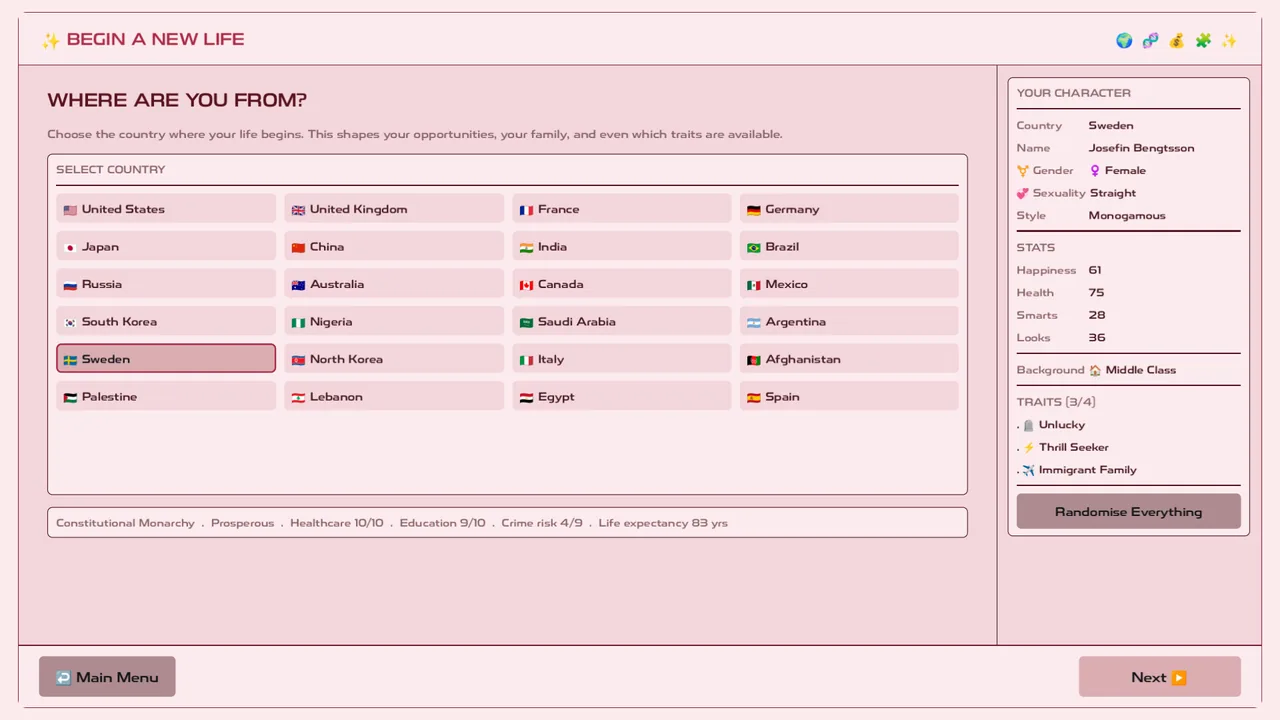
Character creation — choosing a starting country shapes opportunities, traits, and starting statsImage: WaveyGaming Productions via Steam -
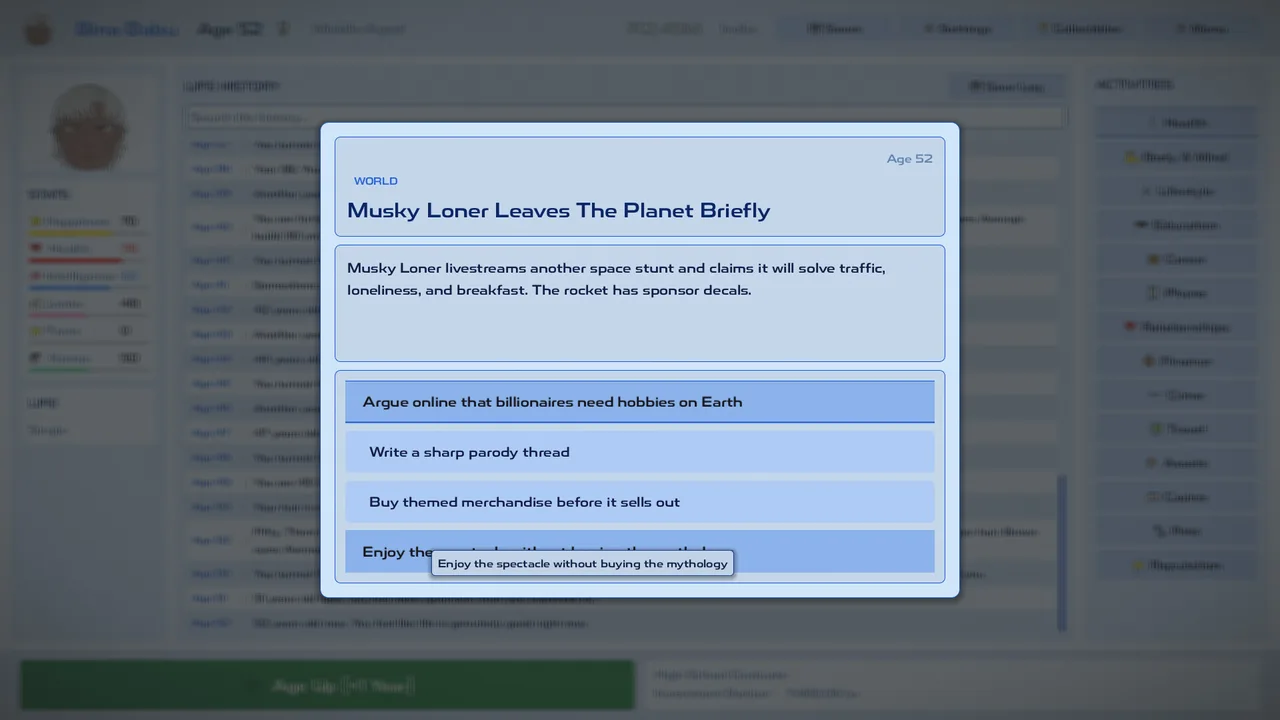
One of the game's satirical world events, with several tonal responses to choose fromImage: WaveyGaming Productions via Steam -
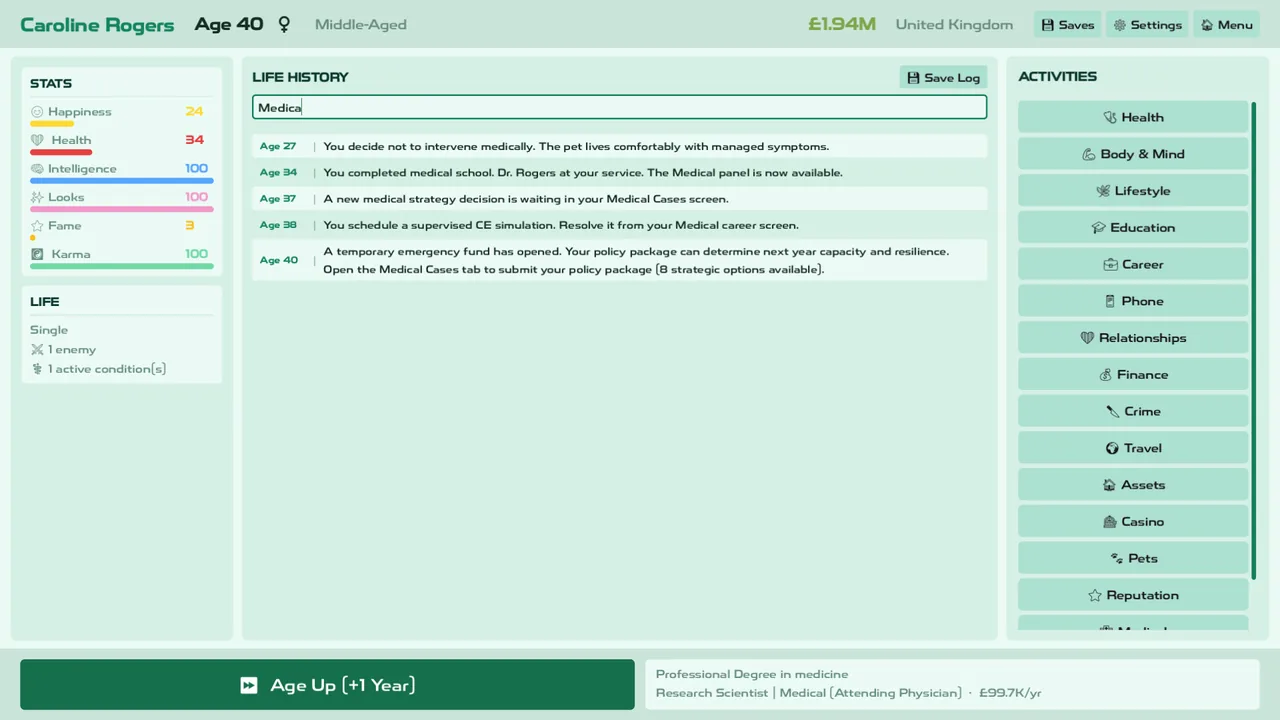
The main life screen — stats, life history log, and the full menu of career, crime, and lifestyle activitiesImage: WaveyGaming Productions via Steam -

Category scores for OurLifeWanderer Game Reviews