Game review
MARINE.EXE - Desktop RPG
6.3 / 10
- Developer
- Exopoint Initiative
- Publisher
- Exopoint Initiative
The short version
Biggest strengths
- A sci-fi desktop-overlay AFK RPG in a genre otherwise dominated by fantasy reskins — reviewers explicitly credit it for that
- Genuine class/subclass depth (6 classes into 16 subclasses) that rewards building deliberately silly squad compositions, not just optimal ones
- Sustained post-launch content cadence: a new party-wide Protocols system, a windowed mode, new bosses and a beginner guide all shipped within months of launch
Biggest weaknesses
- At least one reviewer reports the game crashing specifically when opening the inventory, with no apparent workaround
- The review pool is tiny — four reviews total — so any read on stability or long-term balance is necessarily provisional
- Basic, low-budget visuals that several players say you have to look past to get to the systems underneath
6.3 / 10
The Pitch
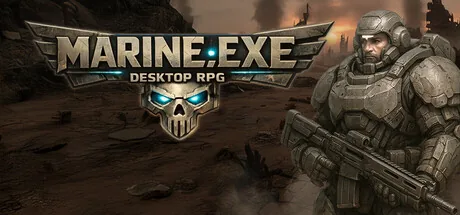
MARINE.EXE takes the increasingly crowded desktop-overlay AFK genre and does the one thing almost none of its competitors bother with: it isn't fantasy. Instead of another wizard or knight wandering a pixel-art town, you're commanding a squad of up to four marines fighting alien hordes directly on top of your desktop while you work, browse, or play something else entirely. It's a small, specific choice, but it matters — several reviewers call it out unprompted as a relief from "yet another fantasy genre version like all the others," and that alone gives it a distinct identity in a subgenre that's otherwise struggling to differentiate itself.
Underneath the sci-fi coat of paint is a genuinely dense RPG: six classes branching into sixteen subclasses, ten rarity tiers of loot running from common whites up to "god-tier Omega" gear, a crafting and high-stakes enchanting system, and a prestige layer that banks permanent account-wide bonuses across runs. That's a lot of system for a genre that could easily get away with a single stat bar and a number that goes up. Exopoint Initiative, the small team behind it, has also kept shipping since the May launch — a Protocols update added party-wide passive modules, a later patch added windowed mode and a new boss, and there's a published beginner guide walking new commanders through early-run decisions. For a four-review indie release, that's an unusually active cadence.
What The Deep End Actually Rewards
The class-and-subclass system is where the reviews get specific and enthusiastic rather than generically positive. One reviewer, sitting at over 13,000 minutes (roughly 217 hours) played, singles out the game for supporting deliberately non-optimal "gimmick teams" as a real, sanctioned playstyle rather than a curiosity — full squads of heavy gunners or flame troopers that never move but fill the screen with ordnance "like it's a bullet hell," or snipers built to delete enemies before they finish spawning. That's a meaningfully different kind of praise than "the numbers go up nicely": it's evidence the underlying systems are flexible enough to support genuinely different playstyles rather than funneling everyone toward one correct build.
A second long-session reviewer, at over 23,000 minutes (roughly 384 hours), frames the appeal in almost nostalgic terms — comparing the whole package to "a freeware game that would have come on a 2003 PC gamer demo disc," praising the near-total absence of handholding once you commit to Elite mode, and predicting a genuine thousand-plus-hour ceiling. Between these two accounts, the throughline is consistent: this is a game whose systems reward the kind of long-haul, build-obsessive player the AFK genre nominally targets but doesn't always actually deliver for.
The Elite Mode Trap, And A Real Stability Report
That same praise comes with an honest caveat worth taking seriously for anyone starting fresh. Standard and Elite modes are chosen once, at party creation, and the choice locks permanently for that party's entire life — there's real difficulty and pacing daylight between the two, and a beginner guide existing specifically to walk new players through this decision is itself a tell that Exopoint knows the default choice architecture isn't self-explanatory. A player who commits to Elite blind, expecting Standard's pacing, is signing up for a much longer, harder road than they bargained for with no easy way back.
More concerning is a direct stability report: one reviewer, admittedly at only 49 minutes played, says the game "crashes when i open my inventory" and otherwise dismisses it as "cool for 5 minutes." That's a single data point against two reviewers with hundreds of hours reporting no such issue, which suggests either a since-patched bug, a configuration-specific problem, or an early-build crash that a newer player happened to hit before the fix landed — the patch notes do include a general "mission bug fixed" entry, though nothing explicitly naming an inventory crash. With only four total reviews to work from, there simply isn't enough volume to confidently rule the crash in or out as a systemic problem rather than an edge case, and that thinness is itself worth flagging rather than papering over with confident language the evidence doesn't support.
Basic Visuals, And Whether That Matters Here
It's also worth being upfront about what MARINE.EXE isn't: it's not a visually ambitious game. The sprite work is functional rather than impressive, animations are minimal, and the "combat zone overlaid on your desktop" pitch is more about the concept than any real visual spectacle — you're mostly watching small figures trade hits in a corner of your screen while you do something else. The reviewer who invokes the "2003 demo disc" comparison means it partly as praise for the nostalgic, no-frills presentation, but they're also explicit that you have to "get past the basic visuals" to find the actual gem underneath. That's a fair trade for players who came up on exactly that era of PC shareware and value mechanical depth over production values, and a much harder sell for anyone expecting the current desktop-idler field's more polished pixel-art entries. Given the genre is currently thick with fantasy-themed competitors putting real budget into character art and animation, MARINE.EXE is competing on system depth and originality of setting rather than on presentation — a viable strategy, but one that narrows its audience to players who specifically prioritise the former.
Value-wise, the NZ$11.25 asking price sits above some of its desktop-idler peers, and with only four reviews to draw from, there's no meaningful consensus yet on whether the content justifies that premium over the long run. What the available evidence does support is that the two reviewers who've put serious time in — well into the hundreds of hours each — regard the price as fully justified by the depth of the build-crafting alone, treating the ten rarity tiers and prestige-driven account progression as a long game rather than a short one. Whether that holds for a player starting today, four months and several patches after launch, is a reasonable question the current review pool simply isn't large enough to answer with confidence.
Verdict
MARINE.EXE earns its distinct identity honestly — a sci-fi AFK RPG with real class-building depth, a developer who's kept adding substantial systems rather than resting on launch, and enough mechanical range to support both min-maxed and deliberately absurd squad compositions. The catch is a review pool too small to fully trust on stability, a genuinely reported inventory-crash complaint that nobody has confirmed fixed, and a permanent mode-lock decision that new players will make with too little information. Worth a look specifically for players tired of the genre's fantasy sameness and willing to tolerate basic visuals for real systemic depth underneath — go in expecting Standard mode until you've actually played it, and keep an eye on the patch notes before committing serious hours.
Pros and cons
Pros
- A sci-fi desktop-overlay AFK RPG in a genre otherwise dominated by fantasy reskins — reviewers explicitly credit it for that
- Genuine class/subclass depth (6 classes into 16 subclasses) that rewards building deliberately silly squad compositions, not just optimal ones
- Sustained post-launch content cadence: a new party-wide Protocols system, a windowed mode, new bosses and a beginner guide all shipped within months of launch
- High-playtime reviewers (hundreds of hours logged) describe it as the rare AFK game that can genuinely absorb thousands of hours
Cons
- At least one reviewer reports the game crashing specifically when opening the inventory, with no apparent workaround
- The review pool is tiny — four reviews total — so any read on stability or long-term balance is necessarily provisional
- Basic, low-budget visuals that several players say you have to look past to get to the systems underneath
- Locking Standard vs. Elite mode permanently at party creation is a steep, unexplained commitment for new players discovering the game blind
Screenshots
-
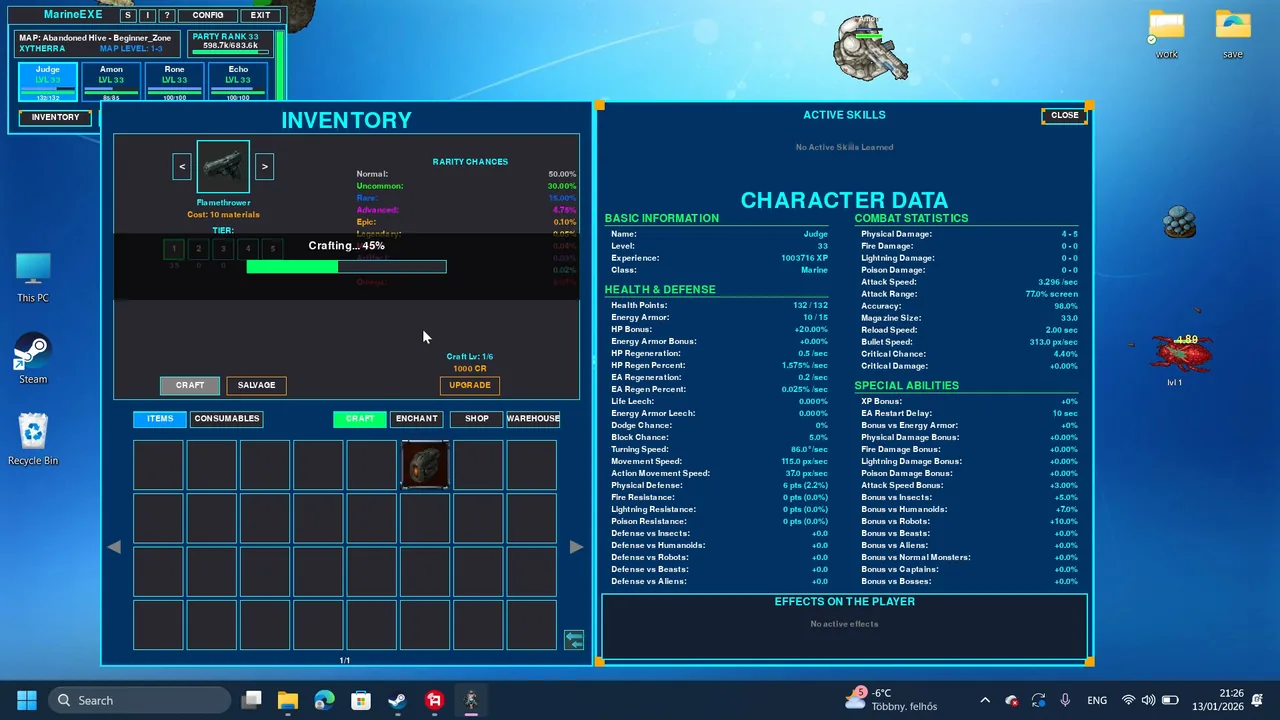
The inventory and character-data panels, where most of the class and loot-tier depth actually lives.Image: Exopoint Initiative via Steam -
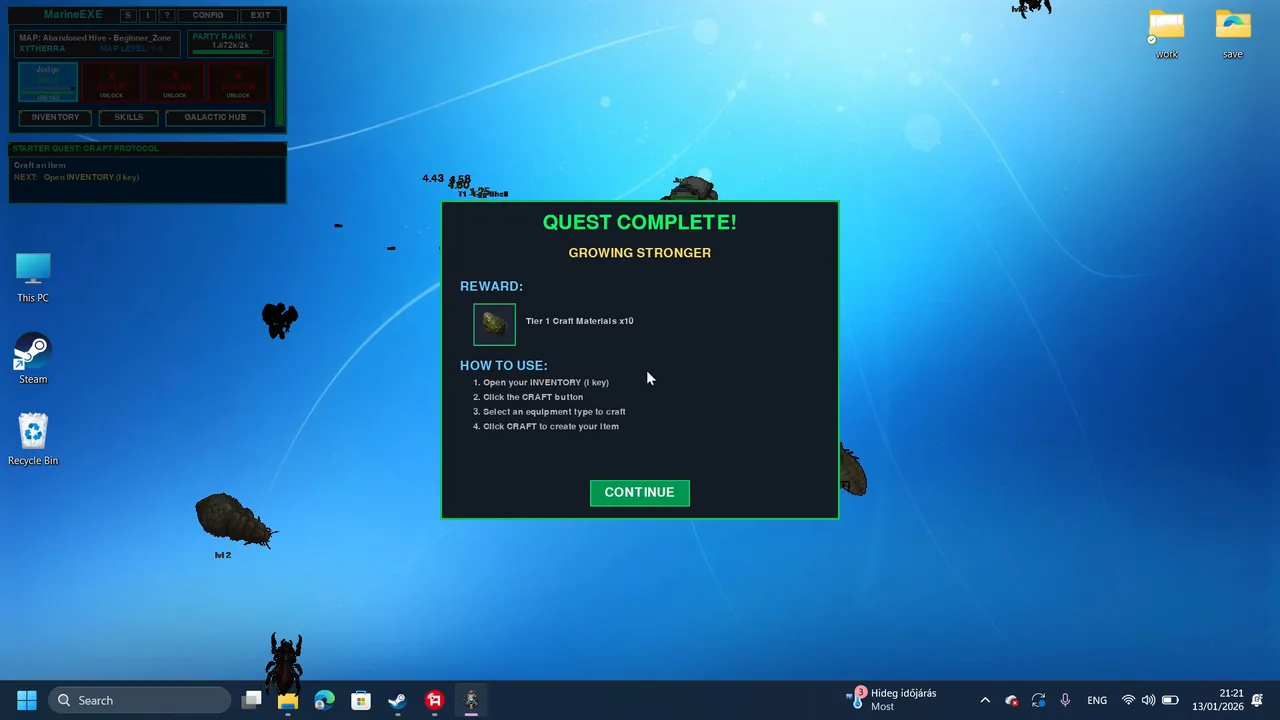
Early questing walks new commanders through crafting, overlaid directly on the desktop rather than a separate window.Image: Exopoint Initiative via Steam -
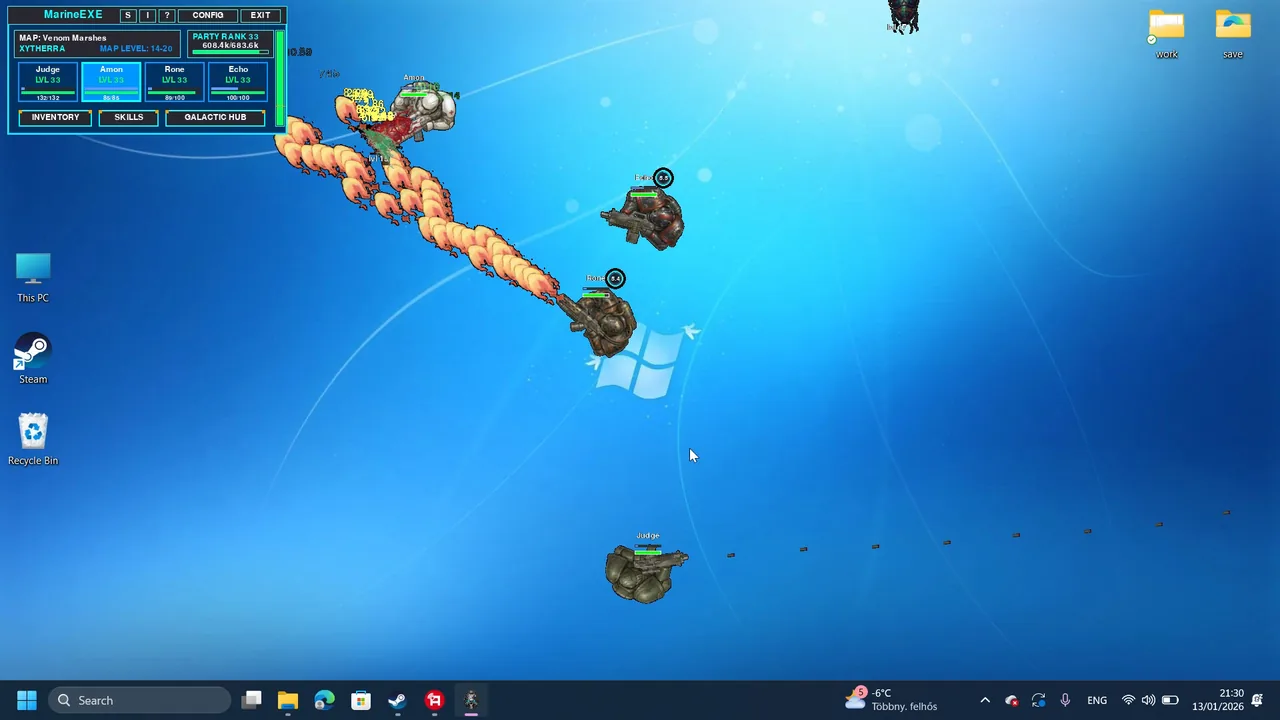
The core pitch in action: marines and monsters fighting in the open desktop space around your icons and taskbar.Image: Exopoint Initiative via Steam -
Developer, release date and platform details at a glance.Wanderer