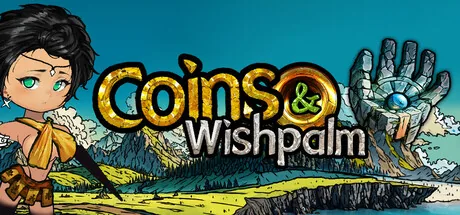
Game review
Coins & Wishpalm
6.1 / 10
- Developer
- Moshow Games
- Publisher
- Moshow Games
The short version
Biggest strengths
- Reviewers repeatedly describe the interlocking web of trading, gambling, tactical board games, card games, and auctions as addictive and unusually rich for a solo-developer indie RPG
- The Chinese-style art direction and 'wandering hero' premise, where honors and items carry over between short, dangerous lives, draws specific praise for feeling fresh compared to more familiar roguelite templates
- Several reviewers compare the open-ended, sandbox-driven exploration favorably to Don't Starve, praising the freedom to build a playstyle around leisure activities rather than combat
Biggest weaknesses
- The tutorial and onboarding are widely criticized as confusing, with reviewers reporting they got stuck or lost immediately after finishing the introductory guidance
- Menu layout and interface readability draw consistent complaints, with reviewers describing clicking through options without understanding what they do
- Translation is incomplete in places, with some names and text still appearing in Chinese, which reviewers say makes tracking specific mechanics like bounties needlessly difficult
6.1 / 10
Overview
Coins & Wishpalm is a solo-developer RPG from Moshow Games that reframes the roguelite formula around leisure rather than combat: players take on the role of a hero with a limited lifespan who fights, hunts treasure, and gathers resources in the wild, then returns to town to spend their gains on trading, tactical board games, card games, auctions, and gambling. It released on Steam on January 9, 2025, priced around NZ$20, and holds a Positive standing across 31 reviews.
The review pool is small but consistent in its shape: reviewers who push through a genuinely rough onboarding experience describe an unusually rich, addictive web of interlocking systems, while a smaller but vocal group bounces off the confusing UI, missing translations, and technical rough edges before ever reaching that payoff.
Story and Setting
The framing is intentionally light: players inhabit a hero whose life is finite, and whose accumulated honors and items pass on to their next life when that one ends, an explicit reincarnation loop that reviewers describe as more of a structural conceit than a driving narrative. The world itself draws consistent praise for its distinct Chinese-inspired visual and thematic identity, with reviewers describing an art style and worldbuilding they found genuinely novel compared to the mostly Western fantasy tropes common in the genre.
Beyond that atmospheric foundation, reviewers don't describe much in the way of a traditional plot, and that appears to be by design; the appeal here is in the systems and setting rather than a scripted story. A few reviewers do note that the game rewards curiosity about its world, with lore and context delivered through item descriptions and environmental detail rather than dedicated cutscenes or dialogue trees.
One reviewer draws a direct comparison to Don't Starve, framing the setting less as a story to follow and more as a sandbox premise to poke at, and says that comparison alone should tell interested players whether the tone will land for them. Another specifically calls out the "wandering hero" framing as a fresh justification for permadeath-adjacent mechanics, since losing a life feels like part of the game's central conceit rather than a punishment layered on top of it.
Gameplay and Mechanics
The core loop alternates between randomly generated wilderness excursions, gathering resources and fighting monsters, and town-based "leisure gameplay" where players trade, gamble, and play a variety of minigames including tactical board games and card games. Reviewers who stick with it describe this as an intricate and quirky web of systems that rewards experimentation, with one calling it "utterly addicting" despite, or perhaps because of, its slow and deliberate pacing.
The barrier to that payoff is real, though. Multiple reviewers describe the onboarding as confusing to the point of actively discouraging, with one reporting they got randomly soft-locked in an in-game prison for what would take thousands of in-game days to escape, with no way to skip the wait. Others note that the UI and menu layout make it hard to understand what any given option actually does without extensive trial and error, a friction point that several reviewers say is the single biggest thing standing between the game and a much stronger reception.
Progression and Replayability
The life-to-life structure, where honors and items persist across a hero's successive short lifespans, gives the game an unusual rhythm: reviewers describe building toward long-term goals across multiple in-game "lives" rather than a single continuous playthrough, with randomized maps and encounters keeping individual runs from feeling repetitive. Several reviewers specifically praise the breadth of viable playstyles this enables, saying they were able to build an entire session around trading and gambling with minimal combat if they chose to.
Not every reviewer finds this rewarding in practice, however. At least one describes losing saved progress entirely on restart despite exiting through the game's own save-and-exit option, a bug serious enough to draw an explicit recommendation against buying until it's fixed. Others simply found the sheer number of interlocking systems overwhelming without better guidance, suggesting the game's greatest strength, its systemic depth, is also its biggest obstacle for less patient players. One long-term player specifically laments a lack of recent updates, noting they hadn't seen developer activity in months despite feeling genuinely invested in the game's interlocking systems, a concern echoed by a couple of other reviewers hoping for continued support rather than an abandoned early launch.
Visual Style and Sound Design
Art direction draws mixed but generally positive comment, with several reviewers praising the distinctly Chinese aesthetic and calling the overall presentation magical or immersive, though at least one reviewer speculates that some of the sprite work may be AI-generated and criticizes the resulting jagged, oversized look of certain sprites at in-game scale. Reviewers don't discuss the soundtrack in much detail, suggesting it neither stands out as a strength nor draws particular complaint.
Technical performance is a more consistent sticking point. Reviewers report stuttering and frame pacing issues tied to unlimited vsync settings, with one noting the game became playable only after manually capping the frame rate. Combined with the incomplete translation, where some item and character names remain untranslated and make certain systems like bounty tracking harder to parse, the overall technical presentation reads as unpolished in ways that compound the game's already steep learning curve.
Verdict
Coins & Wishpalm is a genuinely unusual, systems-dense RPG that reviewers who push past its rough edges describe as deeply rewarding, built around a leisure-focused premise that few other games in the genre attempt. Its confusing onboarding, inconsistent translation, and reports of technical bugs including lost save progress are real enough obstacles that plenty of reviewers bounce off before ever reaching the good part. For players with the patience to learn its systems largely through trial and error, there's a genuinely inventive and addictive game here, but casual buyers looking for a smooth first hour should go in with tempered expectations.
Pros and cons
Pros
- Reviewers repeatedly describe the interlocking web of trading, gambling, tactical board games, card games, and auctions as addictive and unusually rich for a solo-developer indie RPG
- The Chinese-style art direction and 'wandering hero' premise, where honors and items carry over between short, dangerous lives, draws specific praise for feeling fresh compared to more familiar roguelite templates
- Several reviewers compare the open-ended, sandbox-driven exploration favorably to Don't Starve, praising the freedom to build a playstyle around leisure activities rather than combat
- Reviewers who push past the steep learning curve describe long, satisfying play sessions, with some calling it worth returning to across many afternoons
Cons
- The tutorial and onboarding are widely criticized as confusing, with reviewers reporting they got stuck or lost immediately after finishing the introductory guidance
- Menu layout and interface readability draw consistent complaints, with reviewers describing clicking through options without understanding what they do
- Translation is incomplete in places, with some names and text still appearing in Chinese, which reviewers say makes tracking specific mechanics like bounties needlessly difficult
- Technical issues including stuttering tied to vsync settings and at least one report of save progress not persisting between sessions frustrate reviewers enough to actively discourage others from buying
Screenshots
-
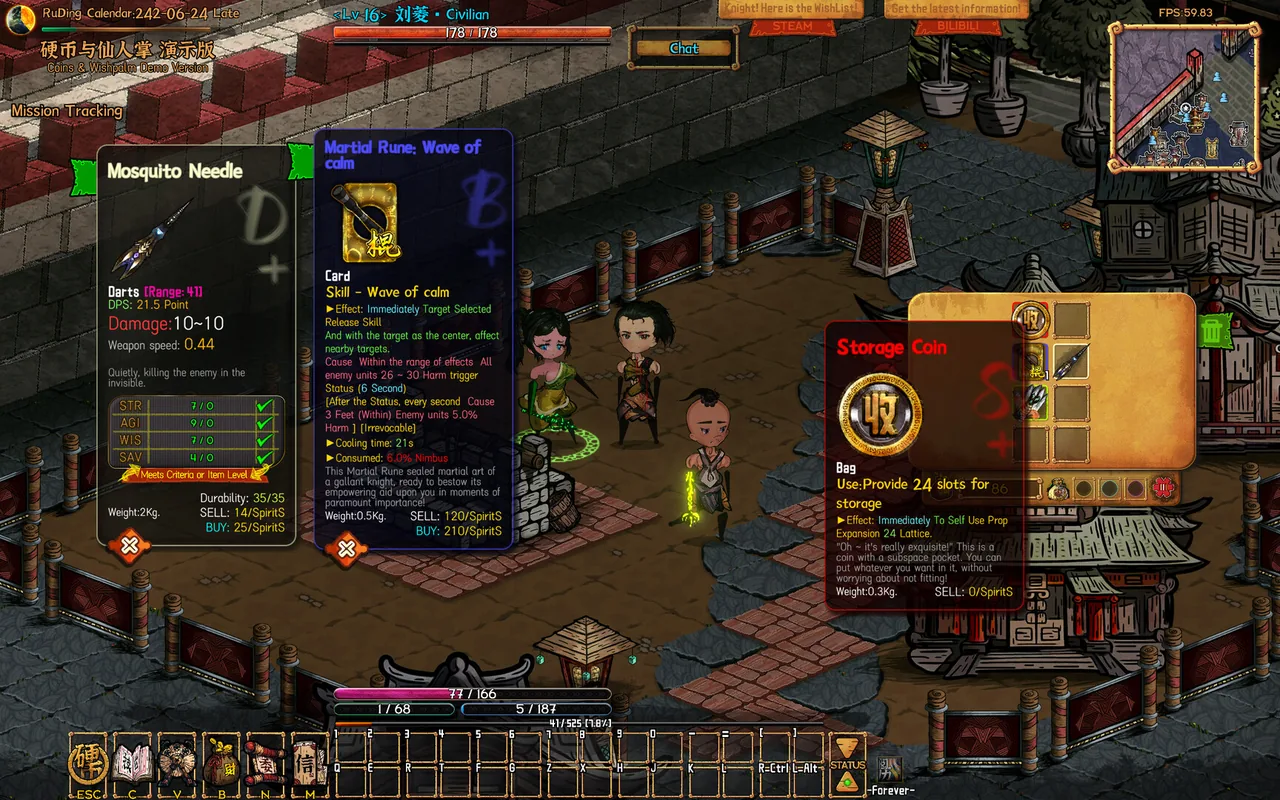
Inspecting a weapon and skill card in one of the game's dense item-detail panelsImage: Moshow Games via Steam -
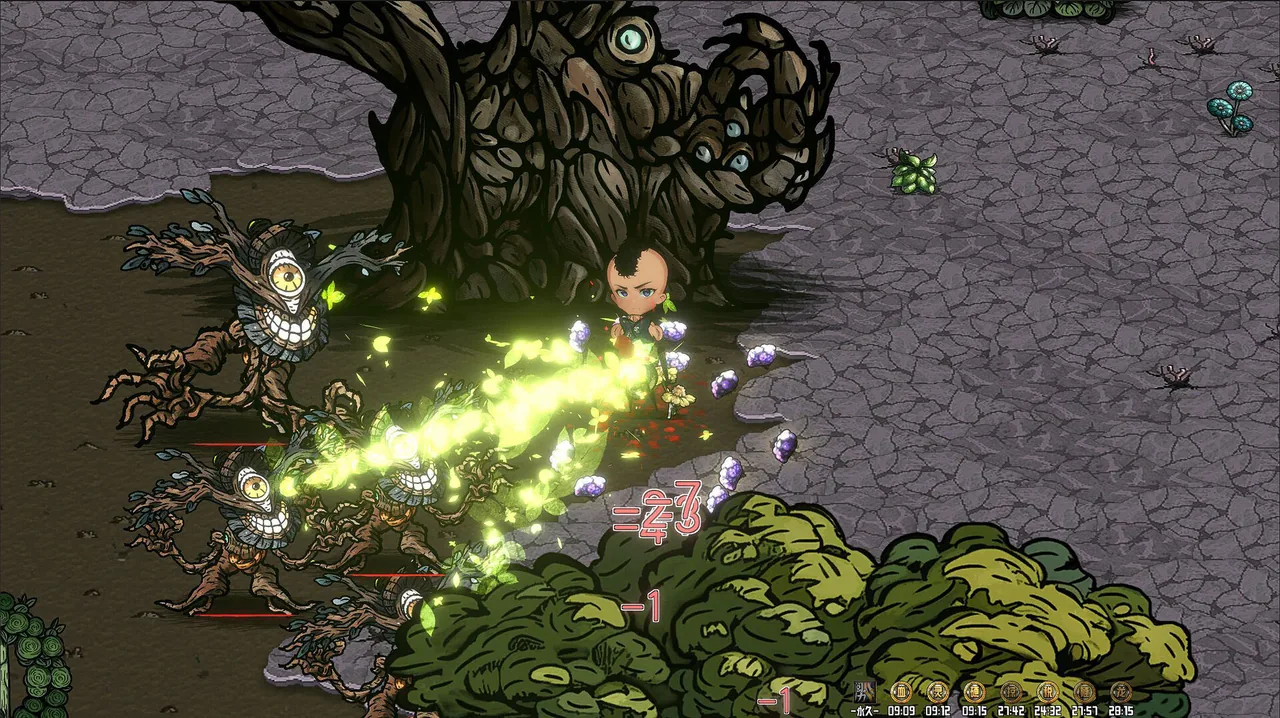
Wilderness combat against tree-like monsters, one of the game's less leisure-focused activitiesImage: Moshow Games via Steam -
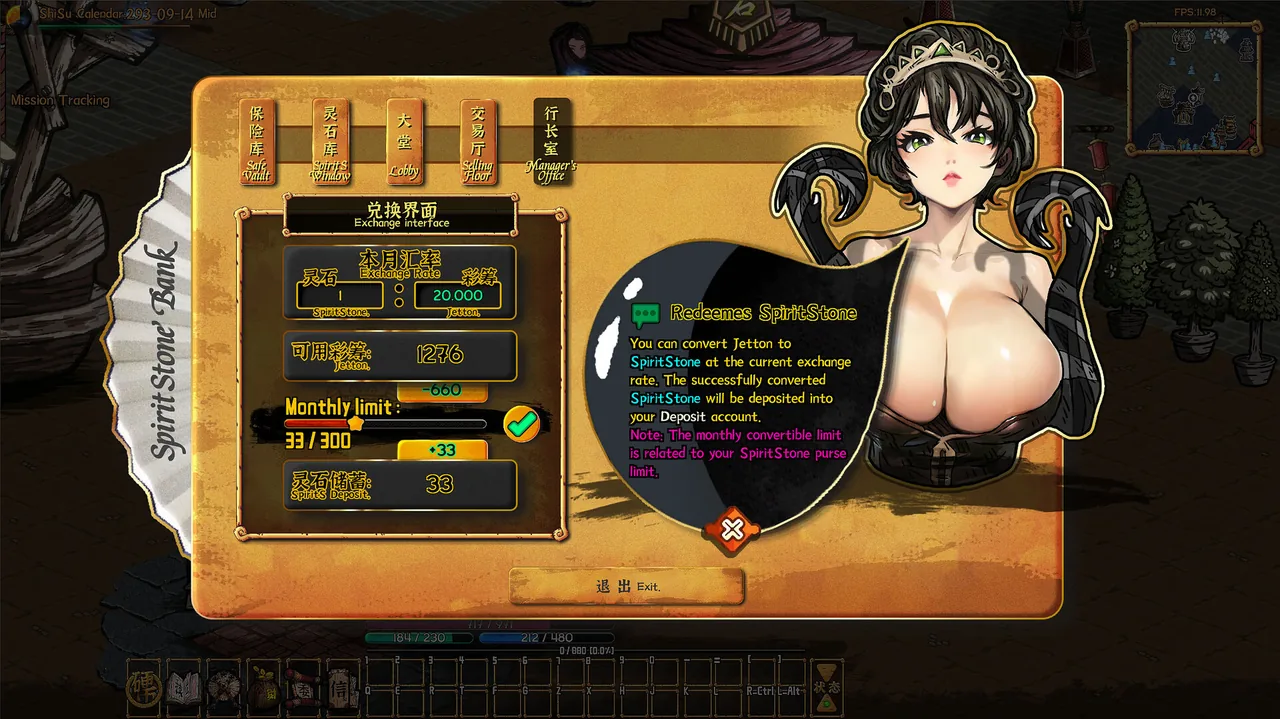
The Spirit Stone Bank's currency-exchange screen, part of the game's gambling and trading systemsImage: Moshow Games via Steam -

Wanderer Game ReviewsWanderer Game Reviews