Game review
Twilight of Bronze
7.4 / 10
- Developer
- NonAverageStudio
- Publisher
- NonAverageStudio
The short version
Biggest strengths
- A genuinely distinctive setting rarely explored in games: a living, simulated Bronze Age Near East where empires like Egypt, Hatti, Mycenae, Babylon, and Assyria rise, war, and collapse independently of the player's actions
- Deep, punishing turn-based combat built around attack timing (Quick, Normal, Heavy, Feint), positioning, and a wound system where a broken leg or bleeding cut genuinely changes how a fight plays out
- Reviewers repeatedly compare it favorably to Mount & Blade and Dwarf Fortress's Adventurer mode for the sheer density of interlocking systems — settlement building, companions, trade, foraging, religion, and morale all layered together
Biggest weaknesses
- A real learning curve reported even by reviewers who ultimately loved the game, with several systems left for players to puzzle out largely on their own
- The review sample is currently very small (six English-language reviews at time of writing), all positive but too thin to draw firm conclusions about broader reception or edge-case bugs
- No dedicated in-game tutorial is described by reviewers beyond the initial character-origin setup, which may frustrate players less willing to experiment their way through a dense simulation
7.4 / 10
A world that keeps moving whether you're in it or not
Twilight of Bronze opens with an unusually specific pitch: choose who you are, when you live, and where you start within a simulated ancient Near East spanning the Aegean coast to Mesopotamia, from Anatolia down to Egypt, at the height — and eventual twilight — of the Bronze Age. It's a turn-based roguelike built around a genuinely living world model rather than a static backdrop dressed up in period art. Civilizations here manage their own food supplies, suffer famines, wage wars, form alliances, impose vassalage on weaker neighbors, and collapse under their own instability entirely independent of anything the player does. Rulers are born, age, die, and are succeeded. Bandit bands fill the power vacuum when a state weakens. Sieges unfold across whole seasons. Reviewers who've spent serious time with it describe exactly this quality as the game's central hook: one long-session reviewer calls it "the closest we currently have to a 'Bronze Age Life Simulator,'" specifically praising the historical research evident in how accurately it renders the period for a self-described history enthusiast.
Combat with real consequences, wrapped in real depth
When violence breaks out, Twilight of Bronze asks for genuine tactical attention rather than simple attrition. Each round, players choose an attack style — Quick for fast, light damage, Normal for a balanced strike, Heavy for a slow but devastating blow, or Feint to bait and interrupt an opponent's own attack — while enemies parry, riposte, and look to exploit any opening left behind. Wounds carry real mechanical weight: a cut arm reduces accuracy, a broken leg turns every subsequent step into a liability, and bleeding drains health steadily turn by turn. Positioning matters too, with flanking reducing an enemy's ability to dodge, guarding absorbing incoming blows, and shoving used to create space when a fight goes badly. Reviewers consistently frame this as more than surface-level flavor: bringing companions and levied soldiers into a fight isn't optional window dressing but a real survival necessity, since a fight taken on outnumbered is one a reviewer specifically warns "you may not survive."
Survival, trade, and a genuinely dense web of systems
Beneath the combat sits an equally dense survival and economic layer. Hunger and thirst apply constant pressure, pushing players to forage open terrain, drink from rivers, and camp to recover health, all while managing an inventory across long journeys where pack animals extend how much can be carried. Skills in combat, survival, and social interaction advance purely through use rather than an abstracted leveling screen, and players can hire levy soldiers at city barracks, recruit named heroes out of taverns, or even open a shop in a city to build a genuine commercial footprint across the region. One reviewer with substantial playtime describes it as playing "like a polished and fun version of Dwarf Fortress Adventurer mode, but somehow has even more features including an entire settlement building system, companions, a morale system, gambling, the list goes on" — a comparison that shows up independently across more than one review, and one that speaks directly to how much is packed into a single Early Access-adjacent release.
Gods, prophets, and a world worth wandering
Religion isn't cosmetic set dressing either. Each civilization worships its own distinct pantheon — Egyptian gods, the Storm Gods of the Hittites, Aegean divinities, the great Mesopotamian temple hierarchies — and players can seek out prophets and storytellers to accumulate divine favor through ritual and deed, with the gods actively shaping the stability, harvests, and fortunes of rulers rather than sitting passively in the background. Combined with a world map that can be explored at multiple scales — zooming out to survey a whole region, zooming into a city for a fully generated local view of market districts, back alleys, and taverns, or boarding a ship to trade along the coastline and reach distant islands — it's a game built to reward genuine wandering. One reviewer calls it simply "the Immersive-Sim that I have been looking for," specifically praising the sense of a world worth losing yourself in over a long, uncertain journey.
A rough learning curve and a thin, but glowing, review pool
The honest caveats here come less from any specific broken system and more from the game's sheer density. More than one reviewer flags a real learning curve before things click, and none describe a dedicated tutorial beyond the initial character-origin setup — players are largely expected to puzzle out interlocking systems like foraging, morale, and settlement building through direct experimentation. It's also worth being upfront that the review pool backing this assessment is currently small: six English-language reviews at the time of writing, every one of them positive, which is a genuinely strong signal but too thin a sample to rule out sharper edge cases, later-game bugs, or balance issues that haven't yet surfaced publicly. A free version of the game is also available on Itch.io, with the Steam release framed explicitly as granting access to future updates that the free build may not receive — worth knowing going in, even if it doesn't read as a bait-and-switch given how substantial the current feature set already is.
Verdict
Twilight of Bronze is a rare thing: a genuinely distinctive setting matched by a genuinely dense, interlocking set of systems, rather than a striking premise wrapped around a thin game. Its living-world simulation, tactical wound-based combat, and layered survival and religious systems earn every comparison reviewers reach for, from Mount & Blade to Dwarf Fortress's Adventurer mode. The learning curve is real, the review sample is still small, and buyers should go in expecting to work things out largely on their own rather than being guided by hand — but for anyone drawn to ancient history, systemic depth, or roguelike life-simulators willing to tolerate some early rough edges, this is a genuinely compelling pickup.
Pros and cons
Pros
- A genuinely distinctive setting rarely explored in games: a living, simulated Bronze Age Near East where empires like Egypt, Hatti, Mycenae, Babylon, and Assyria rise, war, and collapse independently of the player's actions
- Deep, punishing turn-based combat built around attack timing (Quick, Normal, Heavy, Feint), positioning, and a wound system where a broken leg or bleeding cut genuinely changes how a fight plays out
- Reviewers repeatedly compare it favorably to Mount & Blade and Dwarf Fortress's Adventurer mode for the sheer density of interlocking systems — settlement building, companions, trade, foraging, religion, and morale all layered together
- A developer multiple reviewers describe as unusually active and responsive, engaging directly with the community on Discord and continuing to patch and expand the game post-launch
Cons
- A real learning curve reported even by reviewers who ultimately loved the game, with several systems left for players to puzzle out largely on their own
- The review sample is currently very small (six English-language reviews at time of writing), all positive but too thin to draw firm conclusions about broader reception or edge-case bugs
- No dedicated in-game tutorial is described by reviewers beyond the initial character-origin setup, which may frustrate players less willing to experiment their way through a dense simulation
- A free version exists on Itch.io that only receives some updates, meaning prospective buyers on Steam are partly paying for ongoing development access rather than a fixed, finished product
Screenshots
-
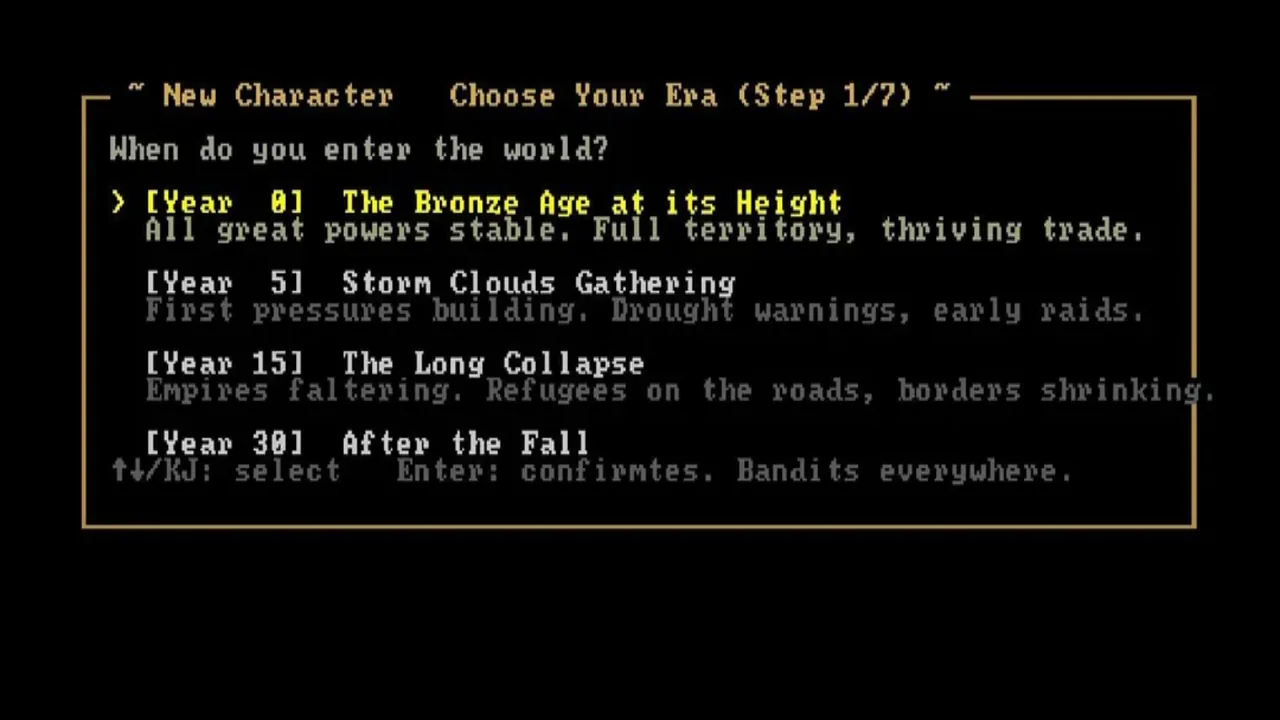
Choosing when to enter the world at character creation, from a stable Bronze Age peak to its collapse decades laterImage: NonAverageStudio via Steam -
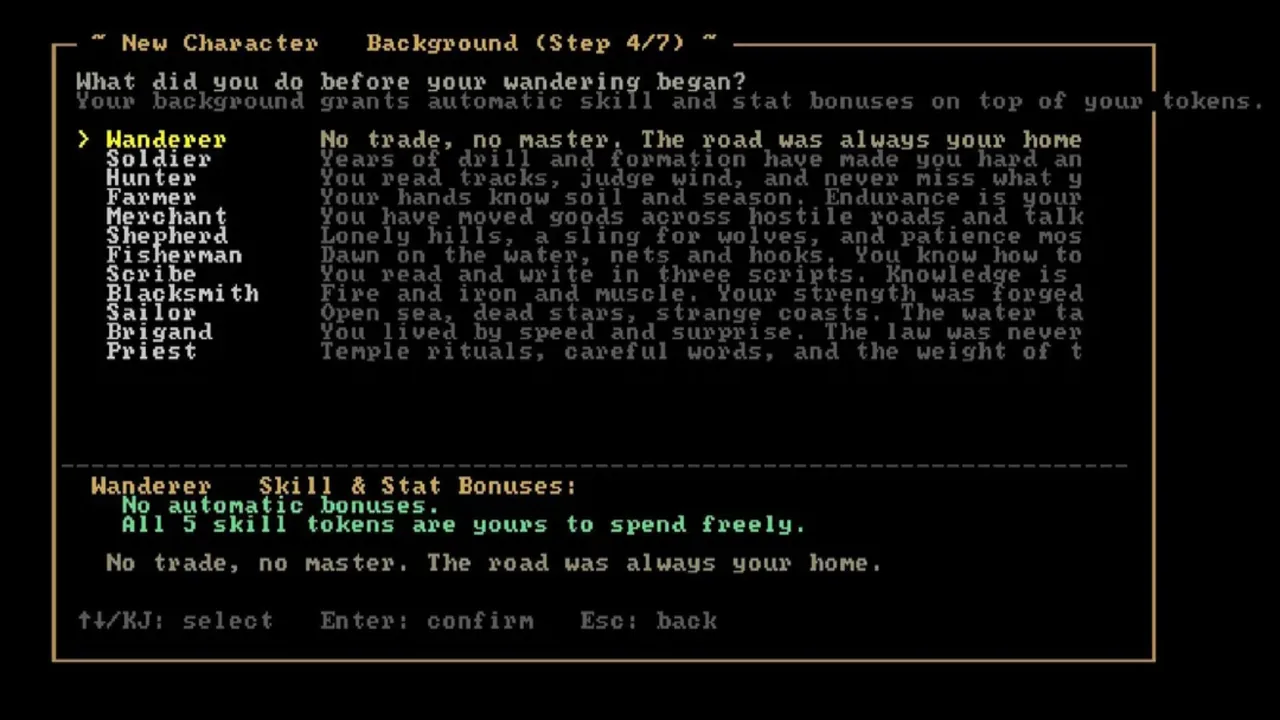
Selecting a character background, from Wanderer to Priest, each granting different skill and stat bonusesImage: NonAverageStudio via Steam -
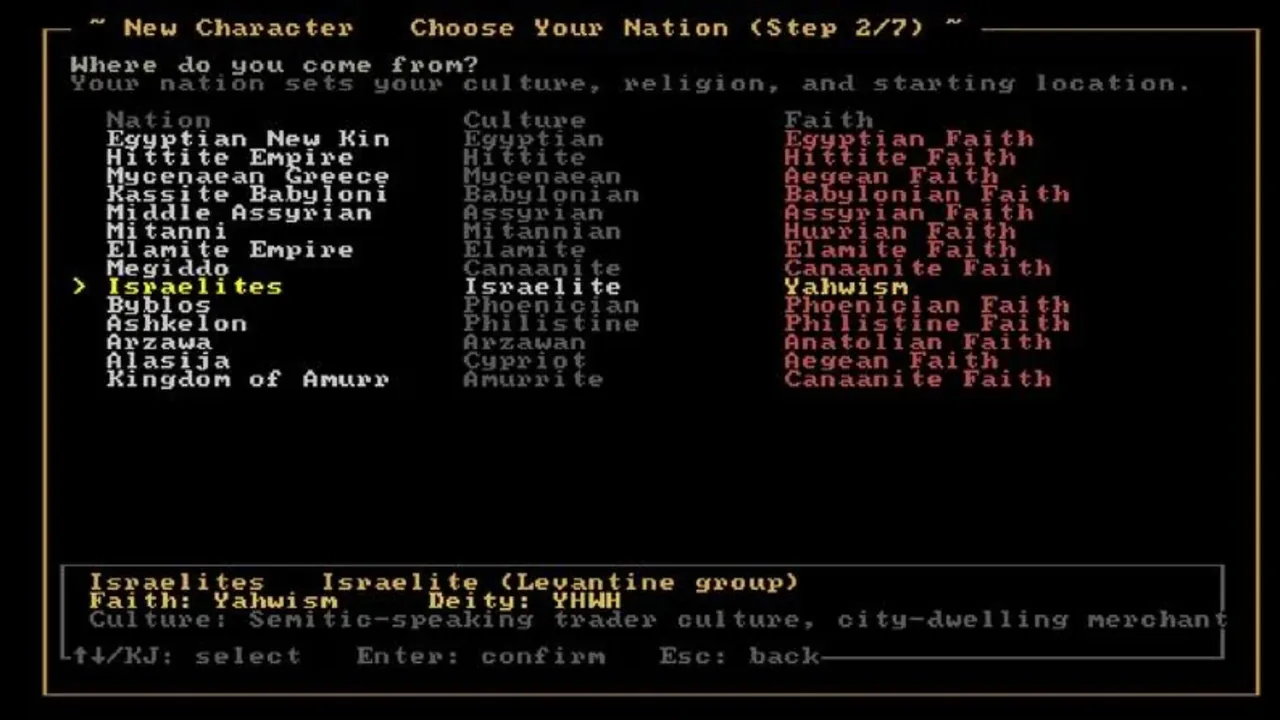
Choosing a starting nation and faith from among Bronze Age civilizations like Egypt, the Hittites, and Mycenaean GreeceImage: NonAverageStudio via Steam -
Category scores for Twilight of BronzeWanderer Game Reviews