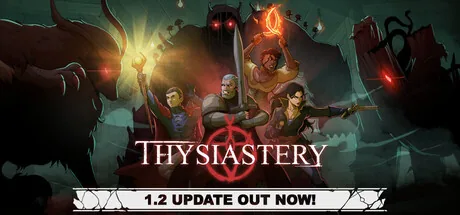
Game review
THYSIASTERY
6.8 / 10
- Developer
- DIRGA
- Publisher
- DIRGA
The short version
Biggest strengths
- A deeply loved core loop backed by remarkably high playtime from its most devoted reviewers, several logging well over 100 hours and calling it one of the best genre entries in years
- A distinctive 'Develop' mechanic that lets characters evolve a known skill into a new, thematically related one, layered on top of a system where party members can directly teach each other their learned abilities
- Genuinely responsive post-launch support: a divisive hidden 'timer' mechanic was made fully optional in a 1.1 update after community pushback, winning back at least one reviewer who'd previously left a negative review
Biggest weaknesses
- Heavy reliance on randomization — class skill pools, loot drops, and enemy spawns are all RNG-driven — draws frequent, detailed criticism for uneven balance and sudden, hard-to-avoid party wipes
- Multiple reviewers report that classes sharing the same broad archetype (several flavors of Fighter, for instance) end up feeling too similar in practice, undercutting the promised build variety
- Some experienced players report burning through the available content in just a handful of runs and a few hours, wishing for a deeper or more expansive endgame
6.8 / 10
Bearers of the Brand, drawn into a hungry Labyrinth
THYSIASTERY casts players as a group of "bearers of the Brand," pulled into a vast and enigmatic Labyrinth that, per the game's own pitch, "hungers once more." It's a turn-based, dungeon-crawling roguelike rendered in a retro-inspired, limited-palette art style, structured around permadeath, procedurally generated areas, and randomly generated characters players recruit, ally with, and learn from as they descend. The framing is deliberately sparse and atmospheric rather than exposition-heavy — several reviewers describe the story as told indirectly, through implied lore and environmental detail rather than dialogue-driven plotting — and that restraint turns out to be one of the game's defining strengths, letting a genuinely haunting sense of place do most of the narrative heavy lifting.
A first-person crawler built on old bones with new ideas
Structurally, THYSIASTERY sits squarely in the lineage of classic first-person dungeon crawlers — reviewers repeatedly invoke Eye of the Beholder, Lands of Lore, Wizardry, and Legend of Grimrock as reference points — but layers on a distinctly roguelike skeleton of permadeath and procedural generation rather than Grimrock's fixed puzzle-box levels. Combat is turn-based and deliberately punishing: enemies come in two rough flavors that reviewers describe as "kinda weak and raidboss strong," they can't reliably be outrun once they've locked on, and a front/back row system governs who takes the brunt of an attack. One reviewer highlights a specific piece of tactical texture worth calling out: an actual combat toggle lets a party enter or leave a fight at the cost of a full party-wide turn, a small but meaningful lever for managing the risk of getting cornered. It's a design philosophy that rewards genre veterans — several reviewers with deep dungeon-crawler and roguelike backgrounds report finishing or even winning their very first run — while punishing newcomers who wander in expecting a gentler curve.
Develop, teach, and the skill system's best idea
The most consistently praised system is how skills move between characters. Each character starts with a randomized pool of passives and actives drawn from their class's Fighter, Mage, or Healer archetype, which they can then teach directly to other party members — but the standout mechanic, singled out by multiple reviewers as something they hadn't seen elsewhere, is "Develop": spending skill points to evolve a known skill into a new, thematically related one, whether that's two crit-chance abilities branching off each other or a pair of light-elemental attacks. One reviewer called it a system that lets players "steer" a class's growth well beyond its starting shape, and the cross-teaching layered on top means a lucky recruit's abilities can ripple through an entire party rather than staying locked to one character. It's genuinely inventive build-crafting wrapped inside an otherwise familiar class-and-skill-tree shell.
The RNG debate at the center of every review
No discussion of THYSIASTERY is complete without its central fault line: just how much of the experience is left to chance. Class skill pools are randomized, loot drops are randomized, and even enemy encounters carry enough variance that reviewers on both sides of the fence cite the exact same systems as evidence for opposite conclusions. Detractors describe "dying by a thousand cuts" to constantly respawning enemies, gear-dependent runs sunk by a bad merchant trade, and classes within the same archetype feeling functionally identical despite a dozen-plus options on paper. Defenders counter that the randomization is precisely what gives the game its replay value, and that losses are almost always explicable in hindsight rather than arbitrary — one reviewer summed up the appeal as "something I could have predicted and overcame if I knew more and prepared better." A KO system that gives characters only a percentage chance of permanent death on defeat, rather than instant permadeath, was cited by several as a fair compromise that softens the genre's harshest edge without removing its tension entirely.
A dev team that actually listens
One detail stands out beyond the moment-to-moment gameplay: THYSIASTERY's developer shipped a genuinely responsive fix to one of the game's most contentious systems. An invisible "harvester" timer mechanic that pressured players to keep advancing drew sustained criticism after launch; in a 1.1 update, the developer made the timer fully optional, with players who disable it accepting a modest 20% score penalty as a tradeoff. One reviewer who'd previously left a negative review over exactly this issue updated it to positive and repurchased the game specifically because the team "listened to the community." That kind of concrete, dated post-launch responsiveness is a meaningfully positive signal for a solo or small-team indie release, and it's the sort of thing worth weighing against launch-week complaints that may no longer fully apply.
Verdict
THYSIASTERY is a genre throwback with real teeth: a first-person, Wizardry-and-Grimrock-indebted dungeon crawler wrapped in dark fantasy and unexpectedly WWI/WWII-flavored horror trappings, held together by a genuinely clever skill-teaching-and-Develop system that rewards experimentation. Its heavy reliance on randomization is a legitimate double-edged sword — the same systems that give devoted fans hundreds of hours of replayable variety are the ones that leave other players feeling cheated by an unlucky run — and dungeons themselves stay fairly light on things to discover outside of combat. But between its distinctive mechanical hook, its atmosphere-first presentation, and a developer that has already shown it will act on community feedback, THYSIASTERY earns its Very Positive reception. At a base price of NZ$24.99 — regularly discounted, currently down to NZ$14.24 — it's a reasonable ask for a genre where the most devoted fans routinely report triple-digit hours squeezed from repeat runs. Genre veterans who don't mind a punishing curve are the clearest audience; anyone allergic to RNG-driven difficulty should look elsewhere.
Pros and cons
Pros
- A deeply loved core loop backed by remarkably high playtime from its most devoted reviewers, several logging well over 100 hours and calling it one of the best genre entries in years
- A distinctive 'Develop' mechanic that lets characters evolve a known skill into a new, thematically related one, layered on top of a system where party members can directly teach each other their learned abilities
- Genuinely responsive post-launch support: a divisive hidden 'timer' mechanic was made fully optional in a 1.1 update after community pushback, winning back at least one reviewer who'd previously left a negative review
- A distinctive genre mashup — classic first-person, Wizardry-and-Eye-of-the-Beholder-style dungeon crawling combined with dark fantasy, Lovecraftian, and WWI/WWII-inspired enemy design
Cons
- Heavy reliance on randomization — class skill pools, loot drops, and enemy spawns are all RNG-driven — draws frequent, detailed criticism for uneven balance and sudden, hard-to-avoid party wipes
- Multiple reviewers report that classes sharing the same broad archetype (several flavors of Fighter, for instance) end up feeling too similar in practice, undercutting the promised build variety
- Some experienced players report burning through the available content in just a handful of runs and a few hours, wishing for a deeper or more expansive endgame
- Minor interface friction (a font some players find hard to read) and dungeons that, outside of combat encounters, are described as fairly barebones on things to discover or interact with
Screenshots
-
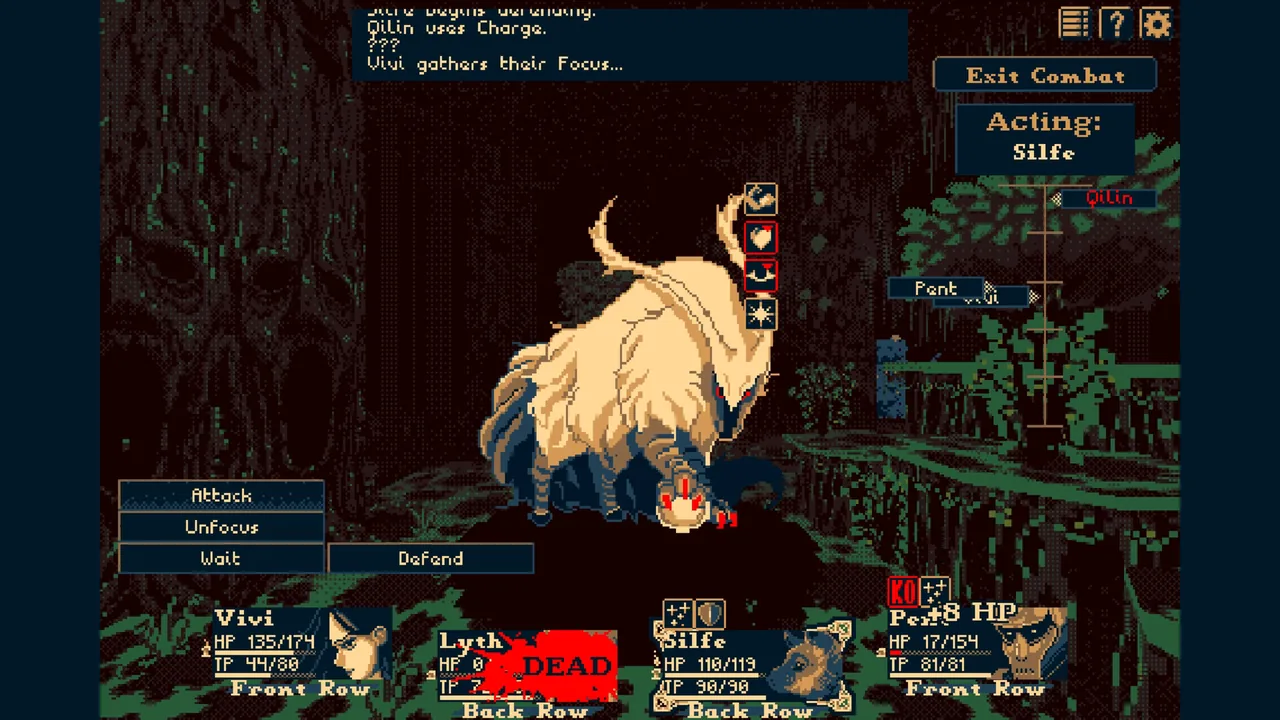
A tense forest encounter, with one party member already down and the front/back row split visibleImage: DIRGA via Steam -
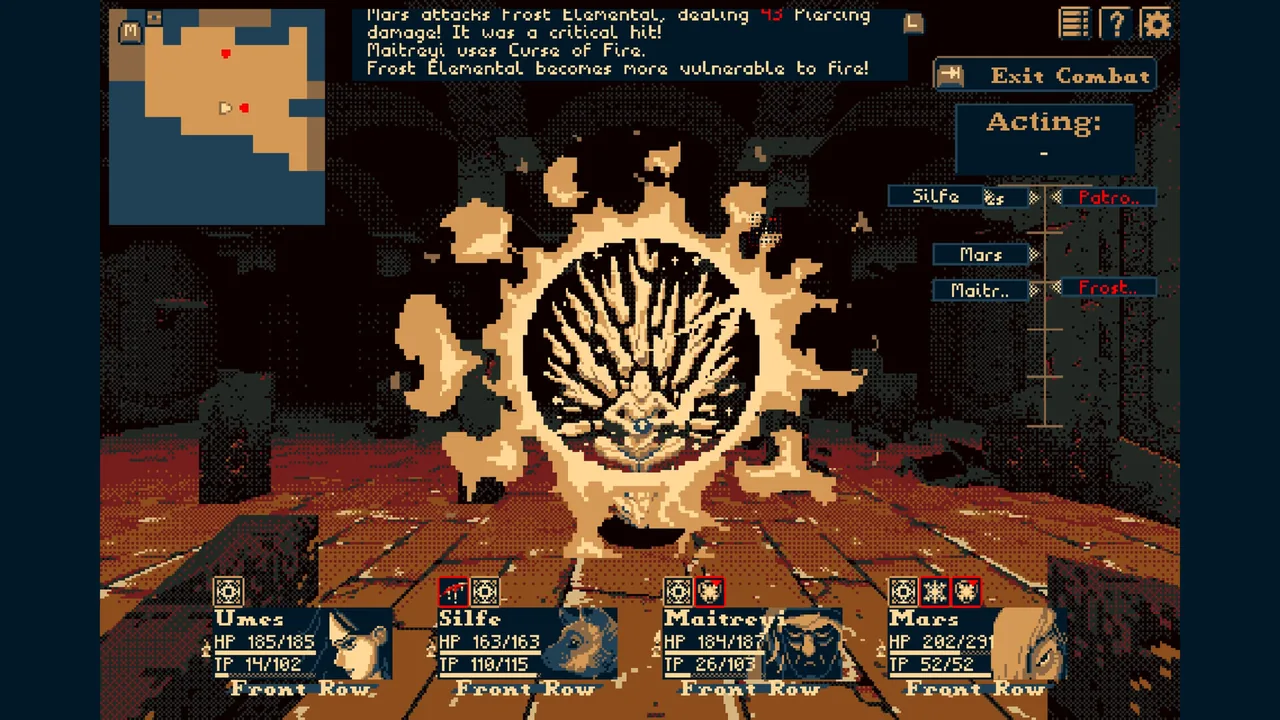
Battling a Frost Elemental deep in the dungeon, with the minimap tracking the party's positionImage: DIRGA via Steam -
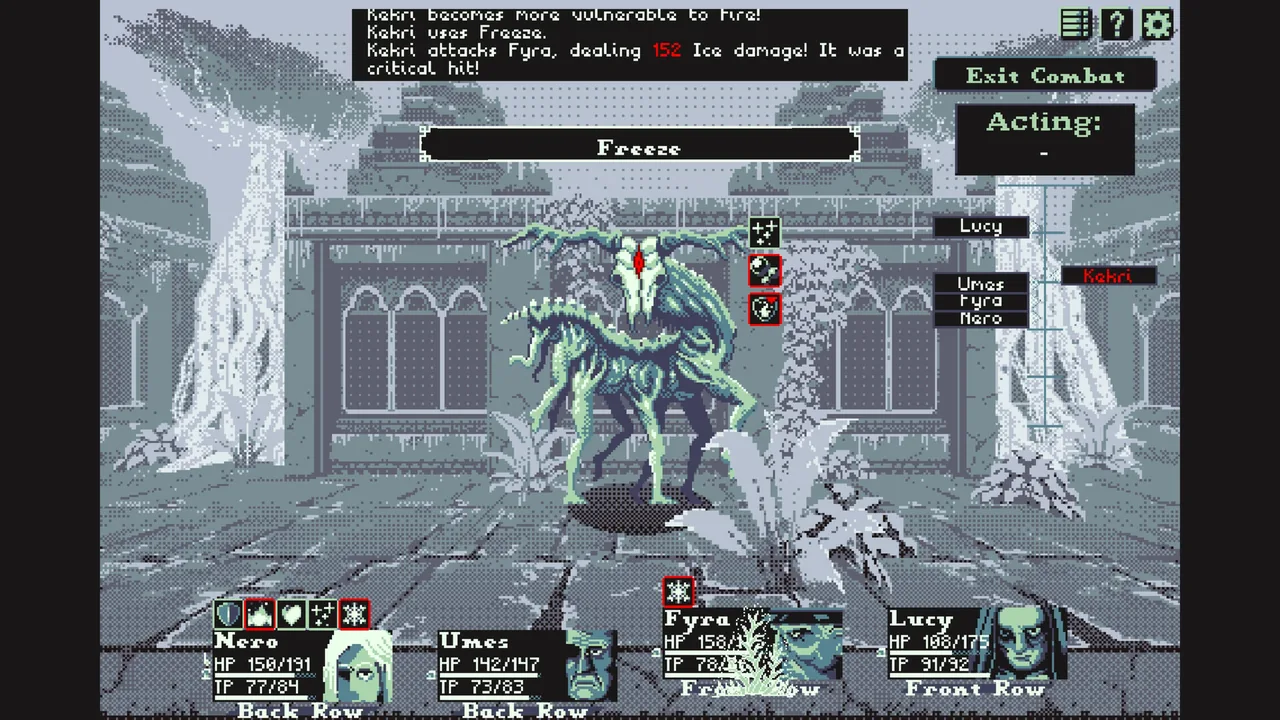
Facing down a frost-themed boss creature amid icy, overgrown ruinsImage: DIRGA via Steam -
Category scores for THYSIASTERYWanderer Game Reviews