Game review
Starminer
5.5 / 10
- Developer
- CoolAndGoodGames
- Publisher
- CoolAndGoodGames
The short version
Biggest strengths
- A genuinely distinct Newtonian-physics space sim that reviewers repeatedly compare to EVE Online's mining and industry loop without the forced PvP griefing, or ΔV: Rings of Saturn 'on steroids'
- Deliberately slow, methodical piece-by-piece ship and station design that a committed niche of reviewers find deeply satisfying and hard to step away from
- Striking visuals, with reviewers specifically praising the sight of automated mining rigs, haulers, and builders coming to life around a design once it's finished
Biggest weaknesses
- A genuinely convoluted, unfinished interface — multiple overlapping and redundant control schemes for piloting ships, tiny unreadable text with no UI scaling option, and menial multi-click tasks like transferring resources between distant ships
- Content is currently sparse for an economy-and-tech-tree-driven game: a small handful of mineable resources, a thin research tree, and combat that multiple reviewers call a minor roadbump rather than a real threat
- Real, sometimes save-breaking bugs — drill rigs vanishing from ships, batteries reporting no energy while at full charge, engineer drones teleporting hundreds of thousands of kilometers away — with reload often the only fix
5.5 / 10
A space sim built for patience, not spectacle
Starminer asks players to design and pilot a fleet of ships with fully simulated Newtonian physics, mining asteroids for profit while staying under an alien empire's radar — the more you mine and build, the higher your "heat signature" climbs, until the aliens notice and come looking for a fight. Reviewers reach for a specific, telling set of comparisons to describe it: EVE Online's industrial mining loop without the forced PvP griefing, X-series-style fleet and station management, Kerbal Space Program's build-it-yourself philosophy, and above all ΔV: Rings of Saturn, whose fans describe Starminer as a spiritual successor "on steroids." That comparison set alone signals what kind of game this is — not a fast, arcade space shooter, but a deliberately slow, methodical sim where mining, hauling, and flying all take real time, and the waiting itself becomes part of the experience for players wired to enjoy it.
Ship-building and mining that rewards the patient
The core loop of gathering resources, researching new modules, and piece-by-piece constructing ever more capable ships and stations draws some of the review pool's most genuine enthusiasm. Reviewers describe watching their own mining rigs, haulers, and automated builders spring to life around a finished design as one of the game's most satisfying moments, and more than one compares the visual result to watching a sci-fi ant farm in miniature. The flight model is a deliberate flashpoint: full six-degrees-of-freedom Newtonian physics mean a ship keeps drifting in whatever direction it was already moving, and firing a thruster to correct course requires genuinely understanding momentum rather than tapping a direction key. Reviewers who click with this design call it immersive and rewarding once it "clicks" — one self-described veteran of both Elite Dangerous and EVE Online calls it the most exciting space game they've played in years — while reviewers expecting arcade-style handling frequently bounce off it within the two-hour refund window, a split the review pool itself openly acknowledges rather than papers over.
An interface that hasn't caught up to the ambition
Where even sympathetic reviewers turn critical is the interface. Multiple, overlapping control schemes exist for piloting a single ship without a clearly superior default, and simple tasks — like sending resources to a ship elsewhere on the map — reportedly require a dozen or more clicks where a single menu action would do. Text size draws pointed frustration from reviewers without perfect eyesight, with no UI scaling option currently available to compensate. The tutorial system fares little better: reviewers describe it as a wall of information delivered all at once, written by people who "tested them perhaps by doing everything on their list and called it a day" without considering how a genuinely new player would experience it. None of this is necessarily fatal for a niche-targeted Early Access sim, but it compounds an already steep learning curve rather than smoothing it.
Thin content for a game built around an economy
Beyond interface friction, the most substantive criticism concerns how much is actually here yet. Several detailed reviews describe the current tech tree as strikingly small — barely ten meaningful research items by one count — and the number of mineable resource types sits in the single digits. Combat, similarly, is widely described as a minor threat rather than a real system: early-game enemies pose little challenge, and the promised alien-detection mechanic hasn't yet developed into the escalating tension the premise implies. One long-time player of complex engineering sims like Kerbal Space Program and Satisfactory, who logged nearly 100 hours before reviewing, still frames Starminer's current state as "as good as it gets for a really early Early Access" — a backhanded compliment that captures the review pool's broader mood: real promise, genuinely thin substance so far.
Bugs, reloads, and a rocky first few months
Stability is a mixed bag. Several reviewers report the game running smoothly out of the box, including surprisingly solid Proton compatibility for Linux players, but an equally consistent thread describes specific, reproducible bugs: drill rigs vanishing from ships entirely, batteries reporting no power while sitting at full charge and solar panels running at maximum, and engineer drones randomly teleporting hundreds of thousands of kilometers off the map, unable to fly back and requiring deletion. Reviewers who hit these bugs consistently note that reloading a save fixes most of them, with a full restart needed for the rest — workable for a patient Early Access player, but a real interruption to the slow, meditative pacing that's otherwise the game's biggest selling point. Camera controls draw a smaller but recurring complaint too: there's currently no locked or first-person camera option, so players are frequently left staring at an upside-down or awkwardly rotated view and have to physically reorient the ship just to see clearly, on top of everything else they're already managing.
Verdict
Starminer is a genuinely distinctive, patient space-building sim that has already won over a dedicated niche audience who specifically wanted a demanding, Newtonian-physics take on EVE Online-style mining without the PvP griefing — and for that audience, the deliberate pace and hands-on ship design are a feature, not a bug. But it's still an early, rough Early Access build in every sense: a genuinely convoluted interface, sparse content relative to its economy-sim ambitions, and real bugs that occasionally demand a reload to fix. At roughly NZ$46, it's a tough recommendation for anyone hoping for a polished experience or fast-paced action right now — but for players who know exactly what kind of slow, methodical space sim they're looking for, Starminer already delivers a real foundation worth building patience around.
Pros and cons
Pros
- A genuinely distinct Newtonian-physics space sim that reviewers repeatedly compare to EVE Online's mining and industry loop without the forced PvP griefing, or ΔV: Rings of Saturn 'on steroids'
- Deliberately slow, methodical piece-by-piece ship and station design that a committed niche of reviewers find deeply satisfying and hard to step away from
- Striking visuals, with reviewers specifically praising the sight of automated mining rigs, haulers, and builders coming to life around a design once it's finished
- A design that trusts its audience rather than smoothing itself into generic live-service mush, according to reviewers who say the demanding flight model is exactly what sold them on the game
Cons
- A genuinely convoluted, unfinished interface — multiple overlapping and redundant control schemes for piloting ships, tiny unreadable text with no UI scaling option, and menial multi-click tasks like transferring resources between distant ships
- Content is currently sparse for an economy-and-tech-tree-driven game: a small handful of mineable resources, a thin research tree, and combat that multiple reviewers call a minor roadbump rather than a real threat
- Real, sometimes save-breaking bugs — drill rigs vanishing from ships, batteries reporting no energy while at full charge, engineer drones teleporting hundreds of thousands of kilometers away — with reload often the only fix
- At roughly NZ$46, several reviewers call the price steep for the amount of actual, hands-on engaged gameplay currently on offer versus long idle stretches of waiting for mining and hauling to finish, with one detailed negative review specifically noting that much of their logged playtime was really the simulation running unattended in a background window rather than active play
Screenshots
-
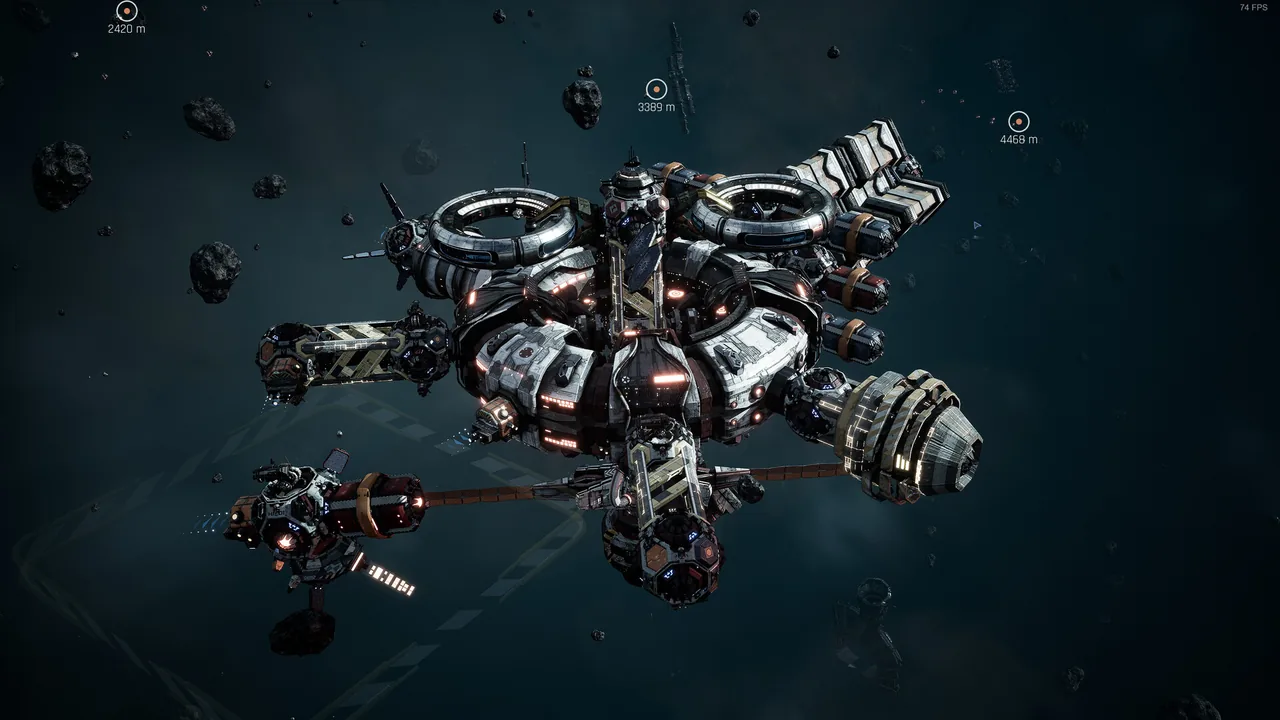
A sprawling modular space station, built piece by piece from interconnected hull segmentsImage: CoolAndGoodGames via Steam -
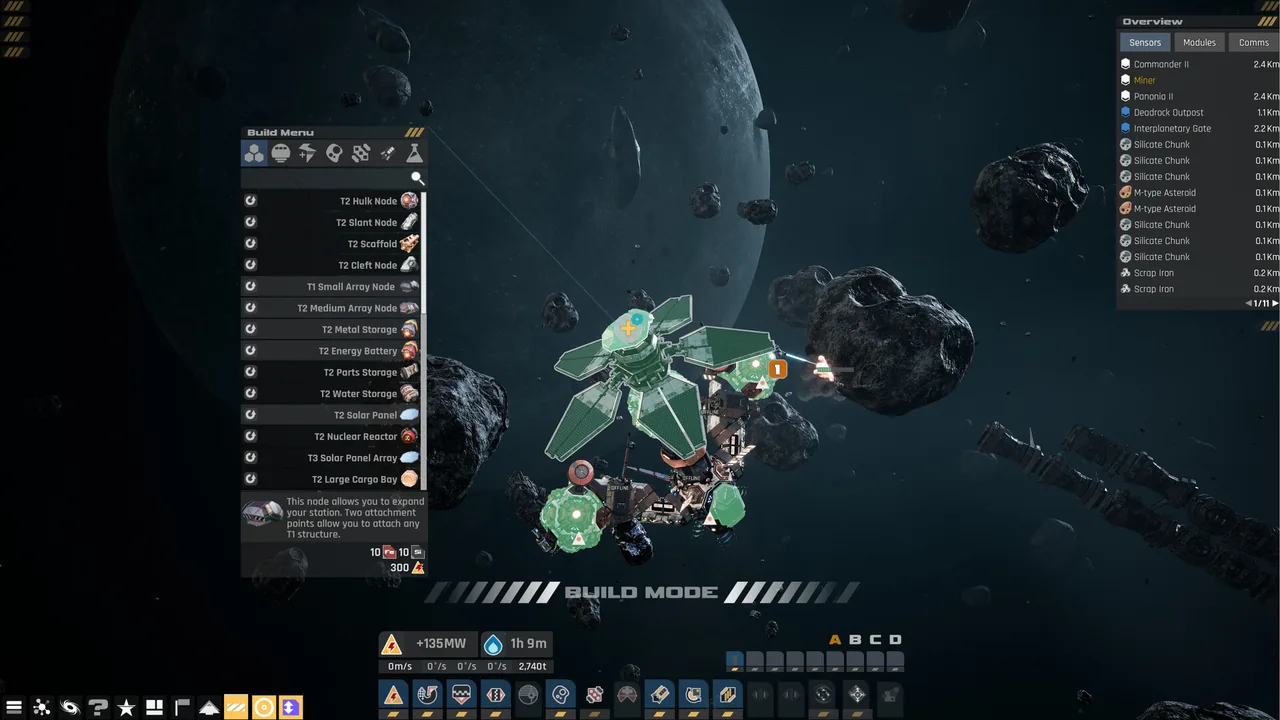
The build menu, used to attach new modules and storage nodes to an expanding stationImage: CoolAndGoodGames via Steam -
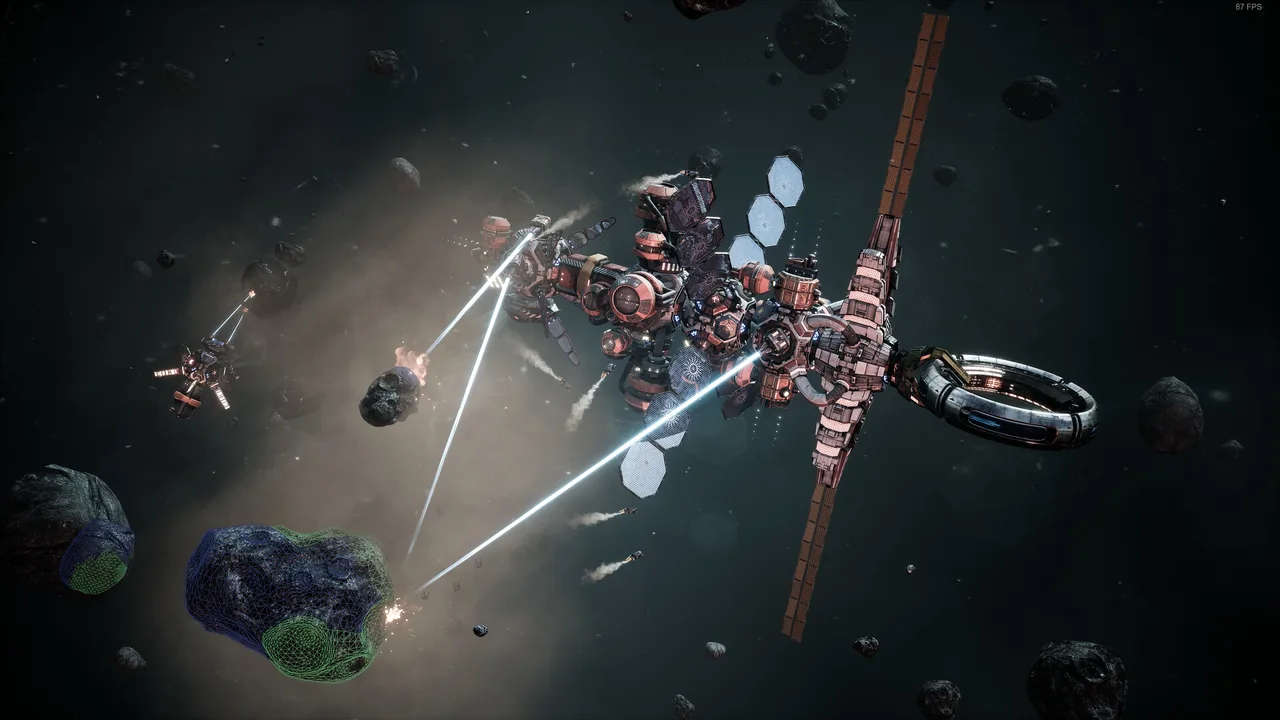
Mining lasers cutting into a targeted asteroid, with debris scattered across the fieldImage: CoolAndGoodGames via Steam -
Category scores for StarminerWanderer Game Reviews