
Game review
SOLARFLARE
7.3 / 10
- Developer
- Swarmforge
- Publisher
- Swarmforge
The short version
Biggest strengths
- A build-discovery loop that reviewers consistently describe as deceptively deep, with dozens of Upgrades that feel weak alone but combine into genuinely surprising, powerful strategies
- A clever passive-driven design where a player's own Upgrade choices effectively program their character's behavior — when it attacks, moves, or holds position — rather than simply raising stats
- Fast, iterative runs make it easy to test a new build idea, fail, and try again within minutes rather than committing to a long session
Biggest weaknesses
- Total content is genuinely small — one detailed review pegs it at a few hours — meaning nearly all of the game's replay value depends on chasing new builds and higher difficulties rather than sheer volume of content
- The developer's own advice to \"review the combat log to figure out why you died\" points to a real gap: the in-combat visualization of stacked status effects and triggers isn't always clear enough to follow in the moment
- Run-to-run randomness is deliberately low compared to most roguelikes, so a working build tends to keep working reliably once found — appealing for build-optimizers, but a real trade-off for players who want more chaotic surprise between attempts
7.3 / 10
A tiny agent against a very large megacorp
SOLARFLARE casts players as a new agent tasked with raiding a sci-fi megacorp's bot armies, stealing their equipment, and sabotaging their operations, one short auto-battler run at a time. It's a solo-developed project from Swarmforge, deliberately pitched as "a tiny game, at a tiny price" — a description the developer states directly in the store description, alongside a promise that players will die a lot before they figure out how to win. That framing turns out to be accurate to the experience: SOLARFLARE isn't trying to be a sprawling roguelike epic, it's a tightly scoped build-discovery toy built around a small pool of Upgrades that reviewers say combine far more explosively than their individual descriptions suggest. Across 18 English-language Steam reviews, the response is unanimously positive, with reviewers repeatedly framing the low asking price as making an easy recommendation even easier.
Programming your own robot's behavior
The core loop revolves around picking an action — melee, ranged, drones, EMP, and more — and then layering Upgrades on top that synergize with it, watching the resulting build fight automatically against waves of the megacorp's bots. What distinguishes SOLARFLARE from a typical auto-battler, according to multiple reviewers, is how directly a player's Upgrade choices end up shaping their character's actual behavior. One detailed review describes it as effectively "programming the AI for your character with your build choices," noting that skilling certain passives determines when a character attacks, moves, or holds position, and that those actions then become triggers for other passives, spiraling into what the reviewer calls "a satisfying chain reaction." Reviewers cite specific favorite builds by name — one calls out "the Porcupine" (standing still and letting enemies impale themselves) and "the Moonwalker" (killing enemies just by stepping around them) as evidence of how varied that build space turns out to be despite the game's small footprint. One reviewer sums up the whole feel by comparing it to "if Path of Achra was an auto battler," a comparison pitched squarely at players who already enjoy sifting through synergistic build systems in other roguelikes.
Fast runs, low-friction experimentation
Because runs are short, reviewers repeatedly praise how easy it is to test an idea, watch it fail, and immediately try something else. One reviewer explicitly contrasts this with other roguelikes and autobattlers by noting SOLARFLARE has "much less rng and run-to-run variation," meaning once a build that works on a given difficulty is found, it tends to keep working consistently — turning the game, in that reviewer's words, into "basically searching for the functional builds" rather than gambling on unpredictable runs. Several reviewers describe ramping up the game's speed setting once they've found a working build, treating later runs almost as a victory lap before pushing into harder difficulty tiers to stress-test that build further. The developer's own advice in the store page — to try turning the difficulty up, though "probably not to 10" — reinforces that the intended arc is deliberate mastery rather than constant chaos. That short-session friendliness comes up again and again in reviews: multiple players specifically describe SOLARFLARE as an easy game to "pop in for a quick session," praising its "quick rounds and constant progression" as ideal for short breaks rather than dedicated play sessions, while one reviewer frames the whole structure as feeling like "stealing" the robots' own powers each time a run ends in an upgrade.
Presentation that punches above its price
Reviewers consistently describe SOLARFLARE's presentation as charming and more polished than its tiny price tag would suggest. Pixel art visuals are repeatedly called clean and pleasing, and the soundtrack draws specific, repeated praise — one reviewer highlights how it "transitions between a mellower version in the build menu between stages, to a more intense version of the same track when in combat," calling the effect "very well done." That level of craft, paired with confirmed Steam Deck compatibility mentioned by one reviewer, gives the whole package a sense of care that belies its status as a small, inexpensive solo release.
Where the seams show
The most consistent limitation reviewers raise is simply how much content there is: one detailed review describes SOLARFLARE as having "a few hours of content," with lasting value coming almost entirely from experimenting with new builds and pushing difficulty rather than any large volume of new material to unlock. Combat clarity is a smaller but real complaint — one reviewer specifically wishes for more visualization of the many status effects a build can generate mid-fight, "so that combat is more grokable," and the developer's own suggestion to check the combat log after a death implicitly concedes that the live view of a chaotic auto-battle isn't always self-explanatory. The deliberately low run-to-run randomness that makes builds reliable once discovered is also a genuine trade-off: it rewards optimization and repeat testing, but players hoping for the wilder unpredictability of a typical roguelike run may find SOLARFLARE's battles converge toward the same outcomes more quickly than they'd like.
Verdict
SOLARFLARE is a small, cheap, and unusually well-crafted auto-battler that gets far more mileage out of its modest Upgrade pool than its price tag implies, built around a genuinely clever system where build choices double as behavioral programming for an automated fighter. Its content is thin by design and its combat can be harder to read in the moment than its results suggest, but for players who enjoy chasing a perfect build and then stress-testing it against escalating difficulty, it's an easy, low-risk recommendation — exactly the kind of tiny, focused release its own developer promises it to be.
Pros and cons
Pros
- A build-discovery loop that reviewers consistently describe as deceptively deep, with dozens of Upgrades that feel weak alone but combine into genuinely surprising, powerful strategies
- A clever passive-driven design where a player's own Upgrade choices effectively program their character's behavior — when it attacks, moves, or holds position — rather than simply raising stats
- Fast, iterative runs make it easy to test a new build idea, fail, and try again within minutes rather than committing to a long session
- Charming pixel presentation backed by a soundtrack reviewers specifically praise for smoothly shifting between a mellower build-menu version and a more intense combat version of the same track
Cons
- Total content is genuinely small — one detailed review pegs it at a few hours — meaning nearly all of the game's replay value depends on chasing new builds and higher difficulties rather than sheer volume of content
- The developer's own advice to \"review the combat log to figure out why you died\" points to a real gap: the in-combat visualization of stacked status effects and triggers isn't always clear enough to follow in the moment
- Run-to-run randomness is deliberately low compared to most roguelikes, so a working build tends to keep working reliably once found — appealing for build-optimizers, but a real trade-off for players who want more chaotic surprise between attempts
- The genre itself is inherently hands-off by design, since battles play out automatically once a build is chosen, which won't suit players looking for more direct, moment-to-moment combat control
Screenshots
-
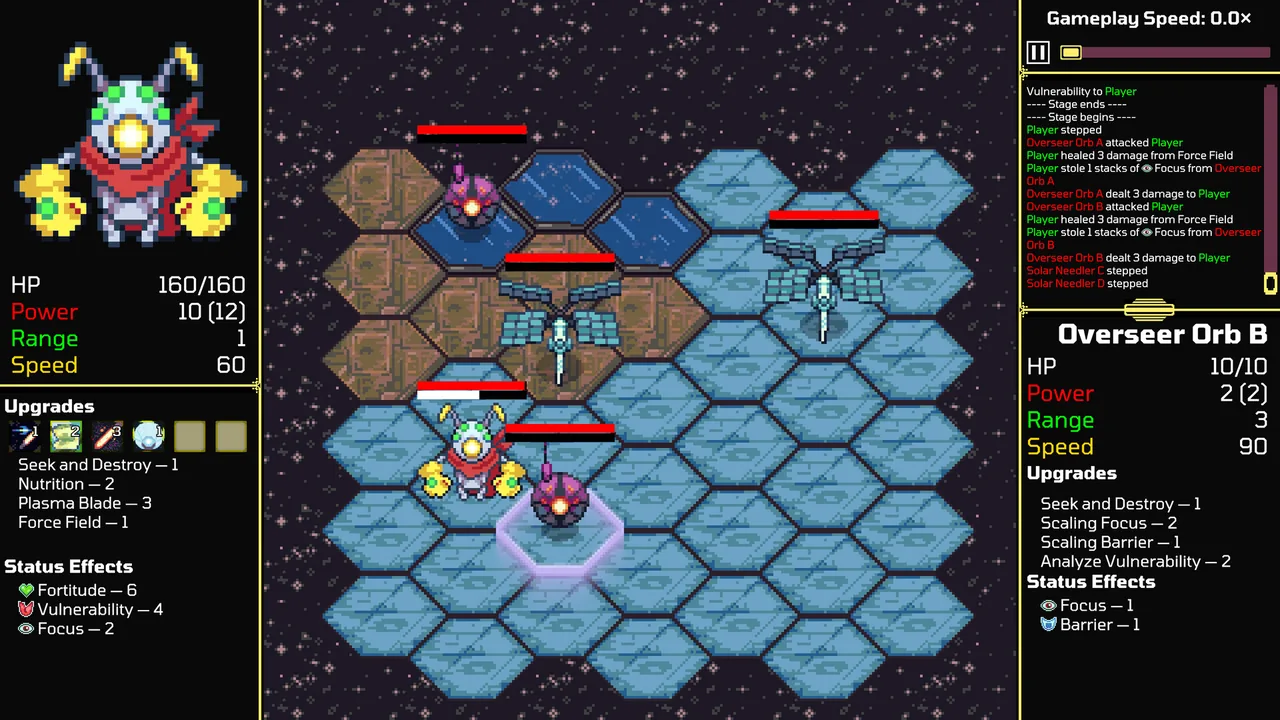
A hex-grid skirmish shows off the stat panels and scrolling combat log players use to parse each automated fightImage: Swarmforge via Steam -
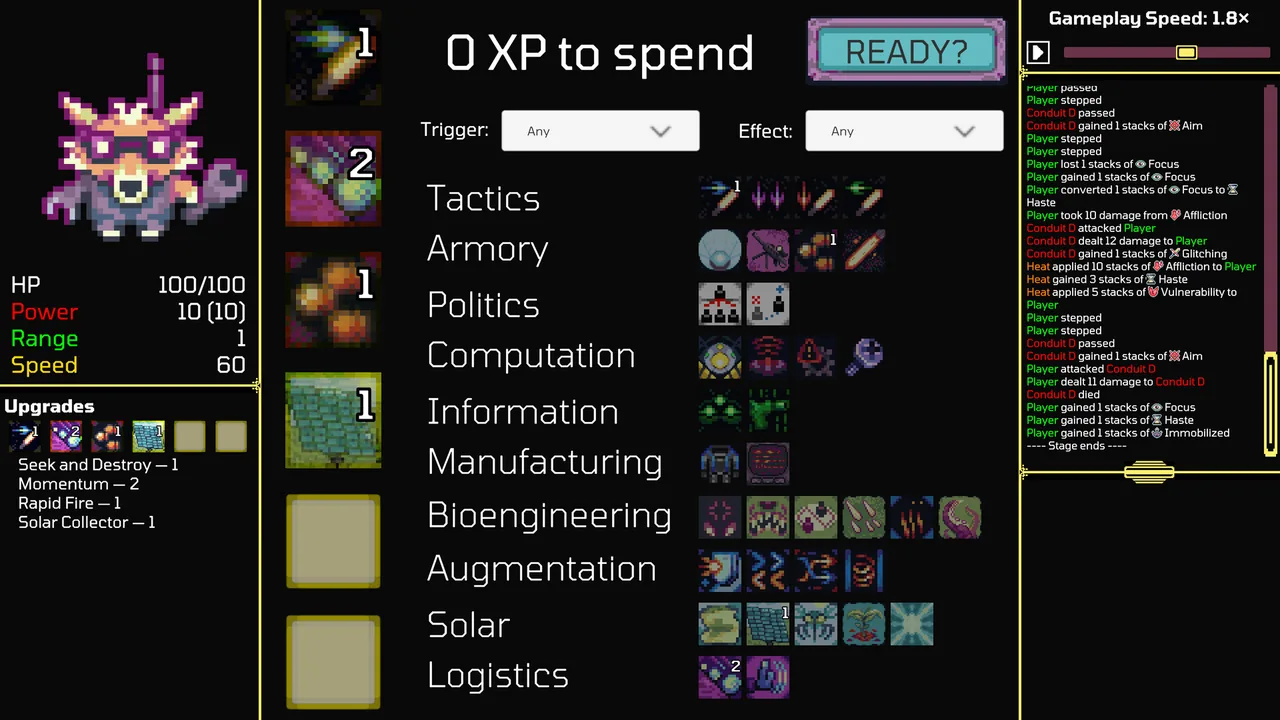
Between stages, players spend XP across a wide spread of Upgrade categories to shape their buildImage: Swarmforge via Steam -
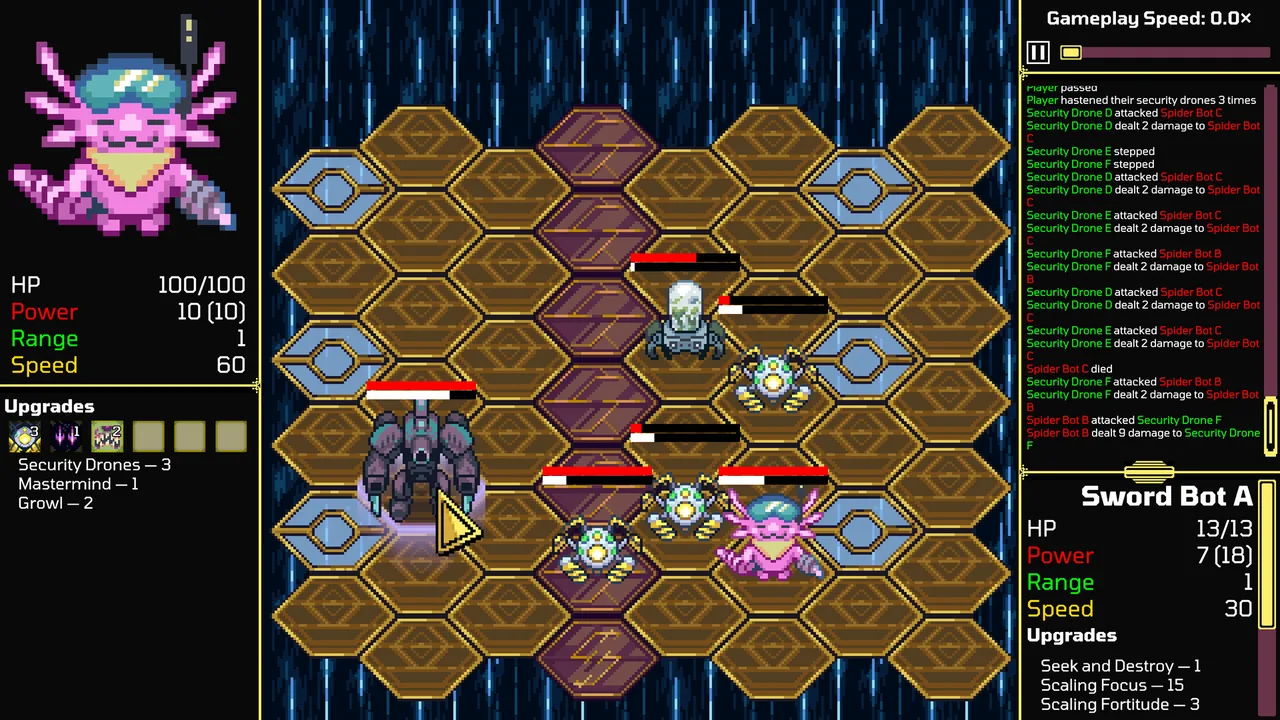
Later fights scale up to multiple drones and bots slugging it out across a bigger hex battlefieldImage: Swarmforge via Steam -
Category scores for SOLARFLAREWanderer Game Reviews