
Game review
Oharion
4.1 / 10
- Developer
- Aily Torezani
- Publisher
- Player Code
The short version
Biggest strengths
- A genuinely ambitious scope for a small-team free-to-play project: a persistent open world with cities, castles, forests, deserts, and elemental-dragon-themed dungeons, a full class system (warrior, elemental mage, archer, druid), guild wars, and crafting
- Several reviewers describe a relaxed, low-commitment appeal — a 'chill' grinder that works well on a second monitor while multitasking, with one long-playtime reviewer reporting genuine fun once settled into a guild
- Colorful, stylized 3D visuals draw specific praise, with one reviewer calling the game 'beautiful' and citing real potential despite its rough state
Biggest weaknesses
- Widespread, detailed reports of pay-to-win mechanics tied to real-money purchases made through an external website rather than Steam, with players describing a small number of top-spending 'whales' controlling guild territory, boss resets, and PvP dominance
- Multiple reviewers describe the core loop as closer to an idle or AFK simulator than active MMORPG combat, with an auto-attack function doing most of the work and manual combat described as clunky, laggy, and imprecise
- Persistent technical problems including 'servers unavailable' login failures reported by several separate reviewers, alongside incomplete English localization (large portions of text remain in Portuguese) that hampers understanding quests and tutorials
4.1 / 10
An elemental fantasy world, built by a small team
Oharion pitches itself as a fantasy MMORPG shaped by elemental forces and ancient dragons, developed by Aily Torezani and published by Player Code as a free-to-play persistent-world project. Rather than a short, self-contained campaign, it's structured the way classic MMORPGs are: a shared open world spanning cities, castles, ancient forests, and dangerous deserts, with long-term character progression, guild-based conflict, and a player-driven economy as the intended draw. One detailed English review frames it fairly as "an ambitious fantasy MMORPG... attempting to establish its own identity through its elemental themes" rather than simply cloning an existing genre leader — a reasonable read of the pitch, even if the execution is where things get considerably rockier.
A familiar MMORPG shopping list, with an AFK-grind caveat
Mechanically, Oharion checks the expected genre boxes: a class system spanning warrior, elemental mage, archer, and druid archetypes, open PvP and guild wars, cooperative dungeons and world bosses, equipment upgrading, and professions layered on top of combat progression. In practice, though, several reviewers describe the moment-to-moment gameplay as far more passive than that feature list suggests. One reviewer lays out the loop bluntly: press "Attack on," watch your character fight and level with minimal input, and periodically check in on progress — "the game is essentially an idle game where you can pvp sometimes." Another reviewer with over 40,000 minutes logged calls it "a mindless afk grind game" where players must check back every 10-15 minutes just to avoid being killed by more aggressive players while away. It's not universally condemned — one long-time player specifically enjoys grinding the lower-level zone on a second monitor while doing other things — but "MMORPG" and "idle game" are doing uncomfortably similar work in how reviewers actually describe playing it.
Real money, real problems: the pay-to-win question
The single most consistent and specific complaint across negative reviews concerns monetization. Multiple reviewers independently describe a system where real-money purchases made through an external website (rather than through Steam itself) let a small number of high-spending players dramatically outpace everyone else — one reviewer estimates roughly 10 of around 200 active players effectively own every world boss reset, locking the rest of the population out of top-tier gear entirely. Another describes a single dominant guild, led by what they call a "whale" with a lead "compared to the entire server," controlling PvP zones and territory as a direct result of that spending gap. A third reviewer opens their review flatly: "Pay to Win, you can become stronger in the website paying a great amount of money." For a genre that lives or dies on a level playing field between grinders and spenders, this is the kind of complaint that shapes an entire community's relationship with a game, and it shows up far too consistently across independent reviews to dismiss as one player's grudge.
A stark disconnect between two review pools
Oharion's Steam page currently shows a Very Positive rating when every language is counted, but the English-only picture is genuinely Mixed — 11 positive against 13 negative at the time of writing. That gap is worth explaining rather than ignoring, and one detailed negative review offers a specific, concrete allegation for why it exists: that the developer offers a 7-day upgrade package and 3,000 in-game coins to players who leave positive reviews, and has reportedly used a favored guild to suppress critical review comments. That's a serious claim from a single source that can't be independently verified here, but it lines up with the broader pattern in the data itself — a large body of enthusiastic reviews, disproportionately in Portuguese, sitting alongside a smaller but far more critical English-language cohort raising nearly identical, specific technical and monetization complaints. Readers should weigh the headline "Very Positive" score with real skepticism given this context.
Rough edges: translation, UI, and server stability
Beyond the economic concerns, Oharion shows clear signs of an early, under-polished project. Several reviewers report outright inability to log in, met instead with repeated "Servers Unavailable" messages, while others describe the game as playable but littered with incomplete localization — quest text and tutorial prompts that remain in Portuguese despite an otherwise English-facing storefront listing. Interface complaints are specific and numerous: no dedicated hotkeys for common menus, no way to directly compare equipped gear against inventory items, no functioning player shops in at least one reviewer's experience, and quests that offer little more guidance than "follow the marker and kill monsters." One player summarized their 47-minute session as "not bad... but it's a bit clunky," which is a fair, if generous, one-line verdict on the state of the whole project.
Verdict
Oharion has a real, coherent pitch — an elemental-fantasy MMORPG built by a small independent team, with a genuine class system, a shared persistent world, and enough visual polish that more than one reviewer calls it beautiful despite everything else going wrong around it. But the execution surfaces the kinds of problems that sink free-to-play MMORPGs specifically: a grind that several players describe as functionally an idle game, pay-to-win mechanics funneled through an external payment site that reportedly let a handful of spenders dominate the server, unstable login servers, incomplete localization, and specific, credible-sounding allegations of incentivized positive reviews that help explain why its all-language score looks so much rosier than its English-language one. There's a kernel of a genuinely interesting MMORPG buried in here, but it needs a great deal more development, transparency, and balance work before it's ready to recommend to anyone beyond genre die-hards willing to tolerate an early-stage, financially lopsided grind.
Pros and cons
Pros
- A genuinely ambitious scope for a small-team free-to-play project: a persistent open world with cities, castles, forests, deserts, and elemental-dragon-themed dungeons, a full class system (warrior, elemental mage, archer, druid), guild wars, and crafting
- Several reviewers describe a relaxed, low-commitment appeal — a 'chill' grinder that works well on a second monitor while multitasking, with one long-playtime reviewer reporting genuine fun once settled into a guild
- Colorful, stylized 3D visuals draw specific praise, with one reviewer calling the game 'beautiful' and citing real potential despite its rough state
- Free to download and play, with no upfront cost barrier to trying the class system and early zones for yourself
Cons
- Widespread, detailed reports of pay-to-win mechanics tied to real-money purchases made through an external website rather than Steam, with players describing a small number of top-spending 'whales' controlling guild territory, boss resets, and PvP dominance
- Multiple reviewers describe the core loop as closer to an idle or AFK simulator than active MMORPG combat, with an auto-attack function doing most of the work and manual combat described as clunky, laggy, and imprecise
- Persistent technical problems including 'servers unavailable' login failures reported by several separate reviewers, alongside incomplete English localization (large portions of text remain in Portuguese) that hampers understanding quests and tutorials
- A stark gap between Oharion's Very Positive all-language Steam rating and its Mixed English-language rating, with one detailed negative review alleging the developer offers in-game currency and time-limited boosts in exchange for positive reviews
Screenshots
-
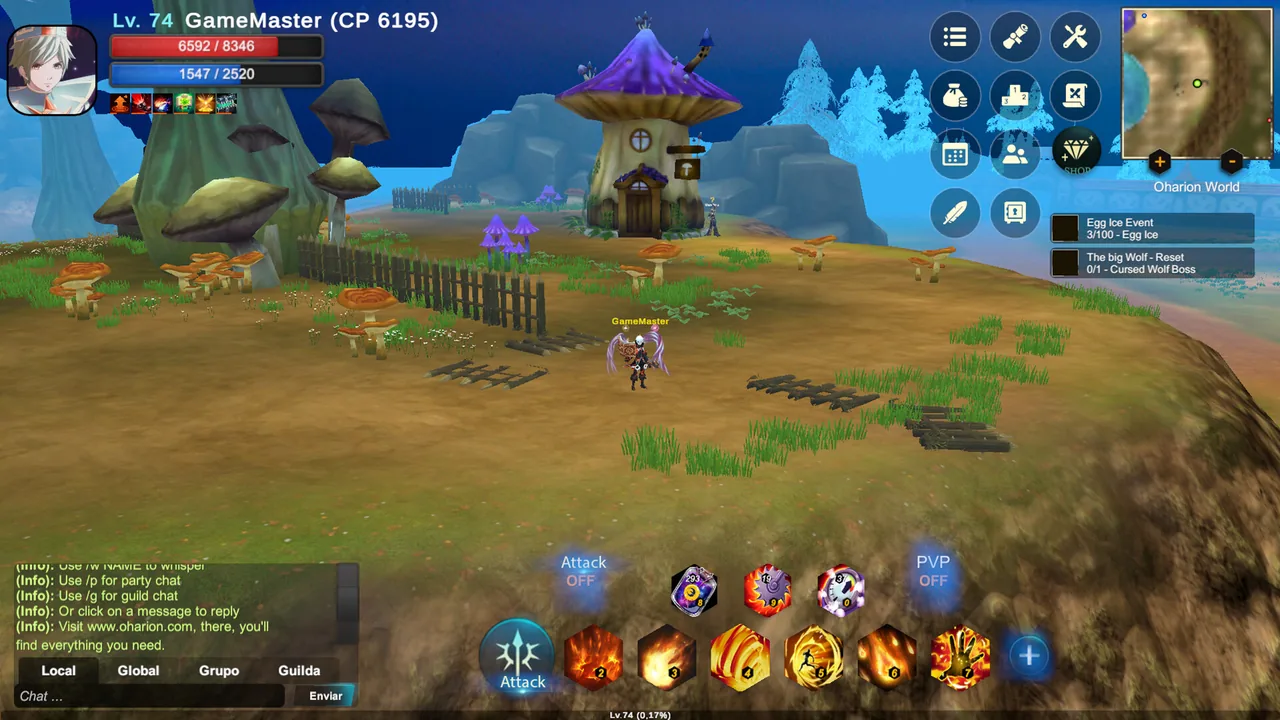
The overworld near a mushroom-forest settlement, with the auto-attack toggle visible along the bottom barImage: Aily Torezani via Steam -
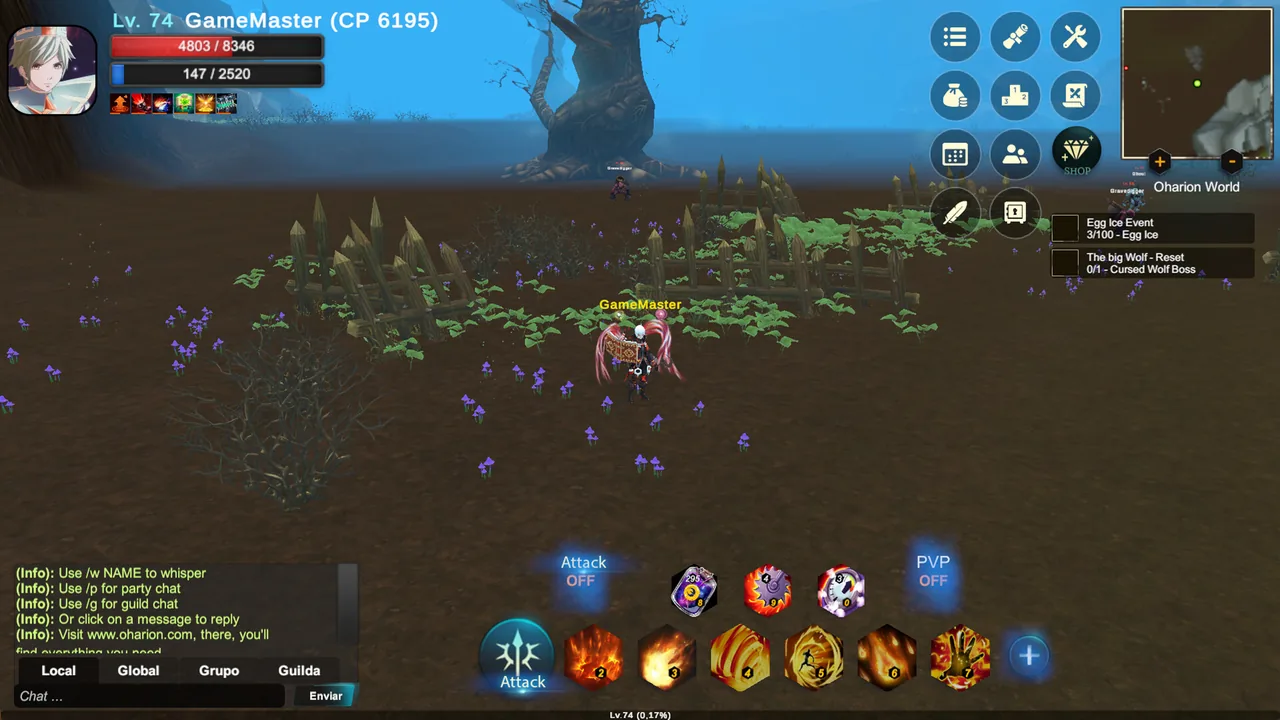
Exploring a shadowy garden area while tracking the 'Egg Ice Event' and 'Cursed Wolf Boss' questsImage: Aily Torezani via Steam -
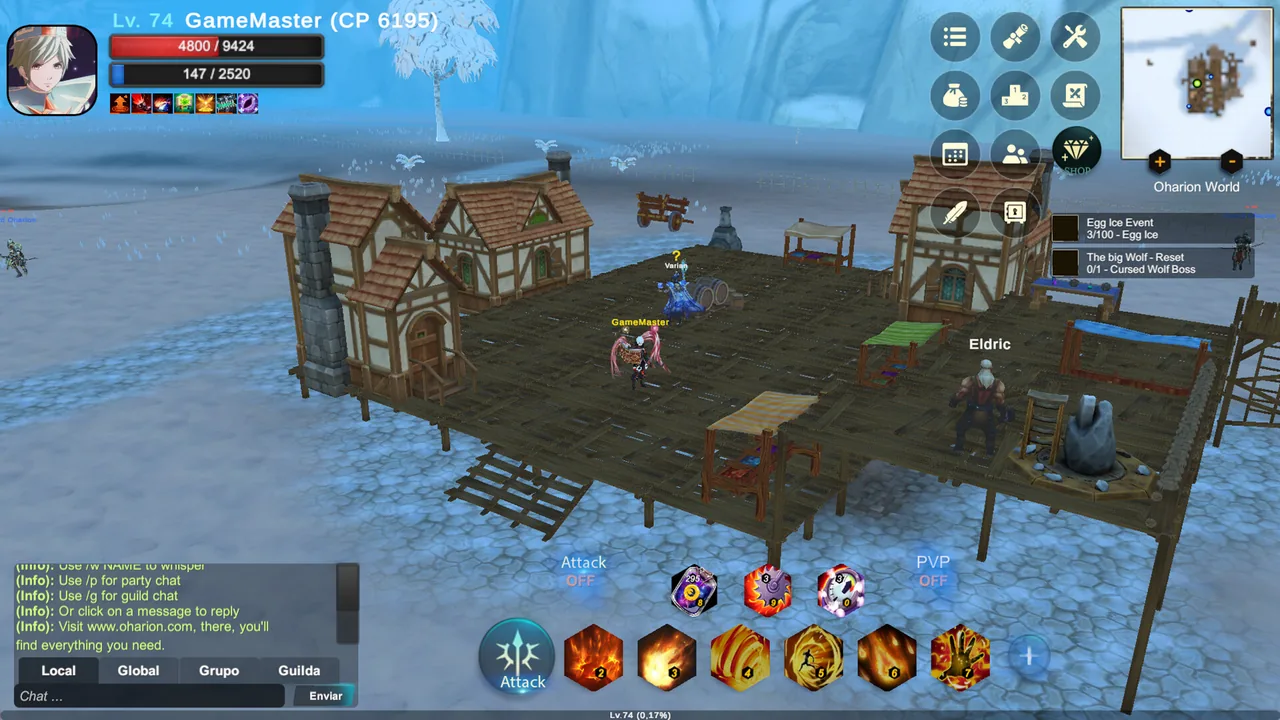
A snowy market village hub, with NPCs and other players visible in local chatImage: Aily Torezani via Steam -
Category scores for OharionWanderer Game Reviews