
Game review
Legends of Amberland III: The Crimson Tower
7.1 / 10
- Developer
- Silver Lemur Games
- Publisher
- Silver Lemur Games
The short version
Biggest strengths
- A faithful, well-executed throwback to 90s first-person party blobbers like Might & Magic, Wizardry, and the Gold Box series, with fast, turn-based combat that reviewers repeatedly call satisfying even after two prior entries
- A new clue-based questing system replaces simple fetch-quest text with environmental hints players have to piece together, praised as a genuine step up in how the game handles its side content
- Extremely low hardware requirements and confirmed smooth performance across Steam Deck, ROG Ally, and even Android via GameNative, alongside a free demo that lets players try the formula before buying
Biggest weaknesses
- Widely described by returning fans as 'more of the same' rather than a meaningful leap forward, with several reviewers naming it the weakest of the three Amberland entries so far
- Noticeably shorter than its predecessors for many players — several report finishing in around 7 hours versus 10-12 for the earlier games — with an ending some call abrupt
- The two new character classes draw specific criticism from at least one detailed review as underwhelming reskins with equipment restrictions rather than genuinely new playstyles
7.1 / 10
A third serving of 90s blobber comfort food
Legends of Amberland III: The Crimson Tower is exactly what it says on the tin: a self-described "love letter from the 90s," built in the image of Might & Magic, Wizardry, Ultima, and the Gold Box series. Players assemble or select a party of seven adventurers and set off on a light, fairy-tale-toned quest against Amberland's latest evil, with the game's own pitch promising something "heroic and slightly humorous" rather than grim or sprawling. It's the third entry in developer Silver Lemur Games' series, and while each Amberland game tells a self-contained story that can technically be played in any order, the overwhelming majority of Steam reviews for The Crimson Tower come from players who've already finished the first two and are returning specifically because that formula worked for them.
The formula: first-person, grid-based, turn-based
Mechanically, the game commits fully to its old-school inspirations: first-person perspective, 90-degree grid-based movement, and turn-based systems governing both combat and exploration, all built around a seven-character party that can be predefined or manually assembled at the start. Combat is deliberately fast, especially against weaker enemies who can be dispatched in a turn or two, and a front-row/back-row positioning system means tankier characters can be deliberately placed to absorb attacks meant for squishier mages and healers. Reviewers consistently praise how quick and unfussy the loop feels in practice — one describes spamming attacks or spells and letting each character's special move carry difficult fights, while another calls the combat "actually pretty fun" despite going in expecting nothing more than nostalgia. Quality-of-life systems carried over and expanded from the earlier games include fast travel to cut down on backtracking, an infinite "magic bag" for unequipped inventory, and a separate personal equipment encumbrance system, all aimed at keeping the classic blobber structure from becoming a chore on modern hardware.
What's actually new this time
Silver Lemur Games didn't rebuild the formula for entry three, but reviewers do single out several concrete additions. A new clue-based quest system replaces the earlier games' more straightforward fetch-quest structure, giving players environmental hints to piece together rather than a direct waypoint — one reviewer calls it "a welcome change to 'simply more quests,' getting you involved and interested in the world without feeling artificial." Two new classes join the roster, including a fist-fighting "Hermit Warrior" that several reviewers highlight by name, and previously midnight-expiring buffs are now timed instead, a small but appreciated fix to a long-standing annoyance. Loot variety and overall balance also get specific praise, with one veteran of all three games calling this entry "vastly better balanced" than its predecessors and noting that mage characters finally feel competitive with warriors deep into a run rather than only in the late game. A new soundtrack and refreshed UI round out the changes, both mentioned approvingly, if briefly, across multiple reviews.
The "more of the same" debate
Because so many reviewers are series veterans, the dominant conversation isn't whether The Crimson Tower is good in isolation, but whether "more of the same" is a compliment or a complaint here — and the split runs right through individual reviews as much as between them. Several players embrace it outright: "more of the same, yes. And exactly because of that it is awesome," reads one representative comment, while another simply states the incremental additions are "well implemented" even while acknowledging they're modest. Others are more ambivalent, praising the steady evolution of systems like clue-based quests and class balance while noting that "the overall game experience... has barely changed" since the second entry, or that the new classes specifically feel like a missed opportunity — one detailed negative review scores the game 5.5/10 and describes the two new classes as "reskinned fighters with equipment restrictions and no fun abilities," arguing the whole release borders on a cash grab despite conceding there's still enjoyment to be had. That review is a clear outlier against an otherwise strongly positive consensus, but its specific class complaints echo faintly in a handful of the more measured positive reviews too.
A shorter, sometimes uneven adventure
Length is the most concrete point of comparison reviewers reach for. Where the first two Amberland games commonly ran 10 to 12 hours, several reviewers who played all three back-to-back report finishing The Crimson Tower in closer to 7, with one specifically calling out an ending that arrives abruptly rather than building to a satisfying climax. World design takes a related hit in a handful of detailed reviews: the desert, swamp, and ice-field regions are described as noticeably larger than in prior entries but with only a couple of dungeons apiece, leaving big stretches of overworld that feel like padding rather than meaningful exploration. None of this appears to have soured the overall reception — the vast majority of reviewers, even the more critical ones, still recommend the game — but it's a consistent enough thread across independent write-ups to flag as a genuine step back from the series' high point in entry two, rather than isolated grumbling.
Verdict
Legends of Amberland III: The Crimson Tower is precisely the game its title and short description promise: an unpretentious, technically unambitious, and thoroughly comfortable continuation of a first-person party-RPG series built for players who grew up on Might & Magic and never stopped wanting more of it. Its clue-based quests, rebalanced classes, and refined UI are real, welcome improvements, and its rock-bottom hardware requirements plus a free demo make it an easy game to simply try. Where it stumbles is in ambition: shorter than its predecessors, light on meaningfully new class design, and prone to padding its overworld rather than filling it with things worth finding. Returning Amberland fans should feel right at home; newcomers curious about the genre are better served starting with the earlier, more fully-realized entries in the series first.
Pros and cons
Pros
- A faithful, well-executed throwback to 90s first-person party blobbers like Might & Magic, Wizardry, and the Gold Box series, with fast, turn-based combat that reviewers repeatedly call satisfying even after two prior entries
- A new clue-based questing system replaces simple fetch-quest text with environmental hints players have to piece together, praised as a genuine step up in how the game handles its side content
- Extremely low hardware requirements and confirmed smooth performance across Steam Deck, ROG Ally, and even Android via GameNative, alongside a free demo that lets players try the formula before buying
- Real, credited developer responsiveness: at least one reviewer describes a personal issue they raised being addressed directly and fixed by the developer
Cons
- Widely described by returning fans as 'more of the same' rather than a meaningful leap forward, with several reviewers naming it the weakest of the three Amberland entries so far
- Noticeably shorter than its predecessors for many players — several report finishing in around 7 hours versus 10-12 for the earlier games — with an ending some call abrupt
- The two new character classes draw specific criticism from at least one detailed review as underwhelming reskins with equipment restrictions rather than genuinely new playstyles
- World and dungeon design in this entry is called out as less interesting than before, with large overworld regions (the desert, swamp, and ice fields specifically) criticized as mostly empty space filled with monsters rather than meaningful navigation
Screenshots
-
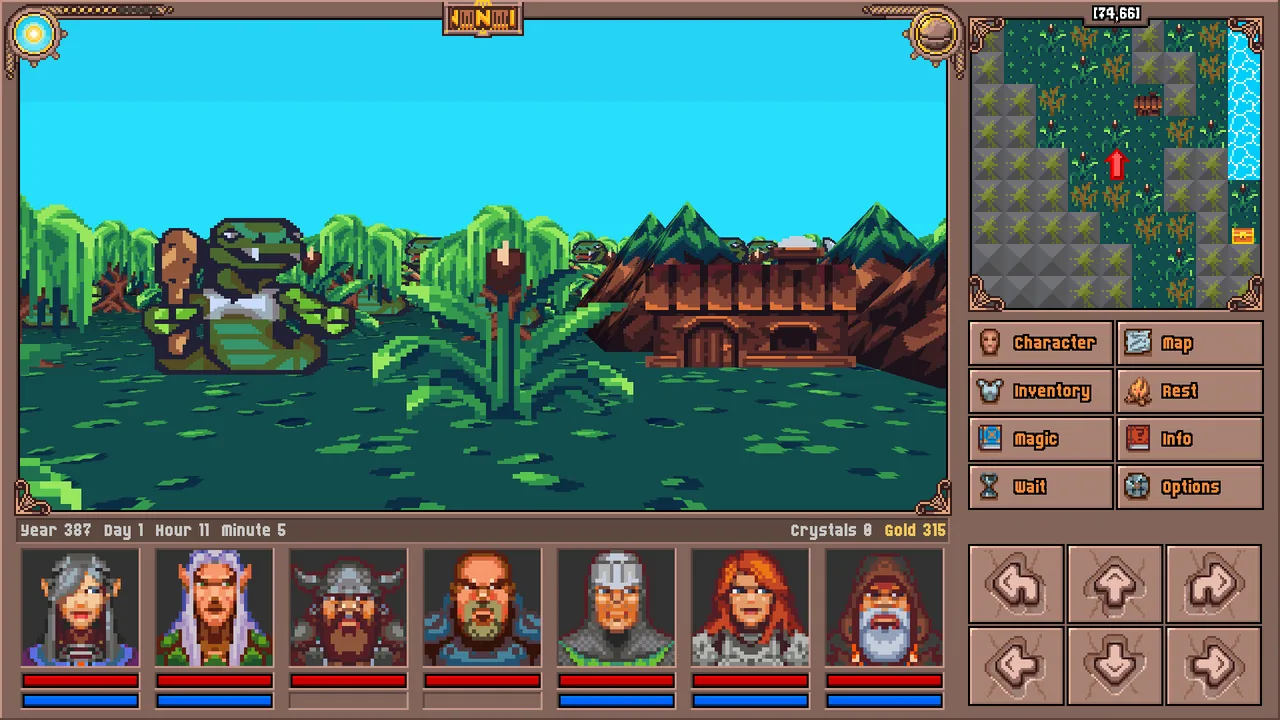
Exploring a swamp region with the full seven-hero party, minimap, and command panel visibleImage: Silver Lemur Games via Steam -
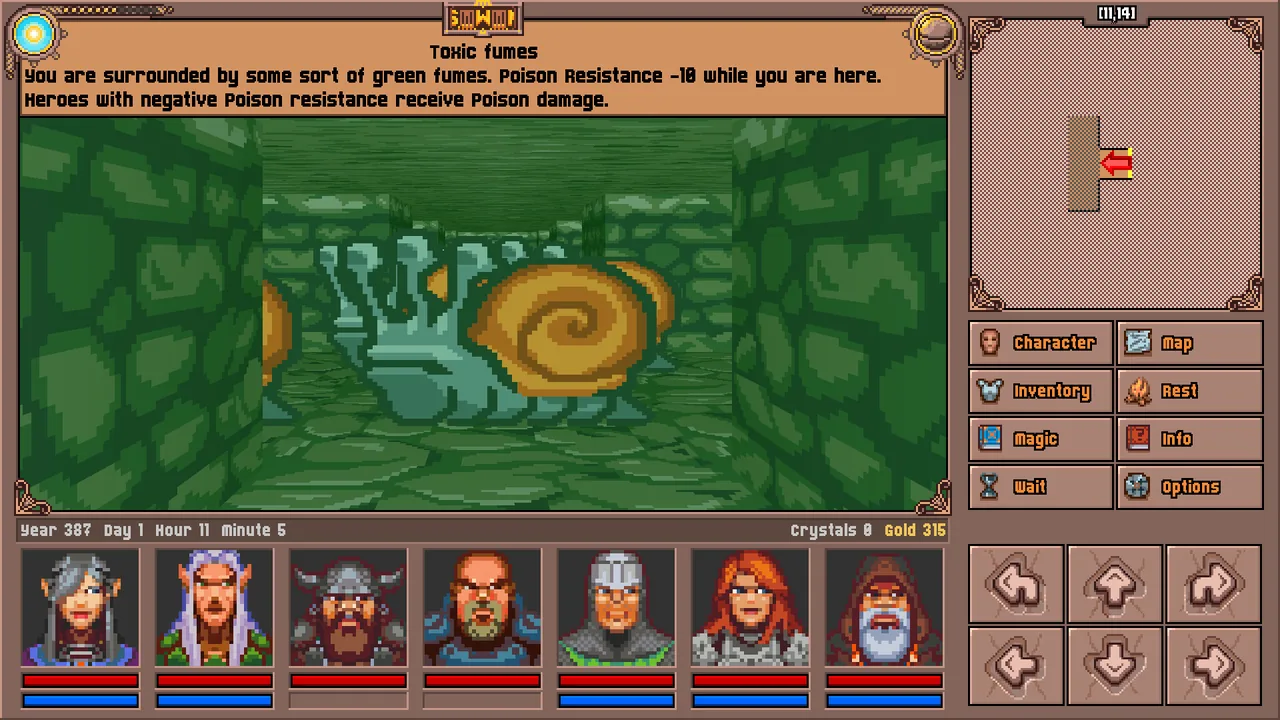
A hazard encounter warning about poison-resistance damage inside a dungeon corridorImage: Silver Lemur Games via Steam -
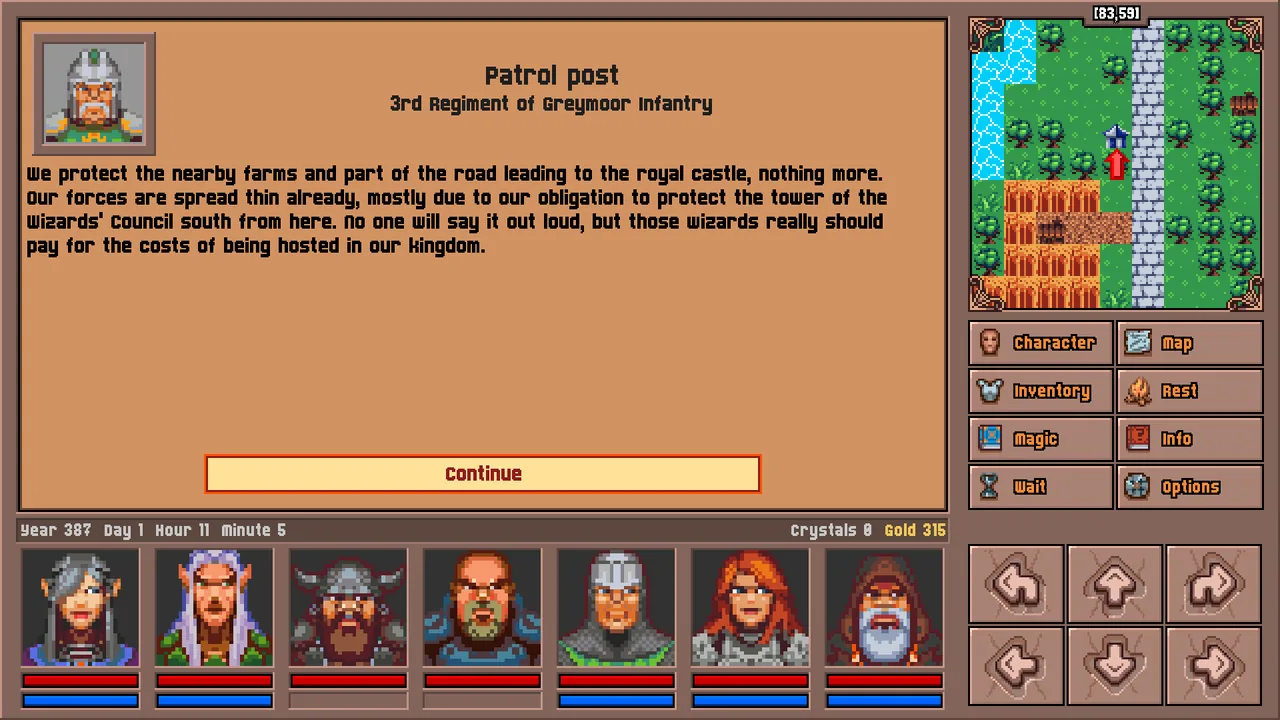
A quest dialogue exchange with a patrol post guard near a walled settlementImage: Silver Lemur Games via Steam -
Category scores for Legends of Amberland III: The Crimson TowerWanderer Game Reviews