Game review
Legacy of Defense
5.8 / 10
- Developer
- Enter the Game Studios
- Publisher
- Enter the Game Studios
The short version
Biggest strengths
- Cheap, addictive idle-roguelite loop that's easy to play alongside something else
- Randomized in-battle skill trees keep individual runs feeling different
- Cute, hand-drawn presentation with a genuine nostalgic charm to it
Biggest weaknesses
- Shipped three new heroes as paid day-one DLC on top of an already-paid 1.0 launch
- The six heroes play near-identically once past their single unique skill
- Endless/Abyss mode criticized as repetitive stat-draining rather than genuinely new content
5.8 / 10
The Pitch
Legacy of Defense is a side-scrolling defense game that bolts deck-building onto the incremental-roguelite formula: pick a hero, draw and play skill cards to fend off waves of fantasy monsters, gain experience, and push through stages toward a final boss, with meta-progression carrying over between runs. Developer Enter the Game Studios released the full 1.0 version on Steam on 14 August 2026, building on a free browser prologue that had already picked up a following, several reviewers mention having played it for dozens or hundreds of hours before ever paying for the Steam release. Its 131 English-language reviews sit at Mostly Positive, 102 of them recommending it, but the tone across those reviews is unusually split between genuine affection for the core loop and real frustration with how the full release was handled.
A Prologue That Already Had Most of the Game
A recurring, specific complaint is how little the paid 1.0 release actually adds over the free prologue that preceded it. One detailed review, after ten hours in the prologue, describes the full version adding two new heroes, two new stages, an endless mode, and comparatively little else, concluding that anyone who played the prologue has already experienced roughly seventy percent of what the paid release offers. That same reviewer beat the entire game in about two hours after starting the full version, with all their prior prologue progress carrying over. It's not framed as a reason to avoid the game outright, several reviewers still recommend it at its low price, but it's a specific, credible data point about how much genuinely new content the Steam launch represents.
An Addictive, if Repetitive, Loop
Where Legacy of Defense earns its Mostly Positive rating is the moment-to-moment loop itself. Reviewers repeatedly describe it as "brain crack," a time-waster they can play while watching a video or half-focused on something else, and the randomized in-battle skill tree, where available upgrades shuffle each run, gets specific credit for keeping individual sessions from feeling identical. Several reviewers with hundreds or even tens of thousands of minutes logged describe it as an easy daily habit rather than something they sat down to finish once. The catch, raised almost as often as the praise, is that build diversity thins out fast once you understand the systems: reviewers describe the six playable heroes as functionally interchangeable beyond one unique signature skill each, and multiple reviews independently arrive at the same conclusion, that there's effectively one dominant strategy that clears the game reliably, after which experimenting with anything else feels like a step down rather than a real choice.
The Day-One DLC Backlash
The sharpest criticism in the review set isn't about gameplay at all. At the same time as the 1.0 launch, the developer released three additional playable heroes as paid downloadable content, priced at roughly half the cost of the base game itself. Multiple reviewers call this out specifically and harshly, one describing it as "plain scummy," another writing that instead of using the 1.0 launch for polish or quality-of-life work, the developer chose to gate new characters behind day-one DLC "as if the game doesn't already cost money." It's a strong enough sticking point that at least one reviewer explicitly says they would otherwise recommend the game but can't get past "delusional developers" making that call. This is a legitimate, first-party monetization decision being criticized on its own terms, not a case of players objecting to the base game's price, which is widely described elsewhere in the same reviews as very fair.
Bugs and Rough Edges
Beyond the content and monetization complaints, a handful of specific technical issues show up across multiple reviews: a bug where starting a new run after dying leaves the character unable to aim, firing only straight ahead; an end boss reviewers describe as unreliable and prone to freezing enemies or breaking basic attacks; and a more frustrating quit-to-desktop bug where the game hangs on exit, forcing players to force-close it through the task manager rather than alt-F4 or alt-tab working normally. One reviewer also reports that clearing the separate Abyss challenge mode doesn't correctly credit progress toward Infinite mode, meaning the two modes' completion tracking doesn't line up the way the game implies it should. None of these come up as universal, but they're specific and detailed enough, rather than vague "it's buggy" complaints, to be worth flagging to anyone considering picking it up.
The endless mode that the full release adds comes in for its own specific criticism, separate from the general bug list. Several reviewers describe its level-up options degrading the longer a run goes, eventually offering nothing but choices to give up an existing stat or gamble on a coin flip between two downgrades, which reads less like an escalating late-game challenge and more like a cheap way of draining the player's stats to force a run to end. It's the kind of design choice that reinforces the broader sense running through the review set, that content added for the paid release doesn't hold up as well as the loop it's built on top of.
Verdict
Legacy of Defense is a genuinely likeable idle-roguelite hamstrung by decisions that have little to do with its core design. The randomized skill trees and low-commitment, background-friendly pacing clearly work, plenty of reviewers with serious playtime are proof of that, but thin build diversity, a full release that barely outgrows its own free prologue, and a day-one paid DLC launch that reviewers view as a bad-faith cash grab all drag it down from what it could have been. At its low asking price it's still an easy pick for anyone who wants a cheap, chill number-go-up game to half-pay-attention to, just go in knowing the "full release" label is doing more marketing work than actual content work, and skip the character DLC unless the backlash doesn't bother you.
Pros and cons
Pros
- Cheap, addictive idle-roguelite loop that's easy to play alongside something else
- Randomized in-battle skill trees keep individual runs feeling different
- Cute, hand-drawn presentation with a genuine nostalgic charm to it
- Frequently praised as excellent value for the asking price
Cons
- Shipped three new heroes as paid day-one DLC on top of an already-paid 1.0 launch
- The six heroes play near-identically once past their single unique skill
- Endless/Abyss mode criticized as repetitive stat-draining rather than genuinely new content
- Reported bugs: a broken aim state after dying, a buggy end boss, and a hang on exiting the game
Screenshots
-

A Forest-stage run against the Giant Mushroom boss and its mushroom swarmImage: Enter the Game Studios via Steam -
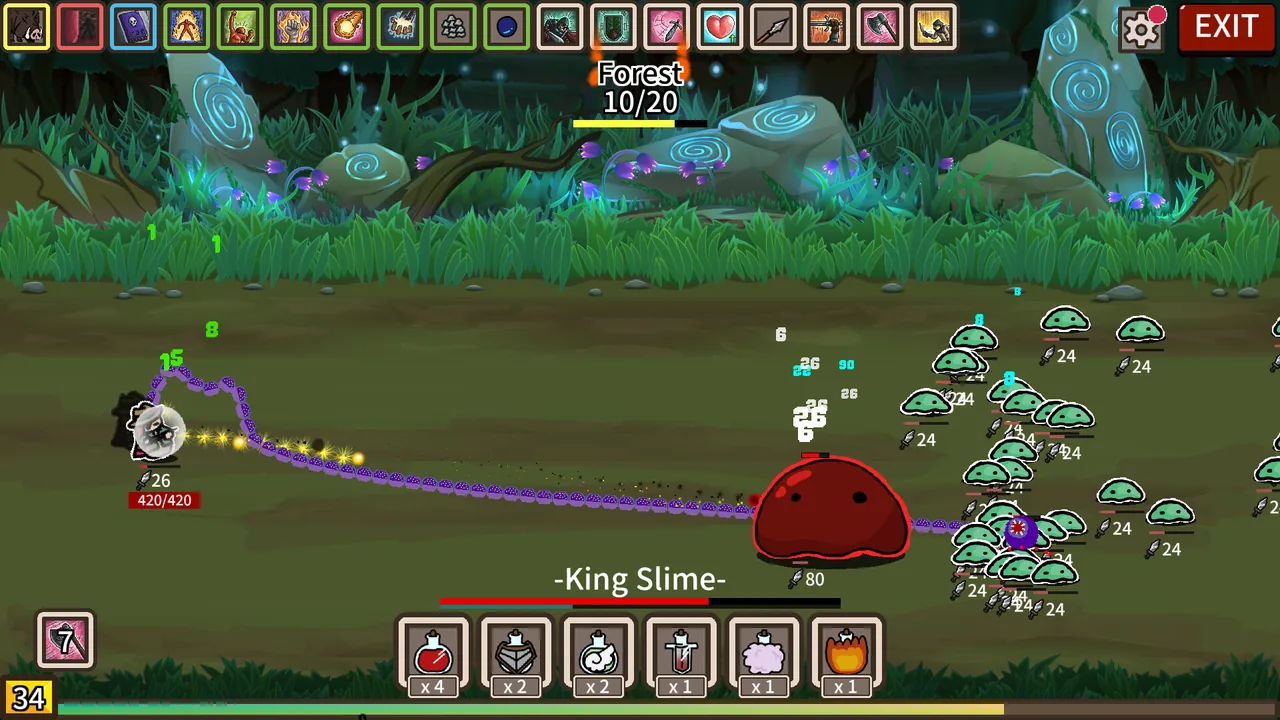
The King Slime boss fight, one of the game's recurring stage encountersImage: Enter the Game Studios via Steam -
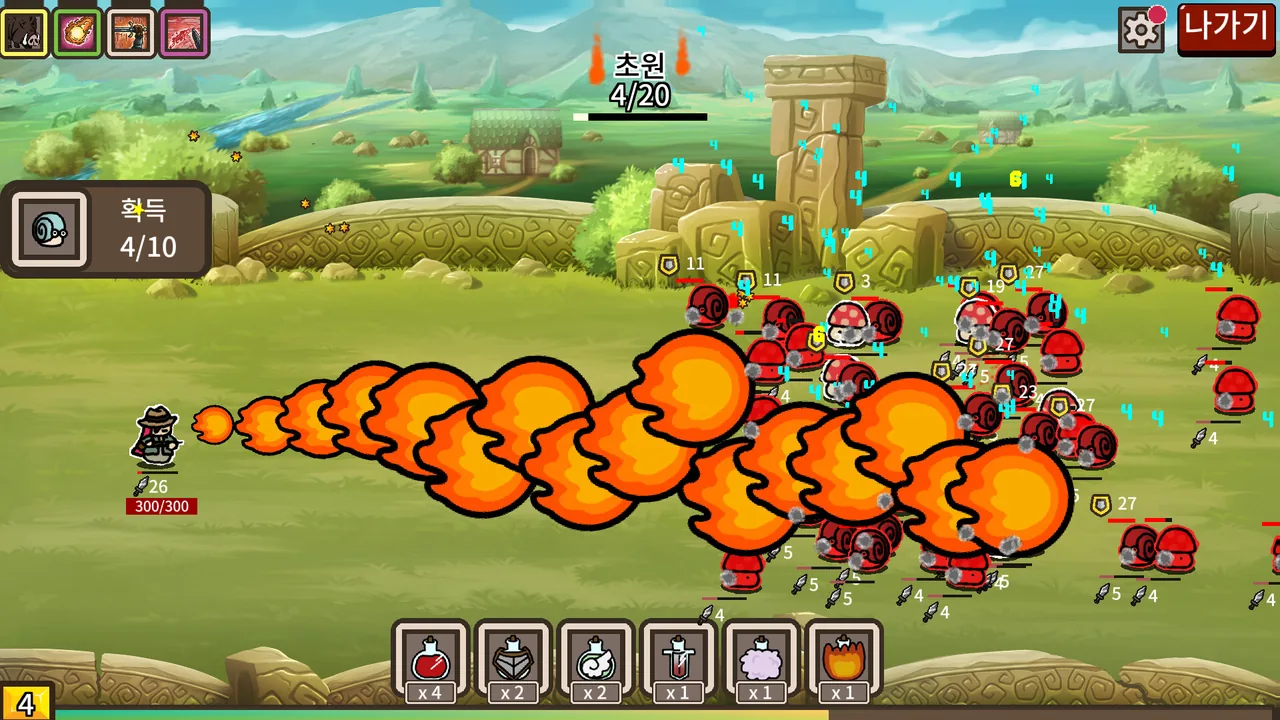
A fire-breathing skill clears a line of enemies in the plains stageImage: Enter the Game Studios via Steam -

Category scores for Legacy of DefenseWanderer Game Reviews