Game review
Huaxia: Warring States
6.1 / 10
- Developer
- 秦川汉渚
- Publisher
- 秦川汉渚
The short version
Biggest strengths
- A genuinely deep Mount & Blade-style RPG loop: clan building, troop recruitment and promotion, trading, crafting, and skill-tree character progression that reviewers describe as having real long-term depth
- An authentically Chinese historical setting reviewers say beats Western 'Chinese-inspired' games at their own game, with Five Elements and Yin-Yang combat mechanics and a bloodline-and-constellation character system
- Large-scale, tactically satisfying battles, with early and mid-game lord fights described as genuinely tense, high-stakes encounters rather than trivial skirmishes
Biggest weaknesses
- At various points since launch, large portions of English text — including the settings menu, quest objectives, and dialogue — have been reported missing entirely, making parts of the game unplayable for non-Chinese speakers
- Serious game-breaking bugs, including save corruption and quests that silently fail when quest items are distributed across companions' inventories
- Archer units are considered overpowered due to how unit collision currently works, and battles are capped at 100 units per side
6.1 / 10
A Chinese Mount & Blade, built by people who clearly love the source material
Huaxia: Warring States drops players into the final chaotic year of the Zhou dynasty, rising from slavery to conquest across a fractured ancient China. The Mount & Blade comparison shows up in nearly every substantial review, and reviewers are quick to note it's not a lazy knockoff: one long-time fan of that series argues the comparison actually undersells Huaxia, calling it a game with "the potential of being a more in-depth game" once its rough edges are sanded down. The setting is more than window dressing — combat draws on Five Elements and Yin-Yang mechanics, and character build identity is shaped by bloodline and constellation systems that reviewers say give the game a genuinely distinct flavor rather than a reskin of familiar Western fantasy RPG tropes. One reviewer, writing as a native Chinese speaker able to judge the setting's authenticity directly, calls the atmosphere and art direction more convincingly Eastern than any Western "Chinese-inspired" game they've encountered.
Clans, crafting, and a skill tree with real teeth
Beneath the historical setting sits a genuinely substantial RPG progression system. Players build and grow a homestead and clan, recruit troops that can be promoted over time, trade goods across the map, and craft equipment through a system more than one reviewer calls "a tad convoluted" but ultimately rewarding once understood. The character skill tree draws comparison to Path of Exile's — praised as a strong foundation reviewers want to see expanded further — and player stats meaningfully gate access to stronger equipment and tactics, which one detailed review specifically credits with preventing the kind of nonsensical power snowballing that undermines pacing in similar open-world RPGs. Exploration is repeatedly singled out as satisfying too, alongside "lairs" — dungeon-like challenges reviewers describe as a welcome change of pace from straightforward field battles. Small quality-of-life gaps stand out precisely because the rest of the system is so considered: one reviewer points out that books already read for crafting recipes aren't marked as owned, forcing players to second-guess purchases in a system built specifically around collecting them, and another wishes for an unarmed, fist-based combat style to round out the game's otherwise strong Wuxia-inspired weapon variety.
Battles that punch above the genre's usual stakes
Combat draws some of the review pool's warmest praise. Group battles are called "new and refreshing" for the Mount & Blade-adjacent genre, and reviewers repeatedly note that fighting even a single enemy lord in the early-to-mid game can feel like "a miniature dark souls battle" — genuinely dangerous rather than a formality before the real fight begins. That said, the combat system isn't without balance issues: because of how unit collision currently works, archer units are considered significantly overtuned, and battles are hard-capped at 100 units per side, a concession reviewers largely understand as necessary for budget hardware but still note as a real limitation on scale compared to genre peers. One detailed review also flags that hero stat scaling gets exaggerated at higher levels in a way reminiscent of the Dynasty Warriors series, undercutting some of the tactical tension in late fights.
The localization crisis dominating the negative reviews
By a wide margin, the most common complaint in the review pool isn't about mechanics — it's about language. Multiple detailed negative reviews describe entire menus, quest objectives, and NPC dialogue rendered as blank text boxes or left untranslated in the original Chinese, with the settings menu itself reportedly unreadable for some players at points since launch. Several reviewers explicitly frame their negative score as conditional, stating they'll revisit their review once translation work catches up rather than as a permanent verdict on the underlying game. That framing turns out to be borne out by the review timeline itself: multiple reviewers who initially couldn't progress past broken menus later updated their reviews to describe dramatic, rapid improvement, with one reporting the game going from unreadable to substantially translated within a single day of active patching.
Bugs that go beyond translation
Translation aside, Huaxia: Warring States has real stability problems reviewers can't attribute to localization. One detailed review describes losing a 30-plus-hour save to corruption after a homestead-building feature broke, only to have a second save corrupted separately when a critical quest item vanished from their quest log after a reload. Another reviewer documents a specific and reproducible bug where quest items distributed across multiple companions' inventories — necessary when a single delivery quest requires carrying more weight than one character can hold — aren't correctly recognized by the game when the quest is turned in, silently failing the objective. These are the kinds of bugs that go beyond "needs more translation work" and speak to a game still very early in its Early Access life, regardless of language.
Verdict
Huaxia: Warring States is a genuinely ambitious, mechanically deep Mount & Blade-style RPG wrapped in a historical Chinese setting that reviewers consistently praise as authentic rather than superficial — its clan-building, skill tree, and large-scale battle systems all show real promise. Right now, though, it's held back by problems that go well beyond typical Early Access roughness: incomplete and at times entirely missing English localization, and game-breaking bugs capable of corrupting dozens of hours of progress. The developer's rapid, visible patch cadence has earned a lot of good faith from reviewers willing to look past the current state, and several who initially couldn't play the game in English now recommend it. For English-speaking players specifically, though, this is one to watch closely rather than buy immediately — the potential is real, but so is the risk of hitting a wall of untranslated text or a corrupted save before the game catches up to its own ambitions.
Pros and cons
Pros
- A genuinely deep Mount & Blade-style RPG loop: clan building, troop recruitment and promotion, trading, crafting, and skill-tree character progression that reviewers describe as having real long-term depth
- An authentically Chinese historical setting reviewers say beats Western 'Chinese-inspired' games at their own game, with Five Elements and Yin-Yang combat mechanics and a bloodline-and-constellation character system
- Large-scale, tactically satisfying battles, with early and mid-game lord fights described as genuinely tense, high-stakes encounters rather than trivial skirmishes
- A visibly active, communicative developer pushing frequent patches, with several reviewers documenting major translation and stability improvements within days of purchase
Cons
- At various points since launch, large portions of English text — including the settings menu, quest objectives, and dialogue — have been reported missing entirely, making parts of the game unplayable for non-Chinese speakers
- Serious game-breaking bugs, including save corruption and quests that silently fail when quest items are distributed across companions' inventories
- Archer units are considered overpowered due to how unit collision currently works, and battles are capped at 100 units per side
- Content is currently thin enough that at least one reviewer describes losing motivation once the early conquest goals are achieved, with little left to do afterward
Screenshots
-
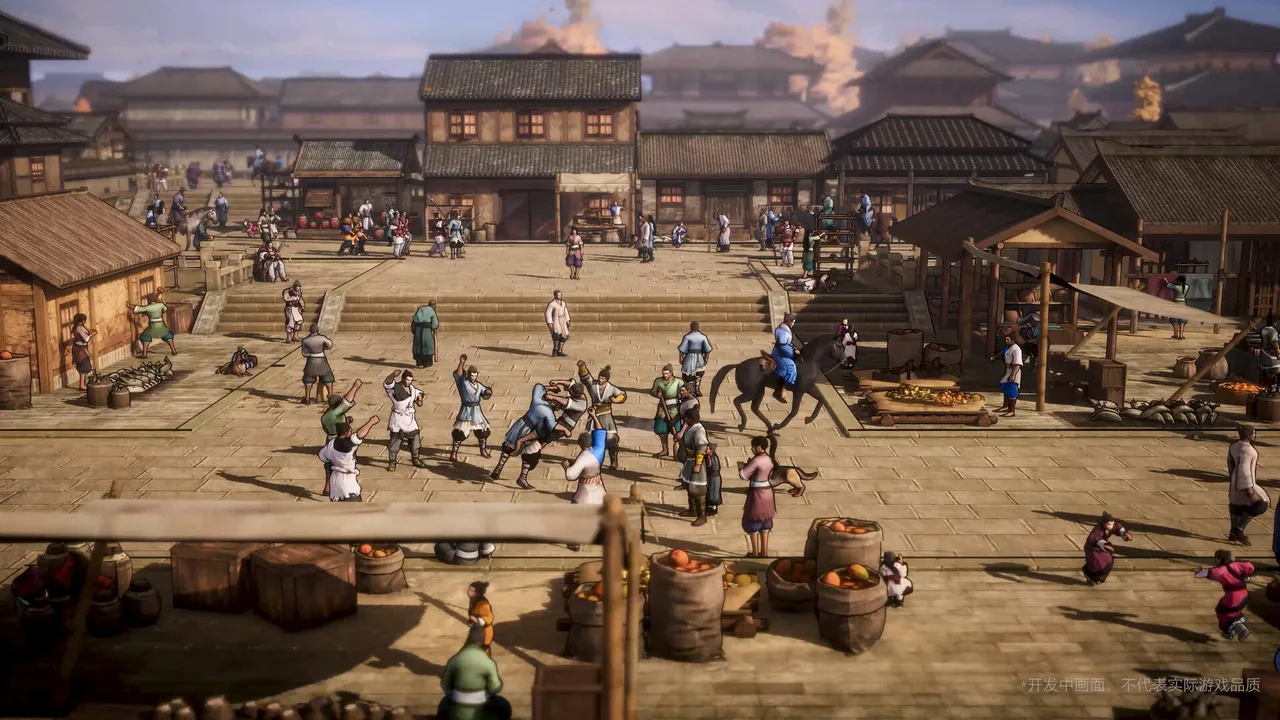
A bustling town square, with a street brawl breaking out near the market stallsImage: 秦川汉渚 via Steam -
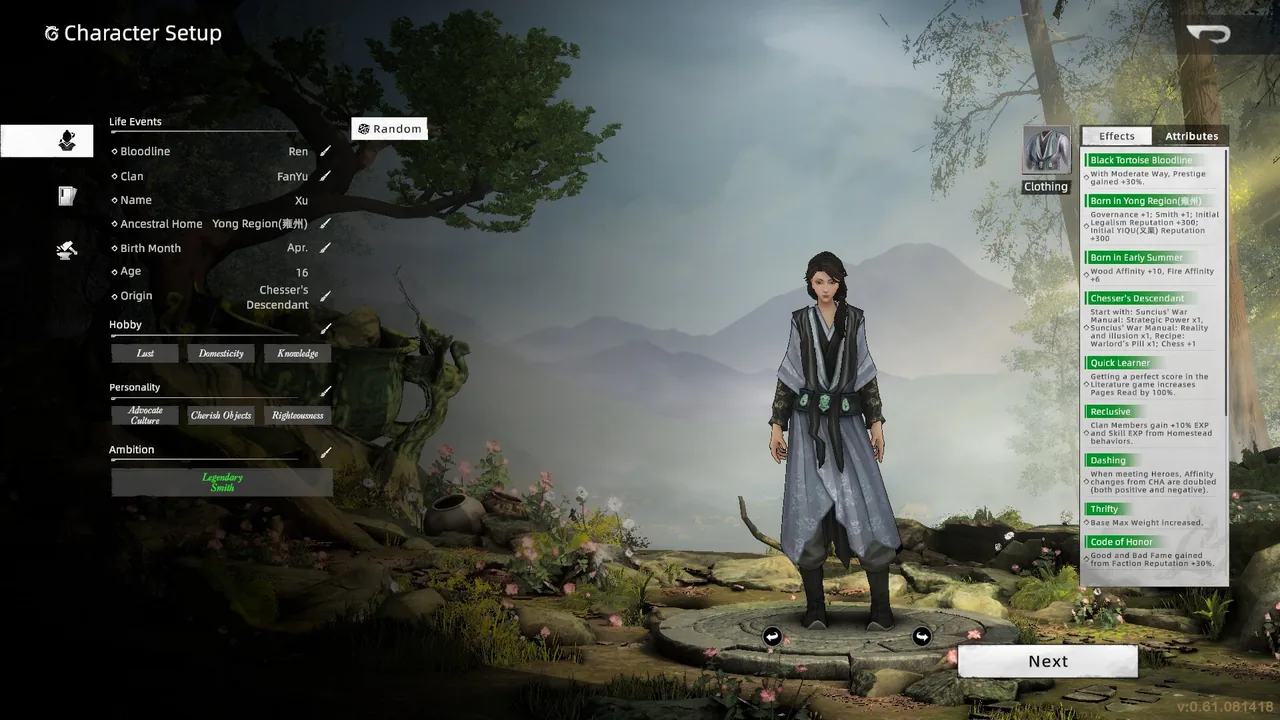
Character creation, with bloodline, clan, and ambition options shaping the starting buildImage: 秦川汉渚 via Steam -
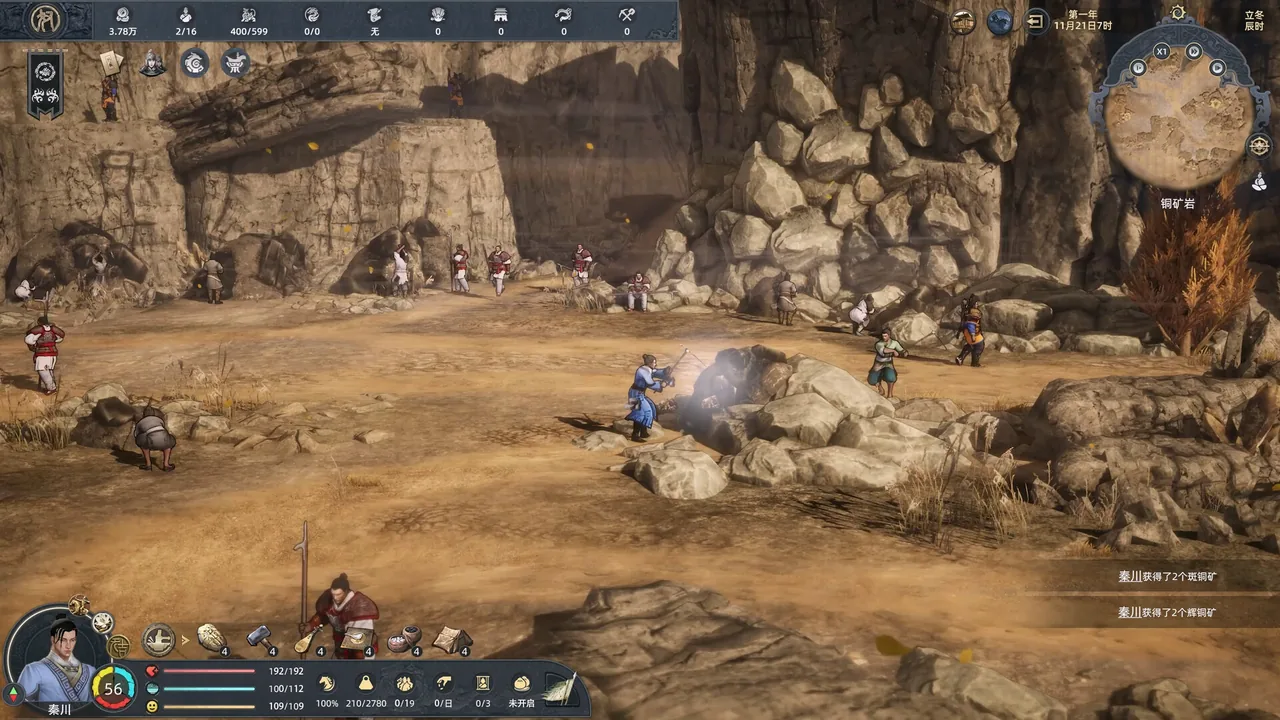
Mining copper ore in a rocky canyon, with the party's resource gathering tracked on the HUDImage: 秦川汉渚 via Steam -

Category scores for Huaxia: Warring StatesWanderer Game Reviews