
Game review
Feywood Wanderers
6.7 / 10
- Developer
- Vicente Miranda
- Publisher
- Vicente Miranda
The short version
Biggest strengths
- A genuinely deep tactical turn-based extraction loop where positioning and resource management matter every single step, since movement itself consumes a turn
- Excellent build variety across races, classes, and equipment — reviewers compare it favorably to genre stalwarts like Tales of Maj Eyal, Dungeonmans, and TOME4
- A generous, carry-over demo and a solo developer widely praised as responsive, actively adding community-suggested weapons and features post-launch
Biggest weaknesses
- Inconsistent stat scaling on weapons and spells that several reviewers describe as arbitrary, undermining some of the build-crafting the game is otherwise praised for
- A reproducible crash around character level 15 reported by at least one player, alongside broken control input specifically on the ROG Ally X handheld
- Both major game modes — the standard roguelite and the story-light 'Lone Wolf' roguelike — are called out as unevenly balanced, with stockpiled endgame gear able to trivialize early floors
6.7 / 10
A forest that wants you dead
Feywood Wanderers drops you at the edge of a corrupted magical forest, hunting a beast that's slowly withering the world away. It's a premise thin enough to fit on a postcard, and that's by design — the Feywood itself, not its story, is the point. Built by solo developer Vicente Miranda, this is a turn-based tactical roguelike wrapped around an extraction structure: you delve into procedurally generated branches of forest, fight or flee from whatever's waiting in them, and decide how much of what you find is worth risking a run home with. Reviewers repeatedly reach for the same comparisons — Tales of Maj Eyal, Dungeonmans, Dungeons of Dredmor, Dungeon Crawl Stone Soup — and those reference points are earned. This is a traditional roguelike at heart, dressed in a more modern interface and an extraction layer that changes how cautious you have to be.
Every step is a turn
The core loop is deliberately unhurried. Battles are turn-based and tactical, and crucially, so is movement — every step through the Feywood counts as a turn, which means positioning is never free. Enemies react to your approach, terrain and line of sight matter, and reviewers describe combat as demanding real thought rather than reflexes. Death is expensive: whatever your character is carrying when they die is gone for good, in keeping with the game's roguelike bones. But Feywood Wanderers softens that blow with its namesake extraction mechanic — clear an area and you can stash anything you've looted, banking it in a persistent central stockpile that survives your character's death and equips the next one. For players who bounce off punishing permadeath, that stash is the game's biggest concession to accessibility, and multiple reviewers single it out as the hook that kept them playing past their first few runs.
Minotaurs, goblins, and everything between
Where Feywood Wanderers earns its strongest praise is build variety. You choose a race — each with its own statline and a unique "lineage" skill tree — and a class, then mix and match abilities and equipment however you like. The result, per the game's own pitch and echoed by reviewers, ranges from a minotaur berserker charging headlong into fights to a book-wielding elf slinging spells, a shadow-lurking goblin assassin, or a druid fighting alongside animal companions. Some classes and archetypes are gated behind a "souls" currency earned during runs, expanding what's available to build with over time — a meta-progression layer reviewers generally credit with keeping the grind purposeful rather than padded. One reviewer who logged over 33,000 minutes calls the character-build depth and replayability "top notch" even while conceding the game is rough around the edges elsewhere, and several others invoke Tales of Maj Eyal and TOME4 by name as the closest points of comparison for how deep the class-and-race system runs. For players chasing full completion, the endgame demands twenty-one multi-hour deep-dungeon dives — steep, though reviewers note the main story and end bosses can be reached well before that point.
Where the seams show
Not every reviewer walked away convinced. A recurring complaint targets stat scaling: weapons and spells reportedly key off inconsistent, seemingly arbitrary attributes — one fire spell might scale with Intelligence, another with Willpower, a third with Strength, with no clear internal logic offered for the variance. The same critique extends to elemental variety more broadly: several reviewers note that different elements mostly look and feel identical in combat, distinguished only by the color of an otherwise generic damage-over-time smoke effect. Balance across the game's two modes draws fire too — in the standard roguelite mode, players who stockpile strong gear in their extraction stash can reportedly carry endgame equipment straight into floor one, flattening the difficulty curve the rest of the game is built around, while the harder, story-light "Lone Wolf" roguelike mode is called out as punishing in the opposite direction, particularly for caster builds saddled with random equipment. On the technical side, one player reports a reproducible crash around character level 15 that locks up movement and menus entirely (recoverable only via a patch download, with no in-game messaging to explain it), and another flags broken control input specifically on the ROG Ally X handheld, where the skills radial menu gets stuck open.
A solo project that listens
What comes through consistently, even from critical reviews, is that Feywood Wanderers feels like an actively tended project rather than an abandoned one. Multiple reviewers describe the developer as unusually engaged with the community — active in Discord, receptive to feedback, and credited by name for adding requested weapons like a blunderbuss and musket based directly on player suggestions. The game also ships with a demo that reviewers repeatedly cite as the reason they bought in, since progress and unlocks made in the demo carry over into the full NZ$21.99 purchase. For a genre where players are often wary of committing blind, that combination of a substantial free trial and a visibly responsive solo developer goes a long way toward justifying the asking price, even for the reviewers who found real rough edges in the scaling and balance underneath.
Verdict
Feywood Wanderers is a promising, occasionally uneven entry in the traditional roguelike space, elevated by genuinely deep build variety and an extraction-stash system that meaningfully changes how permadeath feels without defanging it. The tactical, every-step-is-a-turn combat rewards patience, and the class-and-race combinations give it real replay value for fans of Tales of Maj Eyal or TOME4-style depth. But inconsistent scaling, samey elemental effects, mode balance that can trivialize its own difficulty curve, and at least one confirmed crash bug keep it from feeling fully polished. Anyone curious should start with the demo — it carries over, it's the community's most-cited reason for buying, and it's the fastest way to judge whether this forest is worth getting lost in.
Pros and cons
Pros
- A genuinely deep tactical turn-based extraction loop where positioning and resource management matter every single step, since movement itself consumes a turn
- Excellent build variety across races, classes, and equipment — reviewers compare it favorably to genre stalwarts like Tales of Maj Eyal, Dungeonmans, and TOME4
- A generous, carry-over demo and a solo developer widely praised as responsive, actively adding community-suggested weapons and features post-launch
- A stash-based extraction system that softens traditional roguelike permadeath without eliminating its tension, letting hoarded loot fuel future runs
Cons
- Inconsistent stat scaling on weapons and spells that several reviewers describe as arbitrary, undermining some of the build-crafting the game is otherwise praised for
- A reproducible crash around character level 15 reported by at least one player, alongside broken control input specifically on the ROG Ally X handheld
- Both major game modes — the standard roguelite and the story-light 'Lone Wolf' roguelike — are called out as unevenly balanced, with stockpiled endgame gear able to trivialize early floors
- A brutal early learning curve and visually similar elemental spell effects (differently colored smoke regardless of element) that blunt some of the game's tactical readability at first
Screenshots
-
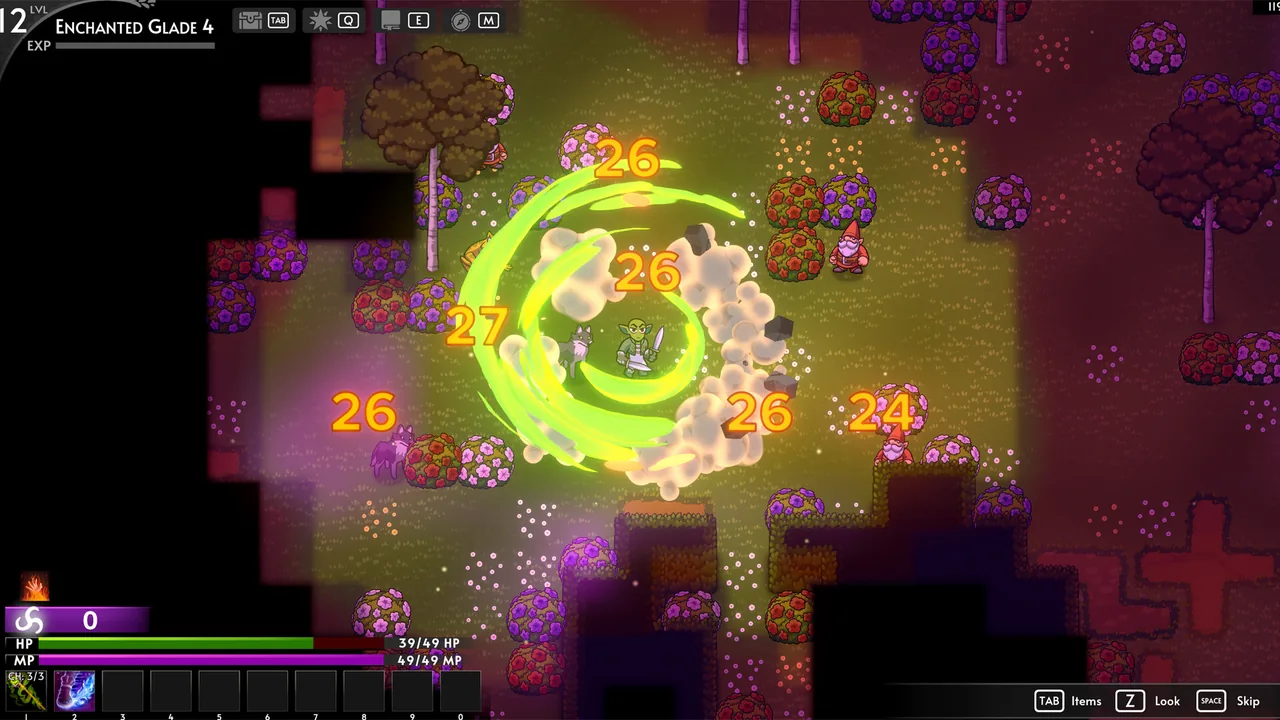
Area-of-effect spells sweep through clustered enemies in the Feywood's Enchanted GladeImage: Vicente Miranda via Steam -
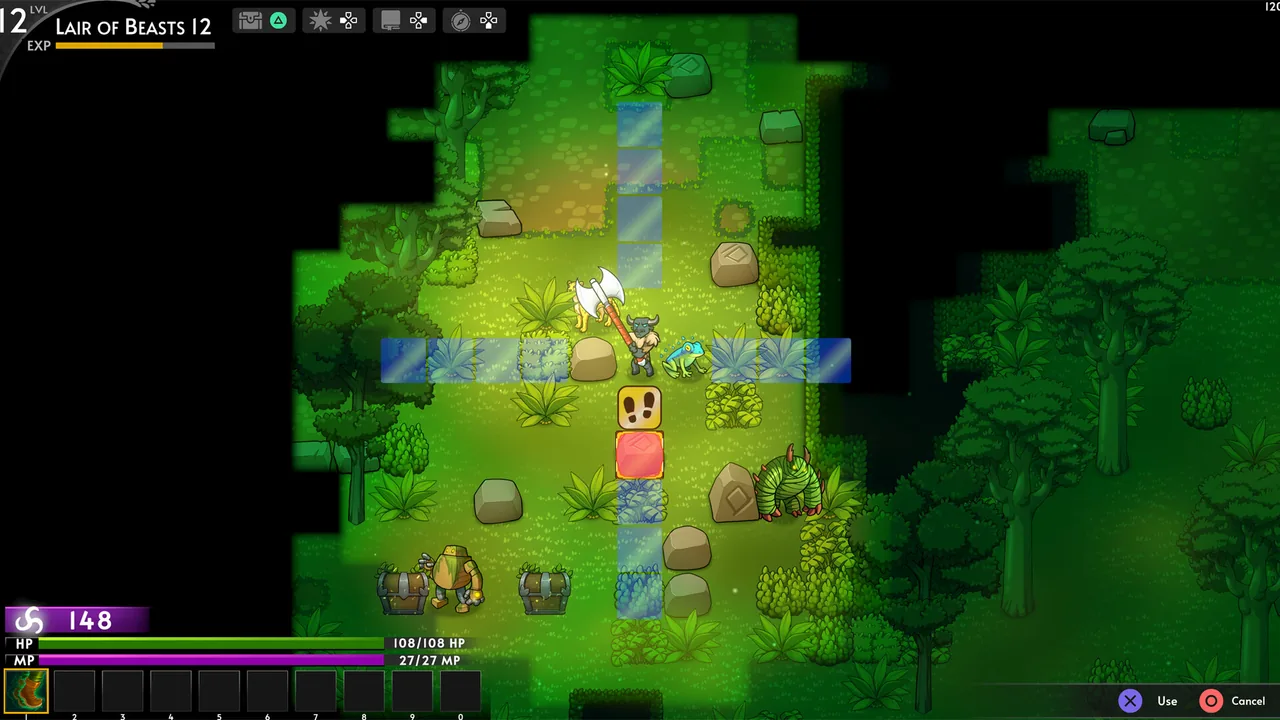
Turn-based movement grids make every step in the Lair of Beasts a tactical decisionImage: Vicente Miranda via Steam -
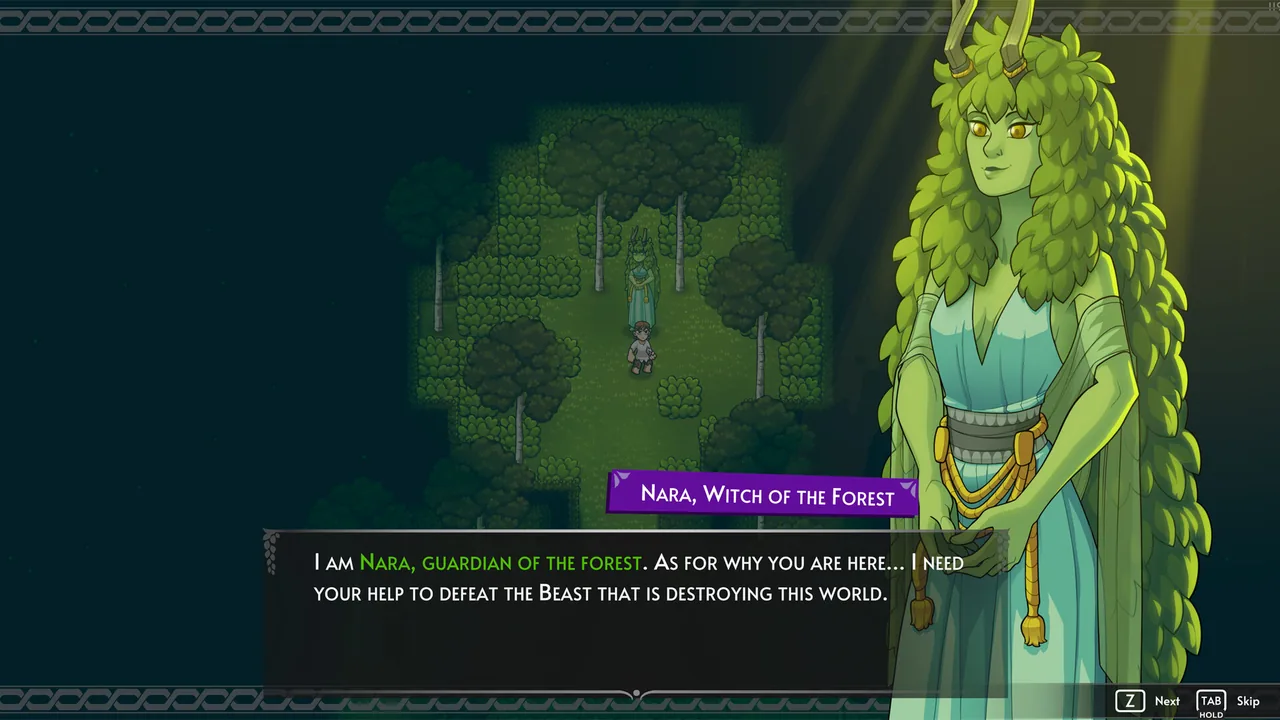
Nara, Witch of the Forest, sets the player's quest to stop the Beast corrupting the FeywoodImage: Vicente Miranda via Steam -

Category scores for Feywood WanderersWanderer Game Reviews