
Game review
Donna Survivors
6.3 / 10
- Developer
- RAZE GAMES
- Publisher
- RAZE GAMES
The short version
Biggest strengths
- Charming pixel art and a genuinely likeable cast of playable pups and kittens
- Cheap entry price delivers a handful of solid hours for genre newcomers
- Ability synergies and evolutions produce satisfying power spikes mid-run
Biggest weaknesses
- Runs are capped at roughly ten minutes, cutting builds off before they truly bloom
- No reroll option on level-up perks means luck outweighs skill in shaping a build
- Offers little connective tissue to its own source material for newcomers to the franchise
6.3 / 10
Overview
Donna Survivors is a bite-sized entry in the crowded Vampire Survivors-like subgenre, built as a spin-off of developer RAZE GAMES' own Donna: The Canine Quest. Rather than continuing that game's adventure-RPG plotline directly, it drops a roster of familiar canine and feline faces into eight arena-style maps and asks players to out-survive escalating waves of enemies using auto-attacking abilities, chosen perks, and stacking synergies. The RPG lineage shows up in the way builds are assembled on the fly: every level grants a random perk pick, weapons evolve when paired with the right complementary items, and stat boosts accumulate into genuinely different playstyles between characters. It's a low-commitment package sold at a correspondingly low price, and it largely delivers what it promises for the length of a single sitting, even if that promise doesn't stretch particularly far.
Story and Setting
There isn't much narrative connective tissue here, and the game doesn't pretend otherwise. Donna Survivors exists in the same universe as Donna: The Canine Quest, populated by the same recognizable characters, but it offers no framing for why they're suddenly fighting off endless hordes across eight disconnected locations. Several reviewers who hadn't played the original title noted feeling adrift, unable to place who Donna actually is beyond "the main hero," with every other unlockable character reading as a stranger without context. Players who arrive already familiar with the source material get a nostalgic hit of seeing its cast reimagined in a new genre; players who don't are left to enjoy the game purely on mechanical terms, with the world-building relegated entirely to the Steam store page rather than anything found in-game.
Gameplay and Mechanics
The core loop is standard for the genre and executed competently: pick a character, enter a map, and hold on as enemies spawn in increasing numbers while your character's abilities fire automatically. Killing enemies drops experience gems, leveling up offers a choice of one perk from three random options, and successive perk stacking is where the build-crafting happens. Ability synergies let certain weapon and stat combinations evolve into stronger forms, and finding those combinations mid-run is the game's best moment-to-moment hook. The catch, repeated by multiple reviewers, is that there's no reroll mechanic for perk choices, so a run's ceiling is set largely by what the random number generator offers rather than by player skill or planning. Runs are also capped at roughly ten minutes each, which keeps sessions tight but also means builds rarely get the chance to fully bloom into the towering, screen-clearing forms genre veterans expect from a full length run.
Individual weapons carry their own quirks worth learning: the starting sword, for instance, aims toward whatever direction the character is facing rather than automatically tracking the nearest threat, which gives it a real learning curve around timing swings while kiting away from mobs. Experience gems also carry diminishing returns as a run progresses, so choosing which pickups to prioritize late in a wave matters more than simply hoovering up everything on screen. A couple of reviewers suggested the maps could use more landmarks or points of interest, such as a shrine granting temporary buffs, to break up the otherwise open, feature-light arenas and give positioning more purpose beyond simple kiting.
Visual Style and Sound Design
Donna Survivors leans into a cute, top-down pixel-art aesthetic that reviewers consistently singled out as a highlight. The character designs translate well from Donna: The Canine Quest's adventure framing into fast-paced arcade action, and the eight maps each carry distinct color palettes and enemy silhouettes drawn from "Donna's Universe" so that stages feel visually differentiated even when the underlying wave-survival structure repeats. The soundtrack drew specific praise for complementing the tone without becoming grating across repeated runs, an important quality in a genre built around replaying short sessions back to back. Nothing here pushes technical boundaries, but the art direction consistently reads as a deliberate strength of the package rather than a place where corners were cut.
Progression and Replayability
Progression follows the familiar survivors-like formula: permanent unlocks and upgrades persist between runs, gradually opening up new characters and strengthening the starting point for future attempts, while each individual run resets to zero and lives or dies on its perk draws. With twelve playable characters, each carrying distinct starting abilities, there's a reasonable amount of build variety to chase across a full unlock sweep. Where the replay loop falls short compared to genre leaders is depth of evolution paths and endgame scaling; several reviewers noted they could realistically only pursue one weapon evolution per run given the ten-minute cap, limiting the "just one more run" pull that defines the best of this style. It's replayable enough to justify its modest asking price, but thin enough that most players described finishing their engagement within a handful of hours rather than settling in for the dozens the format can support.
Verdict
Donna Survivors is a competent, unambitious take on the survivors-like formula that trades on the goodwill of its parent franchise's character designs more than it innovates on the genre itself. Its low price buys several hours of genuinely enjoyable arena chaos, cute pixel art, and satisfying if shallow build synergies, but the lack of a perk reroll, the short run cap, and the thin content roster keep it firmly in "solid budget pick" territory rather than a genre standout. Fans of Donna: The Canine Quest who want more time with its cast, or newcomers looking for a cheap, low-commitment entry into the survivors-like space, will find it worth the asking price; anyone hoping for the depth and scale of the genre's biggest names should look elsewhere first.
Pros and cons
Pros
- Charming pixel art and a genuinely likeable cast of playable pups and kittens
- Cheap entry price delivers a handful of solid hours for genre newcomers
- Ability synergies and evolutions produce satisfying power spikes mid-run
- Low barrier to entry: easy controls make it approachable for casual players
Cons
- Runs are capped at roughly ten minutes, cutting builds off before they truly bloom
- No reroll option on level-up perks means luck outweighs skill in shaping a build
- Offers little connective tissue to its own source material for newcomers to the franchise
- Content roster feels thin next to genre leaders, with few surprises across repeat sessions
Screenshots
-
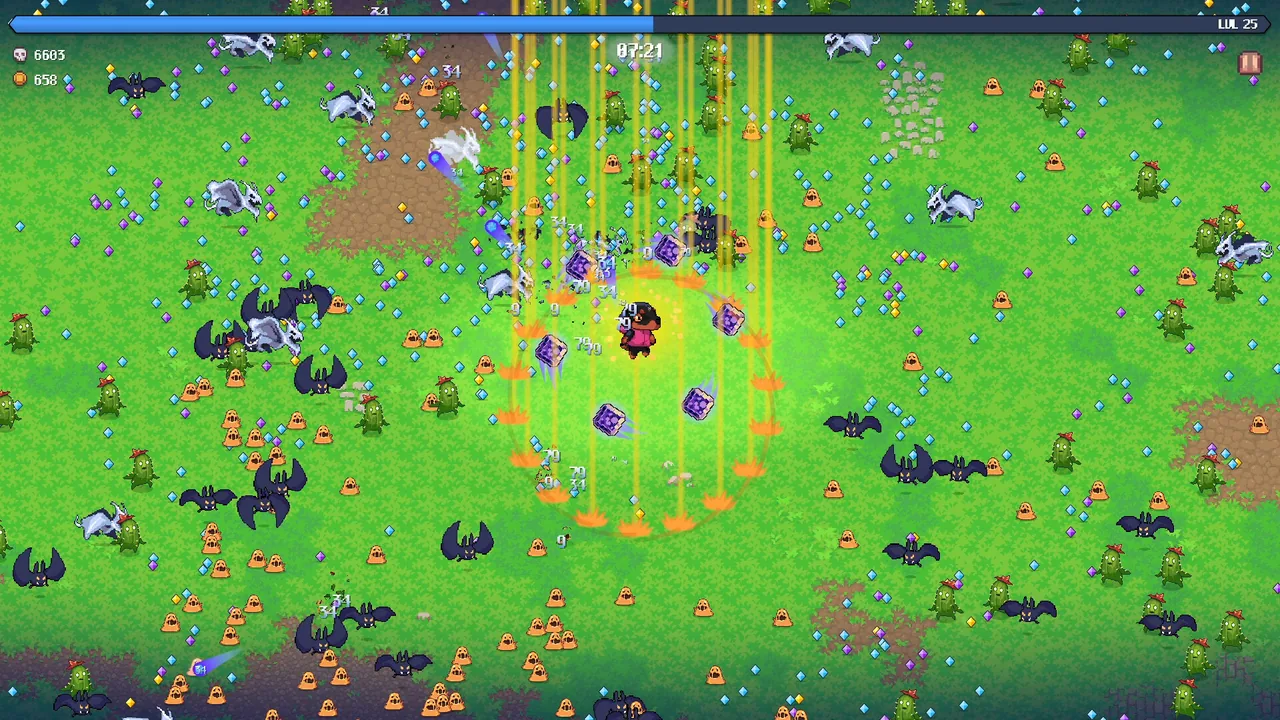
A late-game wave on the field map, with beam attacks clearing swarms of bats and goatsImage: RAZE GAMES via Steam -
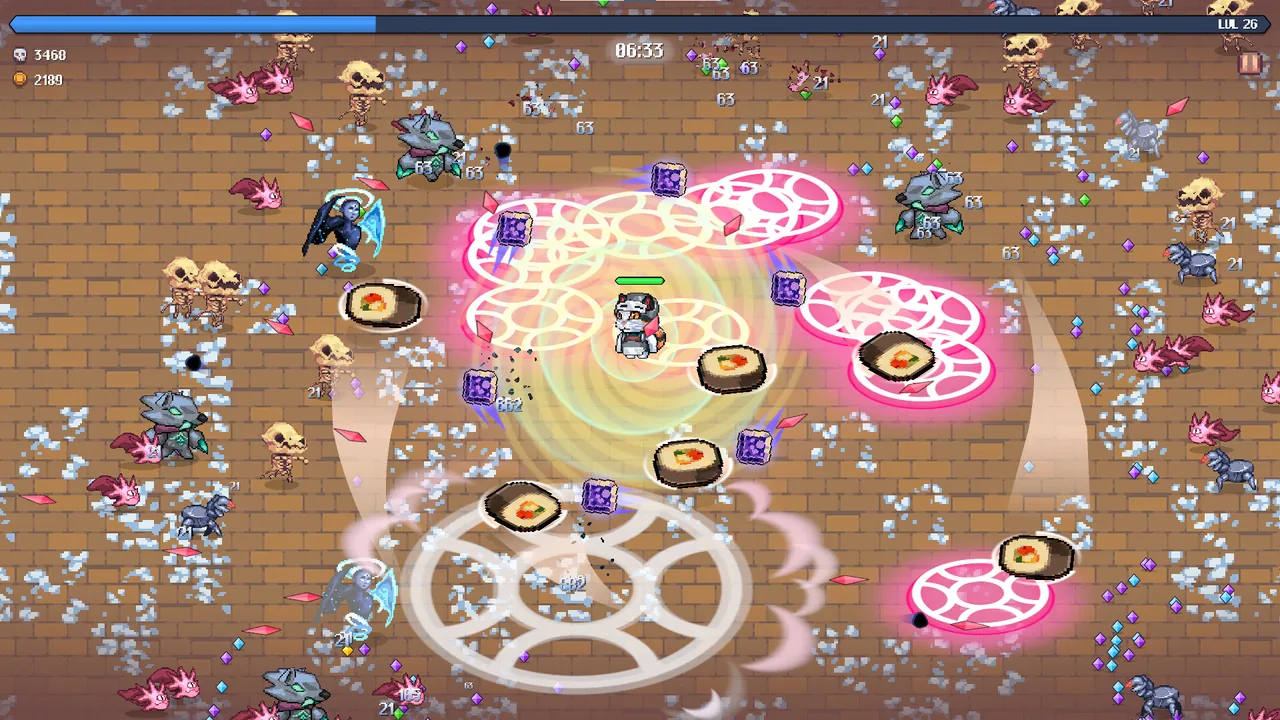
Sushi-roll weapon evolutions and ring attacks clear a skeleton hordeImage: RAZE GAMES via Steam -
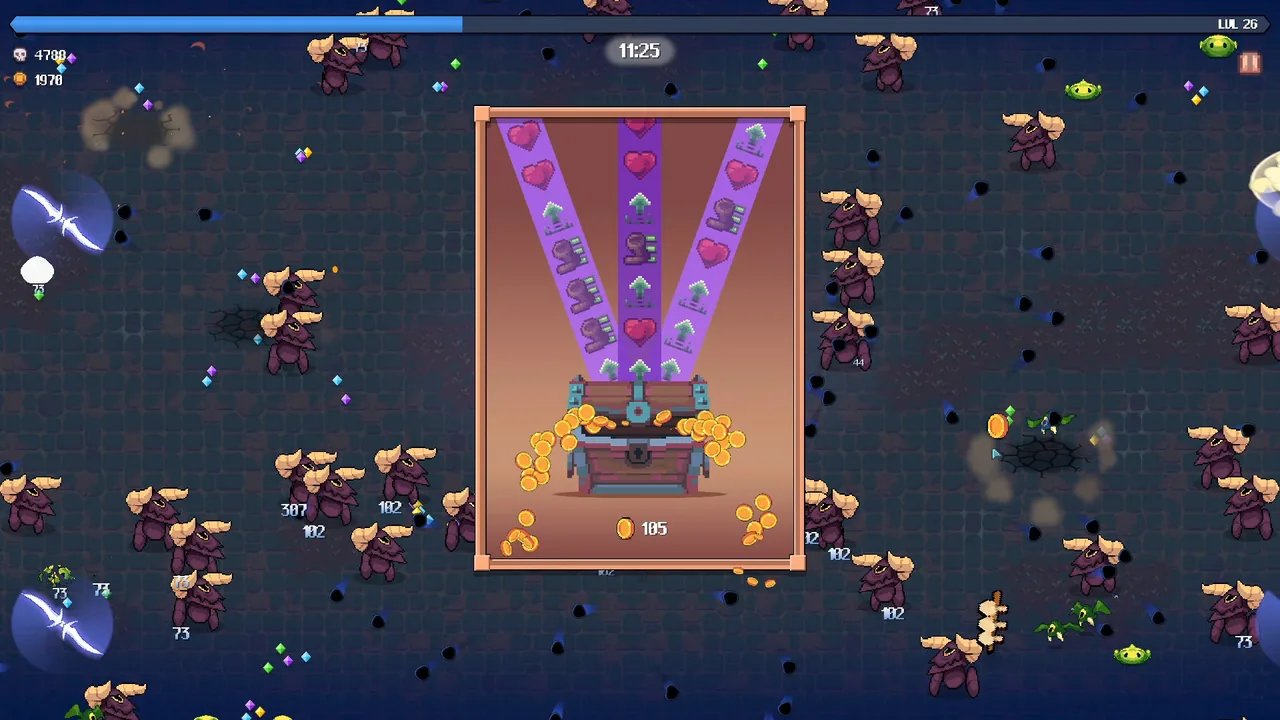
A mid-run chest reward offering a choice of permanent upgradesImage: RAZE GAMES via Steam -

Technical specificationsWanderer Game Reviews