Game review
Dice Goblin's Den
7.2 / 10
- Developer
- babachoo
- Publisher
- babachoo
The short version
Biggest strengths
- A genuinely unique premise that flips tower defense on its head — you're defending a goblin den from quest-driven 'heroes' out to pillage and loot it, with plenty of tongue-in-cheek humor along the way
- Charming, retro-styled pixel art paired with a soothing, action-oriented soundtrack that reviewers repeatedly single out as the game's immediate hook
- Deep, replayable roguelite systems — unlockable classes, perks, party buffs, and a resource economy split between combat and worker units — that reviewers say keep revealing new depth hours in
Biggest weaknesses
- The difficulty curve is steep by design — the developer's own in-game motto is reportedly 'Fail Fast' — and multiple reviewers say the genre-unfamiliar will need real patience before it clicks
- At least one detailed critical review found several of the game's stats poorly explained or barely useful, singling out Wisdom as a stat whose actual effect isn't made clear anywhere in the game
- That same reviewer notes enemy hero stats are hidden except briefly at the start and end of a run, which makes planning around specific threats harder than it needs to be
7.2 / 10
The heroes are the villains this time
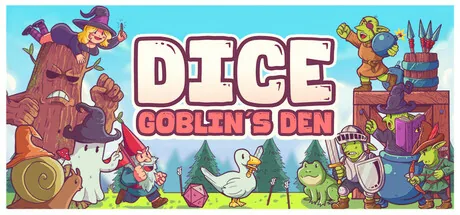
Dice Goblin's Den flips the usual fantasy power fantasy on its head: instead of playing a party of adventurers raiding a monster's lair, you're defending a den of goblins against waves of quest-driven "heroes" who've picked up a bounty at the local tavern to pillage and loot your home. One reviewer captures the appeal directly, saying they bought the game "on a whim because I liked the theme of Goblins being the 'good guys' for once against those pesky 'heroes,'" and another leans into the bit even further, joking that the game shows "the struggles of goblins, and just how unfair we've treated them for so long." It's a simple reframing, but reviewers consistently say the tongue-in-cheek writing and dialogue give the whole thing far more personality than a typical tower defense premise usually earns.
Retro pixel art with real staying power
The presentation is the game's first hook for nearly every reviewer who mentions it. The 2D side-scrolling visuals are repeatedly described as "gorgeous," "cute," and "beautiful retro graphics," with several reviewers saying the art style alone was enough to get them to buy a genre they don't normally play. The soundtrack draws similar praise, with one reviewer comparing its blend of chill and action-oriented cues to classic Donkey Kong. That charm isn't just surface-level polish, either — reviewers say the animations for each goblin unit add real character to fights, turning what could be a static strategy layer into something genuinely fun to just watch play out.
Defending your den, one dice roll at a time
Underneath the pixel art sits a tower-defense roguelite built around resource management and randomization. Each run has you gathering resources by assigning goblin workers to different jobs, then deciding how much of that economy to funnel into combat units versus continued growth — a balance the game's own description warns can be dangerous to get wrong, since "it can be dangerous to spend too many resources hiring workers instead of combat units to defend your goblin den." Levels, enemies, loot, and upgrades are all randomized between runs in classic roguelite fashion, and reviewers say that unpredictability is a feature rather than a flaw: one longtime tower-defense fan calls it a return to "the Warcraft 3 custom game era, when tower defenses were unique, simple on the surface, fun, and required just the right amount of strategy," adding they hadn't enjoyed a TD this much "in a long time."
A steep climb that rewards persistence
That said, Dice Goblin's Den does not go easy on newcomers. Reviewers repeatedly flag a real difficulty spike, and one points to the developer's own in-game philosophy — reportedly summarized as "Fail Fast" — as a fair warning of what's coming. A detailed critical review lays out the friction most clearly: across the game's four stages and 15 waves per stage, "minmaxing is required, not optional," and several of the underlying stats are barely explained, with Wisdom singled out as a stat whose actual in-game effect ("does it make the goblins see further?") isn't clarified anywhere in the interface. That same reviewer notes enemy hero stats stay hidden except briefly at the very start and end of a run, making it harder to plan a defense around a specific threat than it probably should be. Even so, most reviewers who push through the early frustration describe the payoff as worth it, with one admitting "I failed ALOT" before finding a rhythm and getting hooked regardless.
Depth that keeps unfolding
Where Dice Goblin's Den earns its strongest praise is in how much it keeps giving players to work with the longer they stick around. New classes unlock by defeating each enemy party leader, each bringing distinct abilities that reshape available tactics, and reviewers describe discovering perks, party buffs, and additional systems well past their first few hours. One reviewer calls it "an incredibly unique take on tower defense," adding that "after just a few hours, I am overwhelmed with the amount of depth," while another notes that unlocked hirelings and characters stay unlocked across future runs rather than resetting on failure, softening the sting of the game's steep difficulty. A few reviewers do wish the path to spending resources and unlocking new content were made clearer up front, since it isn't always obvious what a given currency is actually building toward.
One returning reviewer, who had previously tried an earlier demo build five or six months before release, specifically notes how far the game has come since then, pointing to a lot more in-game explanation of its different systems and calling out lesser-known mechanics like scaffolds as worth experimenting with rather than sleeping on. That kind of visible, iterative development between demo and launch is echoed by other reviewers too, several of whom describe the tutorial as genuinely useful for getting oriented before diving into the harder stages.
Verdict
Dice Goblin's Den takes a familiar genre and gives it real personality, wrapping a demanding, minmax-friendly roguelite tower defense in charming retro pixel art and a premise with genuine wit behind it. Its steep learning curve, some under-explained stats, and occasionally murky progression paths will test patience early on, but the near-unanimous praise from its review pool suggests that patience pays off — this is a tower defense built with clear love for the genre rather than as a quick cash-in, and reviewers who stuck with it came away recommending it without much hesitation.
Pros and cons
Pros
- A genuinely unique premise that flips tower defense on its head — you're defending a goblin den from quest-driven 'heroes' out to pillage and loot it, with plenty of tongue-in-cheek humor along the way
- Charming, retro-styled pixel art paired with a soothing, action-oriented soundtrack that reviewers repeatedly single out as the game's immediate hook
- Deep, replayable roguelite systems — unlockable classes, perks, party buffs, and a resource economy split between combat and worker units — that reviewers say keep revealing new depth hours in
- Hirelings and unlocked classes carry over permanently between runs, so failed attempts still feel like meaningful progress rather than a hard reset back to zero
Cons
- The difficulty curve is steep by design — the developer's own in-game motto is reportedly 'Fail Fast' — and multiple reviewers say the genre-unfamiliar will need real patience before it clicks
- At least one detailed critical review found several of the game's stats poorly explained or barely useful, singling out Wisdom as a stat whose actual effect isn't made clear anywhere in the game
- That same reviewer notes enemy hero stats are hidden except briefly at the start and end of a run, which makes planning around specific threats harder than it needs to be
- A couple of reviewers wish the path to unlocking new characters and spending currency was clearer, since it isn't always obvious what a given resource is building toward
Screenshots
-
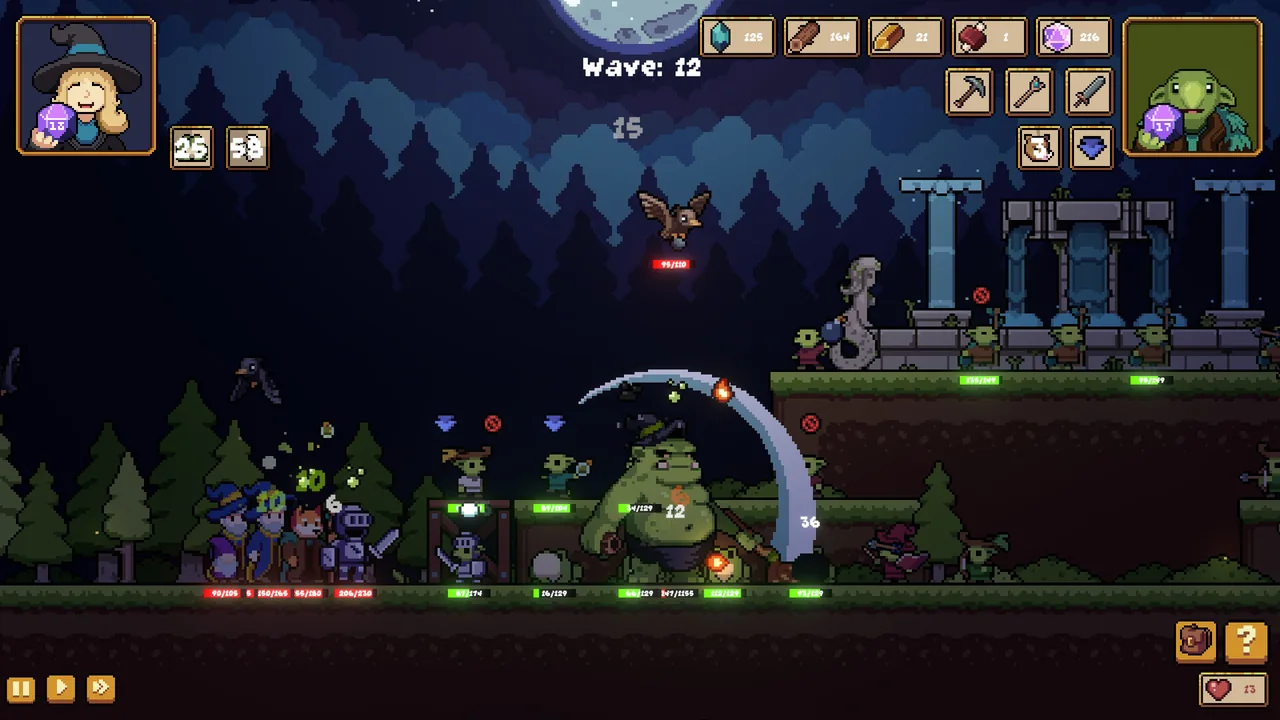
Defending the den against a late-wave assault, with resources and unit stats tracked along the top of the screenImage: babachoo via Steam -
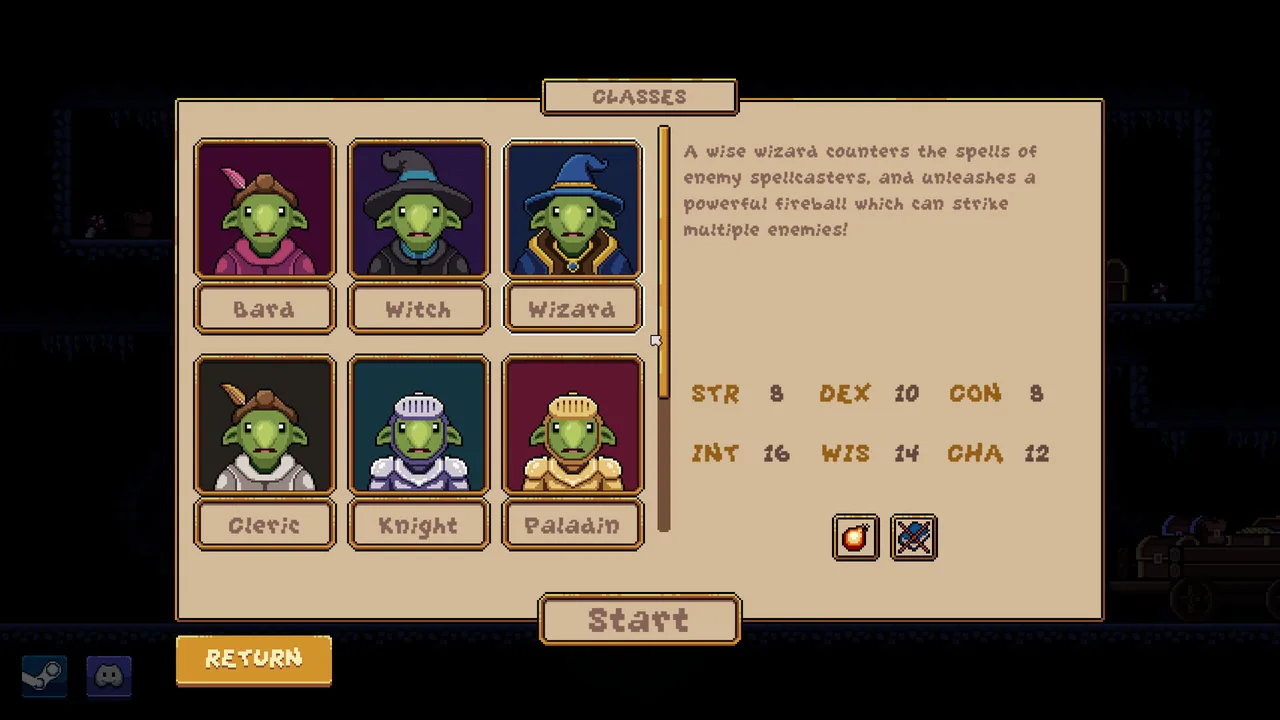
Choosing a goblin class before a run, with STR/DEX/CON/INT/WIS/CHA stats shown for eachImage: babachoo via Steam -
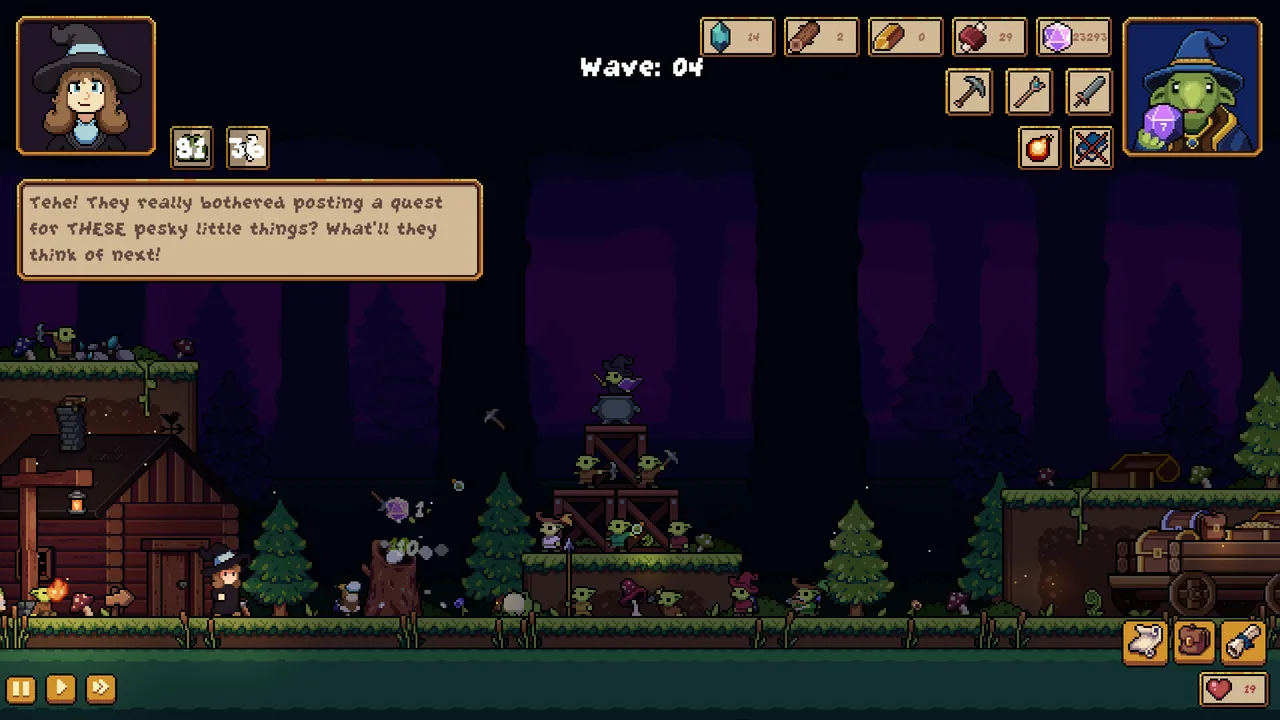
One of the game's many tongue-in-cheek dialogue moments, poking fun at the heroes hunting the goblinsImage: babachoo via Steam -

Category scores for Dice Goblin's DenWanderer Game Reviews