
Game review
Destiny of Immortal
5.9 / 10
- Developer
- LeiYun Games
- Publisher
- 2P Games
The short version
Biggest strengths
- A genuinely unique Dantian combat system that turns cultivation techniques into puzzle pieces players arrange for resonance bonuses, plus a Soul Search skill that lets players steal and repurpose enemy abilities
- An unusually large amount of Early Access content for the price — roughly 500,000 words across one fully-realized storyline — that reviewers describe as remarkable for a day-one release
- A wish-fulfillment cultivation-novel power fantasy that reviewers say genuinely delivers, letting an underdog protagonist claw past overwhelming odds without the genre's more common suffering-protagonist tropes
Biggest weaknesses
- No official English localization during Early Access, leaving English-speaking players dependent on community translation mods or machine translation to understand items, buffs, and story
- Only one of the game's three planned major storylines is currently complete and playable; the other two, along with systems like Talisman Making and Artifact Refining, remain unfinished
- A limited number of usable spell slots means many of the game's dozens of techniques become impractical to build around, and reviewers report late-game combat collapsing into a single repeated button-press once the tech is figured out
5.9 / 10
A cultivation power fantasy built around one perfect treasure
Destiny of Immortal drops players into a wuxia cosmos where a handful of reality-bending Treasures of Creation drift through the world searching for a worthy wielder — and one falls into the player's hands, kicking off a rise from nobody to immortal. It's explicitly built in the mold of a binge-worthy Chinese web novel: an underdog protagonist cutting down enemies far above their level, hiding true strength before unleashing it, leading a small force to an impossible victory over overwhelming numbers. Reviewers, many of whom came in already fans of the cultivation-fiction genre, describe exactly that fantasy landing — one reviewer with over 100 hours logged calls it "very promising," specifically praising the developer for showing a focused vision rather than the overambitious, undelivered scope reviewers say plagues other Chinese Early Access RPGs.
A genuinely distinctive combat system, even if it's still finding its balance
What separates Destiny of Immortal from typical cultivation-RPG grinding is its Dantian system, where a player's techniques take the physical form of puzzle pieces slotted into a limited internal space, with careful arrangement triggering powerful resonance bonuses between compatible effects. Layered on top is a Soul Search ability that lets players extract and steal techniques directly from defeated humans and monsters, turning exploration and combat into an ongoing hunt for new tools to fold into a build — one enthusiastic reviewer describes developing a habit of checking every enemy for skills worth collecting, since the system offers what they call "endless possibilities" to explore. The catch reviewers keep raising is slot scarcity: with only around ten usable spell slots — fewer for players running skill-stealing builds — many of the game's dozens of available techniques simply aren't viable to build around, and one detailed review reports that by the late game, elaborate multi-step builds lose all practical advantage over just spamming a single strong ability, undercutting some of the system's own promised depth.
Enormous content for an Early Access release, but only on one path
The game currently ships with roughly 500,000 words of content and one fully realized, fully playable storyline — the Rakshasa Isle demon-cultivator route, complete with all of its endings — out of three major branching paths the finished game is planned to include. Reviewers are broadly forgiving of this, framing the available route as closer to a complete game in its own right than a typical Early Access slice, and specifically praise the current build for actually finishing what it started rather than spreading itself thin across three half-built paths. That said, the other two storylines, along with entire crafting systems like Talisman Making and Artifact Refining, remain unavailable, and more than one reviewer notes that the currently accessible content only progresses as far as the Foundation Establishment cultivation stage — an early rung on a much longer ladder the full game intends to climb. One detailed review specifically flags the available route as feeling more like an extended tutorial than the harder, more demanding scenarios reviewers expect from the remaining two paths once they arrive.
The English-language elephant in the room
The single biggest asterisk on this Early Access build is squarely stated on its own store page: there is no official English localization during Early Access, with full translation only planned for the eventual 1.0 release. Every English-language review in the current pool reflects that reality directly — reviewers describe leaning on community-made translation mods and live machine translation just to understand item descriptions, buff effects, and story dialogue, and several specifically say they're withholding their strongest recommendation until an official translation lands, even while praising everything they can currently make sense of. For a genre built substantially on dense text — skill descriptions, branching dialogue, hundreds of thousands of words of story — this is a genuinely significant barrier for anyone not fluent in Chinese or willing to fight through a translation layer, and it should be treated as close to a prerequisite consideration for English-speaking players deciding whether to buy in now versus waiting for 1.0.
Rough edges reviewers say need real attention
Beyond the language barrier, the review pool's other detailed feedback consistently points at organizational friction rather than core design flaws. Inventory management draws repeated complaints — no way to bulk-sell unwanted gear below a certain rarity, no ability to search or filter equipment by the specific stat it boosts, and skill lists that become unwieldy to sort through as a collection grows. One player specifically lost a unique, non-recoverable breakthrough item to a poorly timed autosave, and warns other players away from committing fully to the current save structure until it's been refined. On the systems side, several reviewers with deep hours invested offer constructive, specific requests — better herb-tracking in the alchemy system, a proper save-and-name screen instead of dropping straight back into the game world, and the ability to purchase earlier-chapter gear and materials retroactively once later, disconnected chapter maps make certain achievements otherwise unreachable. None of it reads as fatal, but it's a consistent enough thread across the review pool that it reads as genuine, prioritized feedback rather than nitpicking.
Verdict
Destiny of Immortal is a genuinely inventive cultivation RPG whose Dantian technique system and Soul Search skill-stealing give it real mechanical identity in a genre that can otherwise blur together, and reviewers who've sunk dozens or hundreds of hours into its single complete storyline describe a story-rich, wish-fulfillment power fantasy that delivers exactly what it promises. Right now, though, it's an Early Access build in the most literal sense: only one of three planned storylines exists, several major crafting systems are still unbuilt, and — critically for a text-heavy RPG — there's no official English localization yet, leaving non-Chinese-speaking players dependent on community translation tools. For cultivation-genre fans comfortable navigating a translation mod and eager to see where a promising foundation goes, it's an easy recommendation today; everyone else may be better served waiting for the English localization and the other two storylines to arrive at 1.0.
Pros and cons
Pros
- A genuinely unique Dantian combat system that turns cultivation techniques into puzzle pieces players arrange for resonance bonuses, plus a Soul Search skill that lets players steal and repurpose enemy abilities
- An unusually large amount of Early Access content for the price — roughly 500,000 words across one fully-realized storyline — that reviewers describe as remarkable for a day-one release
- A wish-fulfillment cultivation-novel power fantasy that reviewers say genuinely delivers, letting an underdog protagonist claw past overwhelming odds without the genre's more common suffering-protagonist tropes
- Runs smoothly even on modest hardware, with one reviewer specifically noting it performed fine on an old, low-spec machine
Cons
- No official English localization during Early Access, leaving English-speaking players dependent on community translation mods or machine translation to understand items, buffs, and story
- Only one of the game's three planned major storylines is currently complete and playable; the other two, along with systems like Talisman Making and Artifact Refining, remain unfinished
- A limited number of usable spell slots means many of the game's dozens of techniques become impractical to build around, and reviewers report late-game combat collapsing into a single repeated button-press once the tech is figured out
- Inventory and system organization draws consistent complaints even from fans — no bulk-sell tools, no way to search gear by stat, and a single-save structure that one reviewer says cost them an irreplaceable item after a bad autosave
Screenshots
-
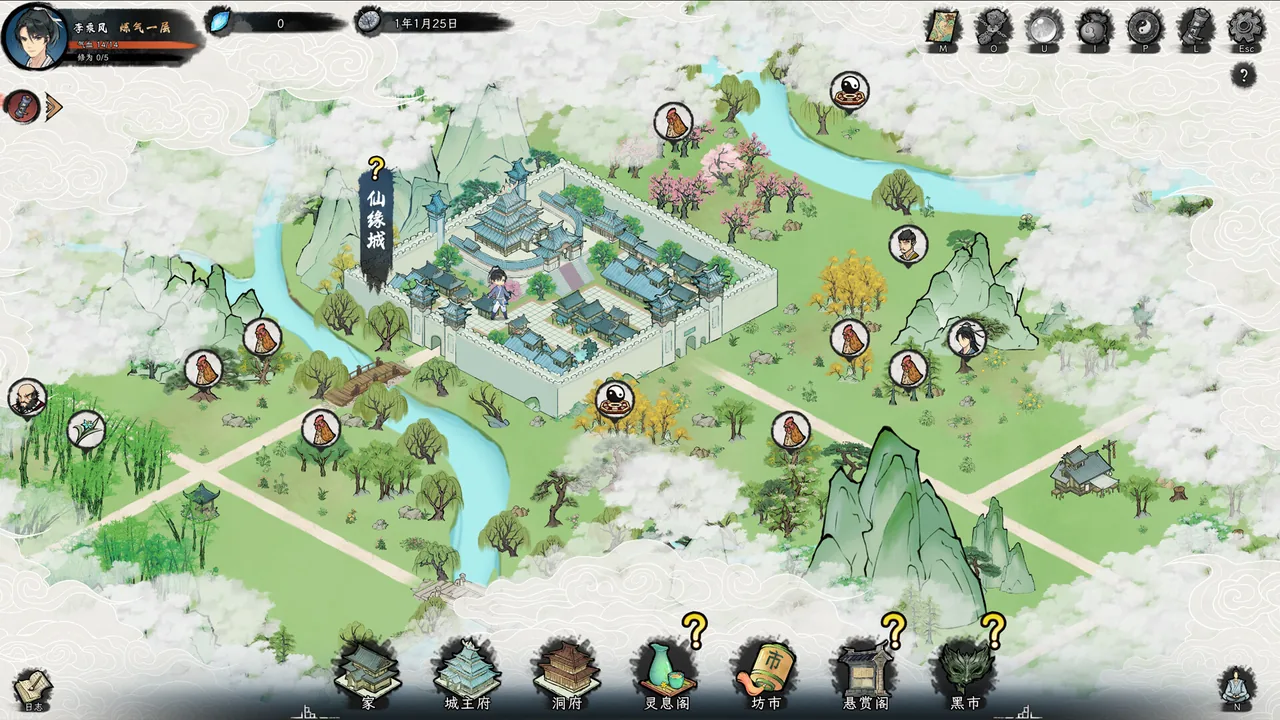
The overworld map, styled like a traditional Chinese ink painting, dotted with NPCs and points of interest around a walled cityImage: 2P Games via Steam -
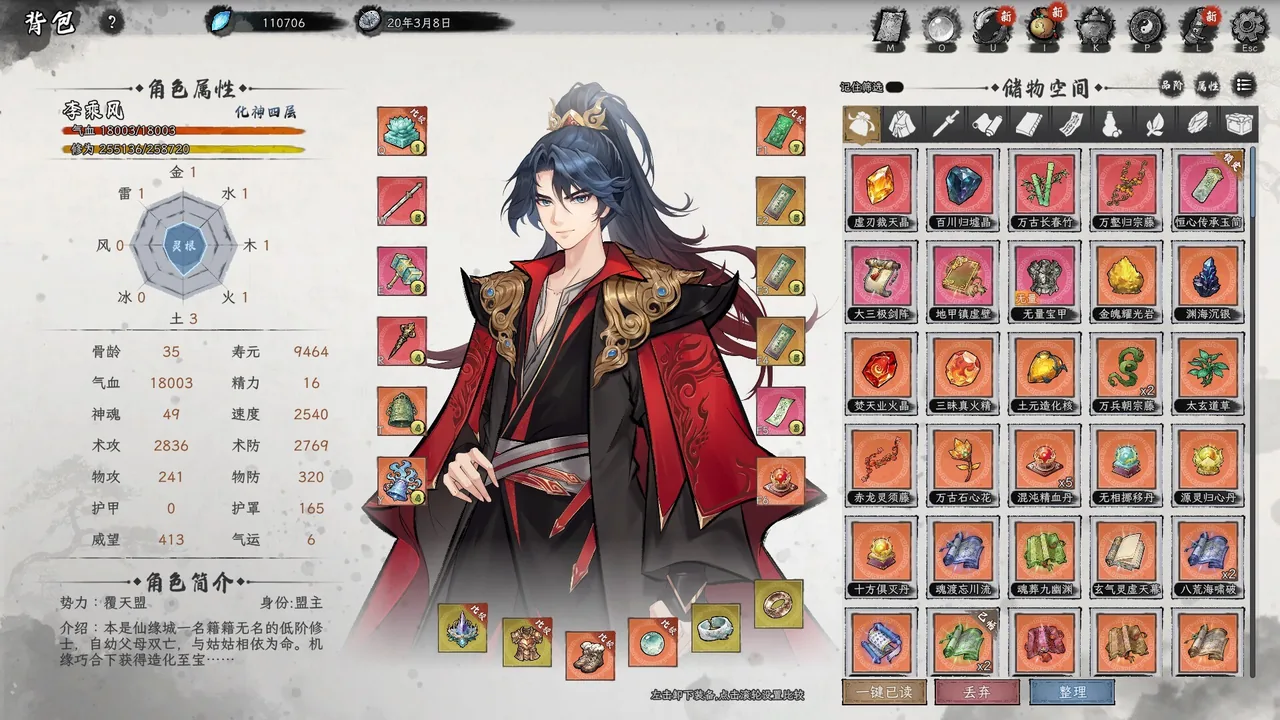
The character and inventory screen, showing elemental affinities, stats, and a dense grid of stored treasuresImage: 2P Games via Steam -
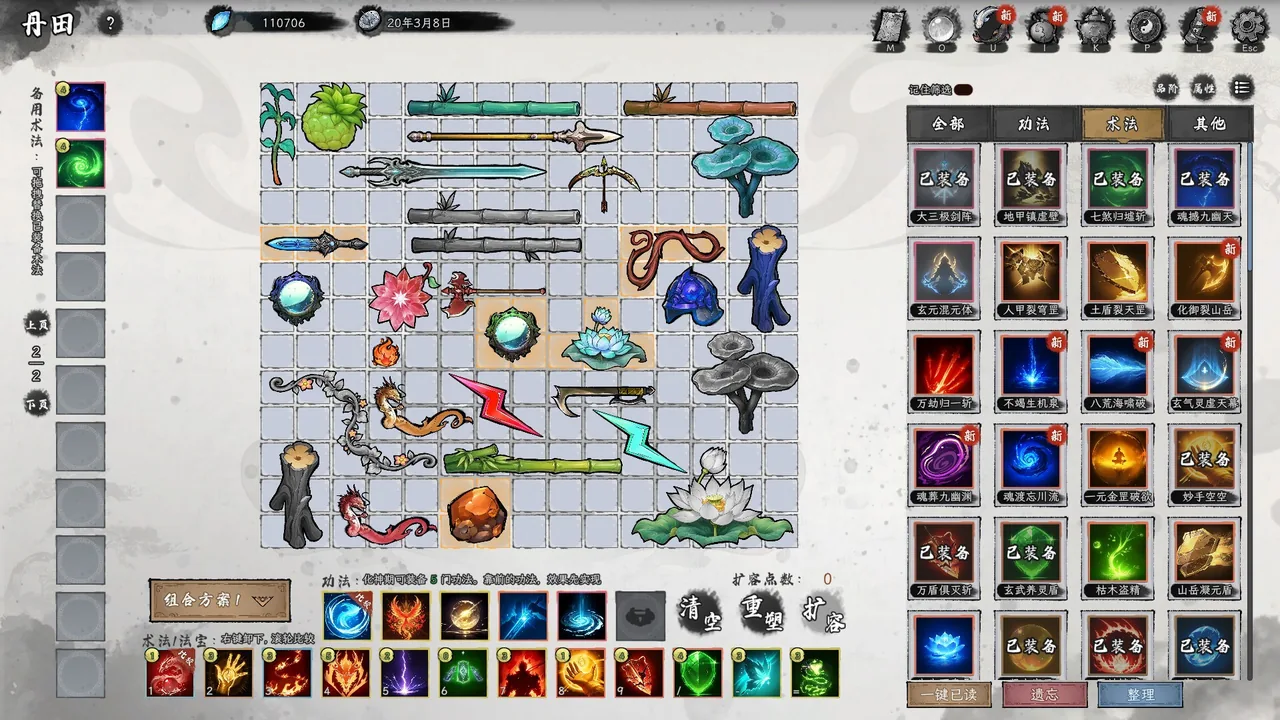
The Dantian system, where cultivation techniques are arranged as puzzle pieces to trigger resonance bonusesImage: 2P Games via Steam -

Category scores for Destiny of ImmortalWanderer Game Reviews