Game review
Demon Castle Story
7.3 / 10
- Developer
- Kairosoft Co.,Ltd
- Publisher
- Kairosoft Co.,Ltd
The short version
Biggest strengths
- Clever reversal of the dungeon-crawler formula: build the labyrinth and defend it, rather than raid one
- Charming monster roster with genuine build variety across traps, decor and minion placement
- Strong replay value through New Game Plus, with a meaningfully harder second run
Biggest weaknesses
- Constant confirmation pop-ups interrupt the intended AFK-friendly pacing every 30-60 seconds
- Mouse-and-keyboard controls feel like an afterthought on an interface tuned for touchscreens
- Most low-tier monsters contribute negligible damage, narrowing viable minion choices
7.3 / 10
Overview
Demon Castle Story is Kairosoft's latest pixel-art management sim, and it distinguishes itself within the studio's sprawling catalogue by flipping one of the genre's oldest premises on its head. Rather than sending a party of heroes to clear a dungeon, players take charge of the dungeon itself: an old, crumbling demon castle that must be rebuilt, staffed with monster minions, and armed with traps to repel the very adventurers who would normally be the protagonists. It's a small twist, but a genuinely effective one, and reviewers repeatedly framed it as a mirror image of Kairosoft's own Dungeon Village, with the roles of raider and defender swapped. The result sits comfortably alongside the studio's best work, according to longtime fans who described it as one of their favorites in a catalogue that now spans dozens of titles.
Gameplay and Mechanics
The core loop asks players to lay out castle rooms on a grid, populate them with recruited monsters, and decorate them with gargoyles, ritual altars, and other devilish trinkets that boost a room's stats. Traps are the other major pillar of castle design, ranging from sleep-inducing gas to oversized washbowls, and reviewers consistently praised the creativity of combining trap placement with monster positioning to build an "impregnable fortress of fiendishness." Combat itself is automated once an adventuring party breaches the castle: minions and traps do the fighting, and the player's role is architectural rather than reactive, deciding in advance how a labyrinth will grind down each wave of intruders. Monsters can also be merged into stronger forms and sent out on exploration missions to nearby dungeons and towns, bringing back loot and occasionally new recruits, adding a light resource-gathering layer on top of the core building. The studio's trademark humor threads through the raid encounters too, with adventurer dialogue and random events landing jokes that regular Kairosoft players will recognize as house style, alongside odd little surprises like a monster evolution earning a deliberately silly rebranded name. Several longtime fans drew direct comparisons to earlier build-and-battle Kairosoft titles like Dungeon Village, Beastie Bay DX, and High Sea Saga DX, noting that anyone who enjoyed those games' core loop should feel comfortably at home here.
Progression and Replayability
Progression follows the traditional Kairosoft difficulty curve of starting hard and gradually easing as systems click into place, and several reviewers noted the game becomes noticeably easier once traps begin to out-scale incoming adventurers, which can blunt the sense of tension in the back half of a run. New Game Plus is where the design intends players to find lasting challenge, restarting with carried-over knowledge against tougher waves and higher numbers, and multiple reviewers singled out the second run as where "the real game begins." One persistent complaint across the review pool concerned monster balance: only a handful of recruitable creatures contribute meaningful damage, while many others exist largely for flavor or encyclopedia completion, narrowing the practical roster even as the cosmetic variety stays wide. Achievement hunters and completionists nonetheless found plenty to chase, with some reporting dozens of hours spent working toward a full monster collection across repeated New Game Plus cycles.
Interface and Accessibility
This is where Demon Castle Story shows its clearest weakness. Multiple reviewers flagged the mouse-and-keyboard control scheme as clunky, with clicking anywhere on the screen re-centering the view rather than simply selecting an object, and several specifically recommended playing with a controller instead. The bigger recurring frustration, mentioned across a large share of the review pool, is the game's habit of pausing constantly to display confirmation pop-ups: a new monster wanting to join, a raid party approaching, a festival happening off-screen. Because the genre's appeal rests partly on letting a well-built castle run semi-autonomously, having to click "OK" every thirty to sixty seconds undercuts that fantasy in a way that drew consistent criticism even from otherwise enthusiastic reviews. At high speed and late-game castle sizes, the interface can also become visually cluttered, with one reviewer noting the UI ate up more than half the screen during busy stretches.
Visual Style and Sound Design
The game maintains Kairosoft's signature charm: bright, blocky pixel art, an enormous roster of expressive monster sprites, and the studio's trademark deadpan humor scattered through event pop-ups and adventurer dialogue. Reviewers were particularly fond of small touches like birthday celebrations for castle minions and the visual gag of adventurers being knocked out by a washbowl trap seconds after entering. The demon-fortress reskin gives familiar Kairosoft building mechanics a fresh coat of personality, and the game reuses and remixes creature designs from earlier titles in the catalogue, which longtime fans appreciated as a form of continuity even as newcomers found the roster charming on its own terms.
Verdict
Demon Castle Story succeeds by taking a formula Kairosoft has iterated on for years and inverting its perspective just enough to feel new again, wrapping the reversal in the studio's dependable blend of cute monster design, grid-based building, and slow-burn progression. The interruption-heavy pop-up system and mobile-first control scheme are real friction points that keep it from being a definitive genre pick, but the trap-and-monster synergy at its core, paired with a genuinely tougher New Game Plus, gives it more staying power than most entries in Kairosoft's back catalogue. Recommended for existing fans without hesitation, and a solid entry point for newcomers willing to tolerate some interface roughness in exchange for a uniquely villainous take on dungeon management.
Pros and cons
Pros
- Clever reversal of the dungeon-crawler formula: build the labyrinth and defend it, rather than raid one
- Charming monster roster with genuine build variety across traps, decor and minion placement
- Strong replay value through New Game Plus, with a meaningfully harder second run
- Generous, affordable package that rewards both short sessions and long grinding stretches
Cons
- Constant confirmation pop-ups interrupt the intended AFK-friendly pacing every 30-60 seconds
- Mouse-and-keyboard controls feel like an afterthought on an interface tuned for touchscreens
- Most low-tier monsters contribute negligible damage, narrowing viable minion choices
- Progression can flatten once traps out-scale attacking adventurers, dulling the mid-to-late challenge
Screenshots
-
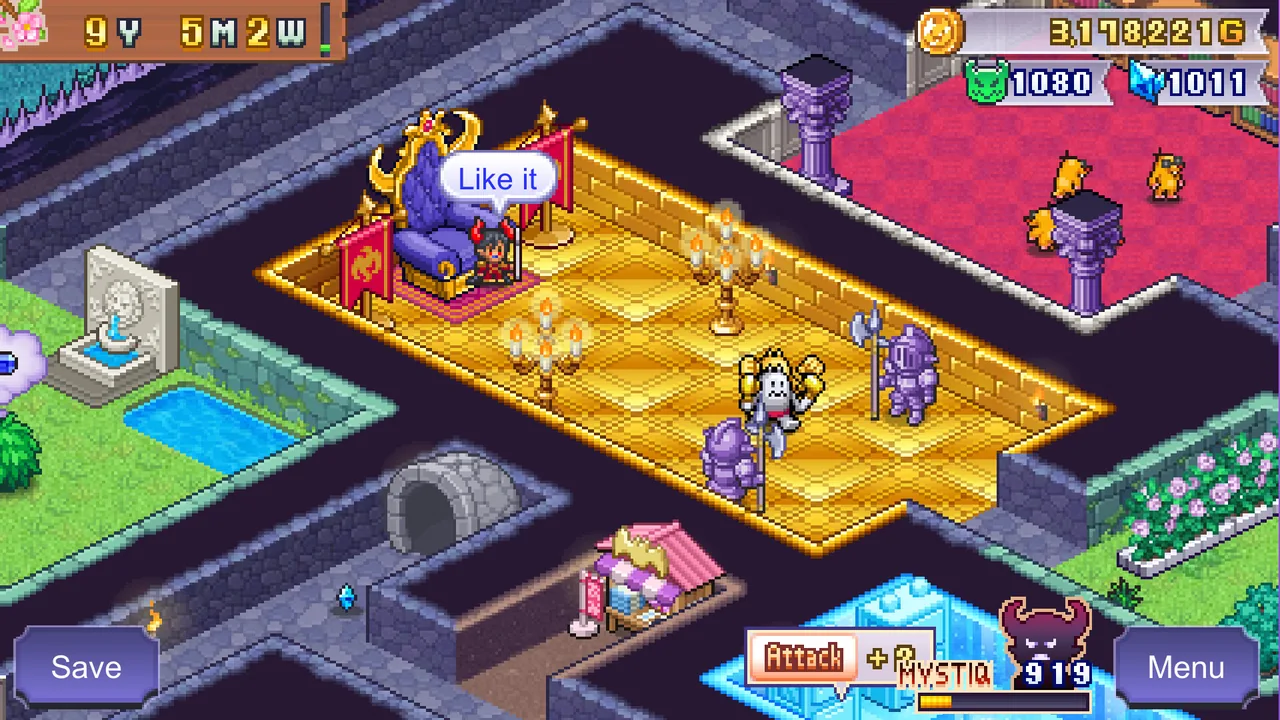
The overlord's throne room, decorated for maximum stat bonuses and minion moraleImage: Kairosoft Co.,Ltd via Steam -
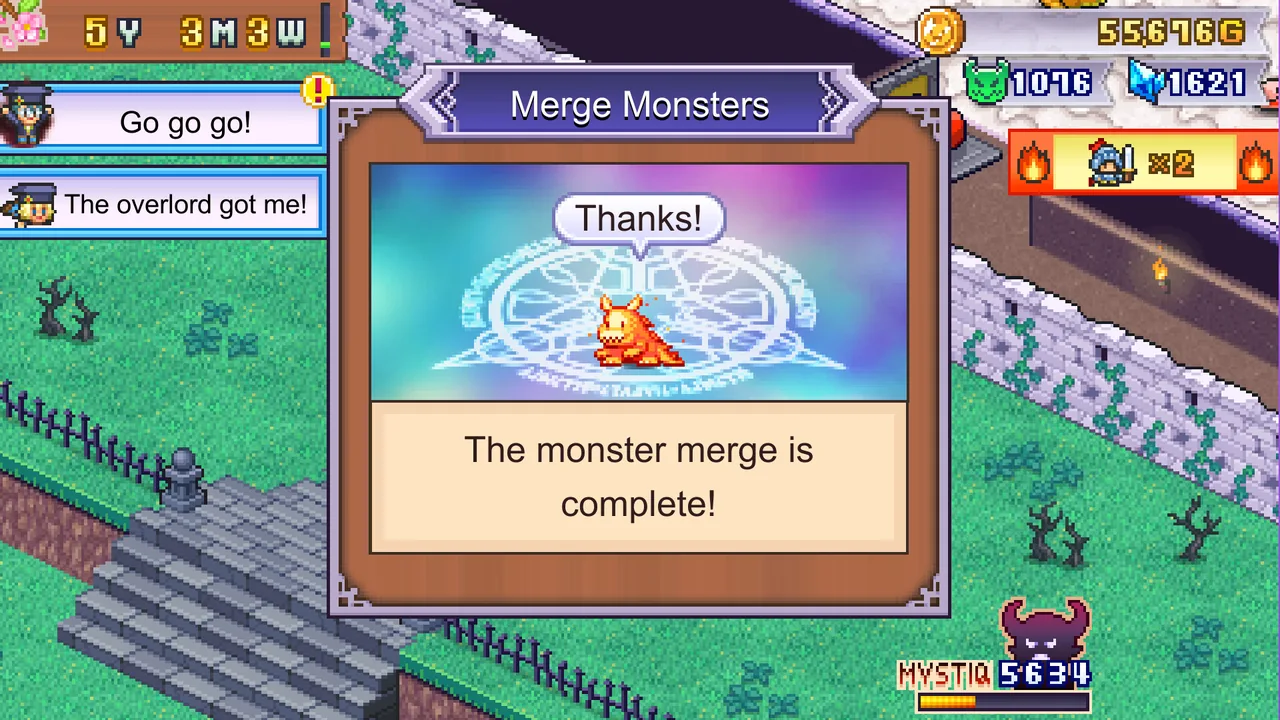
Merging two monsters together to create a stronger hybrid minionImage: Kairosoft Co.,Ltd via Steam -
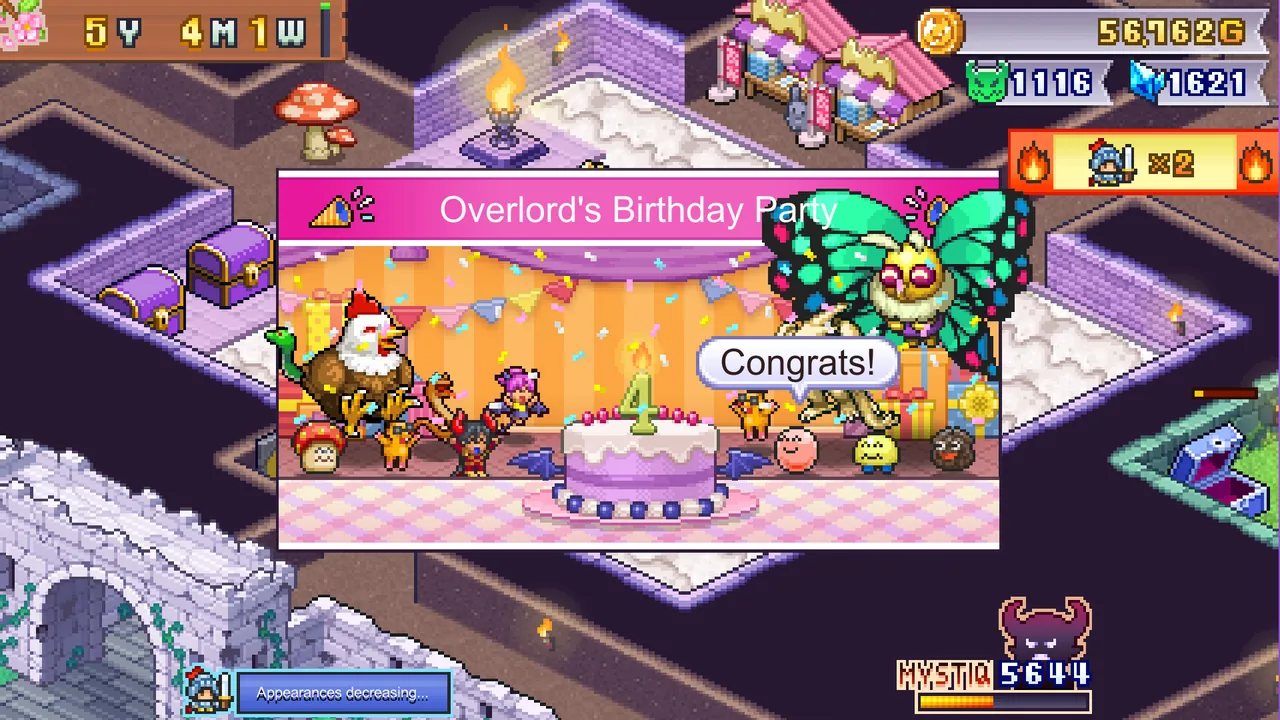
One of the game's many pop-up events, celebrating the overlord's birthday with the castle's minionsImage: Kairosoft Co.,Ltd via Steam -
Technical specificationsWanderer Game Reviews