Game review
Celestial Return
6.3 / 10
- Developer
- Metaphor Games
- Publisher
- Shoreline Games
The short version
Biggest strengths
- A distinctive dice-as-survival-currency system creates genuine tension around every choice
- Striking hand-drawn cyberpunk-noir art direction and a strong, genre-blending soundtrack
- Cheap, focused 5-to-8-hour experience with multiple branching endings
Biggest weaknesses
- Launch-state dice economy could soft-lock a run with no dice left and no way forward
- Save/load bugs, including a bug that reset a player's saved dice count between chapters
- Ending and Chapter 3 pacing draw consistent complaints about a lack of closure
6.3 / 10
The Pitch
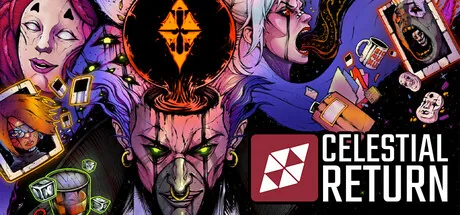
Celestial Return is a dice-driven narrative RPG from Metaphor Games, a small studio whose Kickstarter-funded debut casts the player as Detective Howard, investigating a string of suicides in the neon-soaked, cyberpunk-noir city of Netherveil. It draws obvious inspiration from Disco Elysium's internal-voice dialogue system and Citizen Sleeper's dice-as-resource economy, wrapping both around a hand-drawn comic art style the developers cite Blame!, Biomega and Berserk as touchstones for. It released on Steam on 14 July 2026 at a low NZ$14.75, and its 147 English-language reviews sit at Very Positive, 124 of them positive, though the negative fifth of that total raises specific, recurring problems rather than vague dissatisfaction.
Dice as Life Support
The core system asks players to treat a limited, non-regenerating pool of dice as both currency and survival tool: spend them to pass skill checks, reroll bad outcomes, or buy items, and every choice not to spend one is a bet that you'll need it more later. Reviewers who click with the system describe genuine tension around hoarding versus spending, several specifically citing "wondering whether you'll run out of rolls" as the game's best emotional hook, and it plays into a stat system built around Intelligence, Virtue and Foolishness traits that shape which dialogue and story branches even become visible. It's a clear cousin of Citizen Sleeper's dice economy rather than a copy, and when it works, reviewers describe it as adding real weight to choices that would otherwise be simple dialogue picks. One especially detailed multi-run review frames the setting itself as a low-key "megastructure game," a dystopian cyberpunk city sealed off from the rest of the world for undisclosed reasons, and credits the dice system with reinforcing that isolation: every roll is a reminder that help isn't coming from outside, only from what you've managed to hoard.
Atmosphere Carries the Weight
Almost every review, positive or negative, agrees on the presentation. The hand-drawn character art and city backdrops get singled out repeatedly as worth the asking price on their own, and the "Noir Jazz, Cyberpunk Techno, Death Metal" soundtrack draws specific praise for tonal range rather than settling into one mood. Several reviewers explicitly frame the game as a "Disco-like" done through a different genre lens, closer to Gibson's Sprawl trilogy or Shadowrun than to Disco Elysium's political satire, and long-time fans of dystopian cyberpunk fiction describe the writing hitting real sweet spots for them even when they concede the plot itself is thin. One reviewer flags an unexpected first-person 3D dream sequence as a genuinely surprising, well-executed tonal swing partway through.
Launch Bugs and a Punishing Dice Economy
The most consistent negative thread isn't about tone or art, it's about the dice system breaking under its own rules at launch. Multiple reviewers describe getting soft-locked: reaching a mandatory skill check requiring more dice than they had left, with no way to earn more and no way to proceed, forcing a reload from an earlier save. One detailed review traces this directly to a bug where a player's saved dice total silently reset to a lower number between story "Books," wiping out a carefully hoarded stockpile without warning; the developer patched the underlying dice-economy balance issue after launch, and several reviewers who initially bounced off the game specifically credit that patch with making it playable again. Save and load reliability is a separate, recurring complaint: reviewers report the game refusing to save or load at certain points in the story, sparse autosave placement that can cost real progress, and one detailed critique lists both issues alongside events that can trigger out of their intended order.
A Story That Thins Out by the End
Beyond the technical issues, the most common criticism concerns how the narrative resolves. Reviewers repeatedly describe Chapter 3 as noticeably weaker than the first two, and several specific endings are singled out for leaving major plot threads, including the fate of a key supporting character and the true nature of the game's central "Abstract" entities, unresolved rather than concluded. A handful of negative reviews go further, describing the five-to-eight-hour runtime as a better fit for a visual novel than an RPG, and arguing the dice mechanics feel bolted on rather than load-bearing to the story being told. A separate, smaller but pointed complaint concerns the prose itself: one detailed negative review argues the writing leans so heavily on a repetitive "it wasn't just X, it was Y" simile structure that it reads as AI-generated text, a claim echoed less directly by a couple of other reviewers who found the writing style grating rather than atmospheric; other reviewers pushed back directly on that read, defending the prose as intentional stylistic choice rather than a quality problem, so it's worth going in aware it's a genuinely contested point in the game's own review section rather than a settled fact.
Verdict
Celestial Return is a striking-looking, ambitious debut that mostly earns the comparisons it invites to Disco Elysium and Citizen Sleeper without simply imitating either. Its art direction and soundtrack are close to universally praised, and its dice-as-survival system creates real, distinctive tension when it's balanced properly. The problem is that "when it's balanced properly" wasn't a given at launch, several reviewers describe genuinely broken, soft-locking states that needed a post-release patch to fix, and even with that fixed, the story's back half and endings leave a meaningful chunk of reviewers wanting more closure than they got. At its low price, it's an easy recommendation for fans of narrative-forward, dice-driven RPGs willing to accept a short, occasionally rough-edged runtime in exchange for genuinely distinctive presentation, just go in with patched expectations rather than launch-week ones.
Pros and cons
Pros
- A distinctive dice-as-survival-currency system creates genuine tension around every choice
- Striking hand-drawn cyberpunk-noir art direction and a strong, genre-blending soundtrack
- Cheap, focused 5-to-8-hour experience with multiple branching endings
- A dev team reviewers repeatedly describe as fast and responsive to bug reports
Cons
- Launch-state dice economy could soft-lock a run with no dice left and no way forward
- Save/load bugs, including a bug that reset a player's saved dice count between chapters
- Ending and Chapter 3 pacing draw consistent complaints about a lack of closure
- A minority of reviewers flag the prose's repetitive metaphor style as reading AI-generated
Screenshots
-
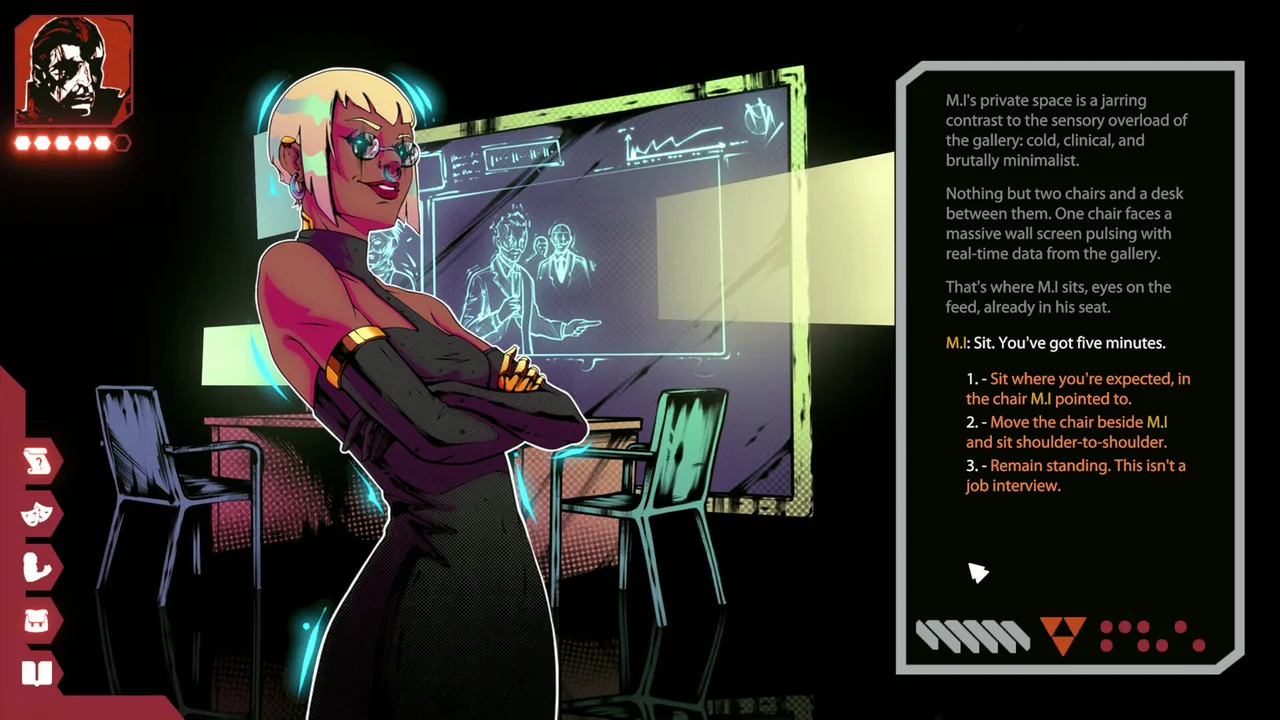
A tense meeting with M.I., the game's dialogue choices rendered in its hand-drawn comic styleImage: Shoreline Games via Steam -
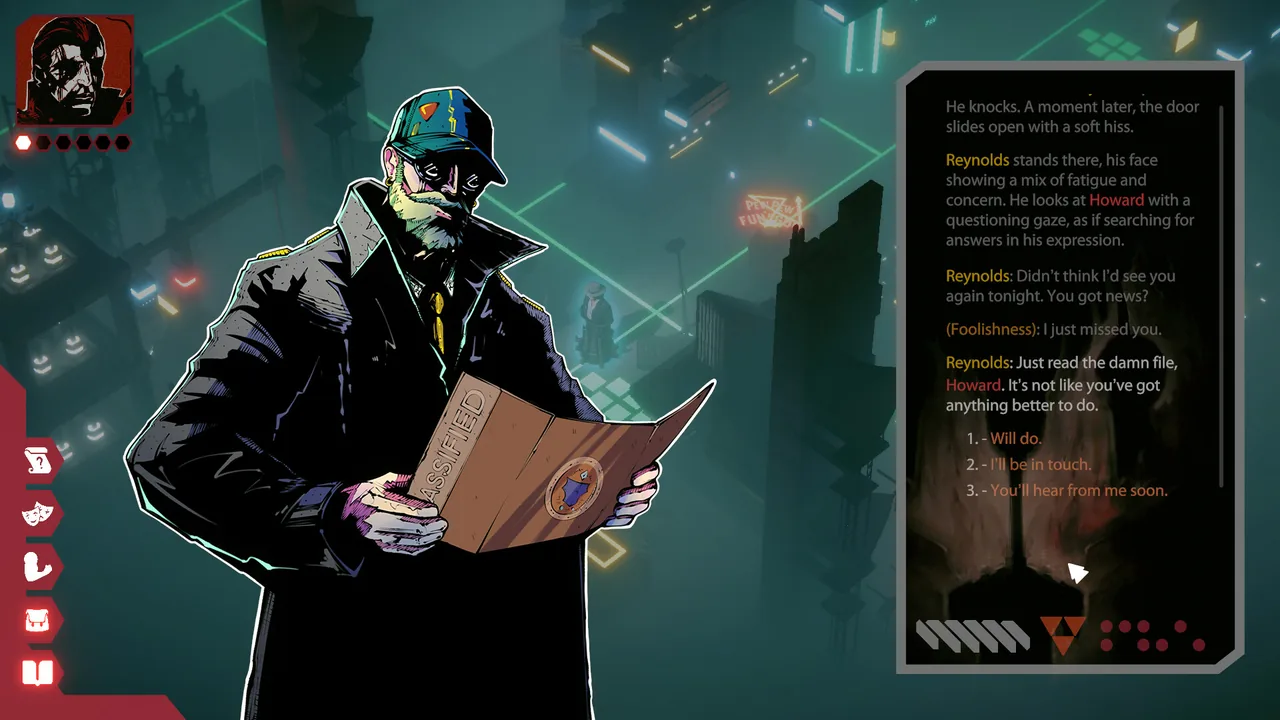
Detective Howard receives a classified file against Netherveil City's neon backdropImage: Shoreline Games via Steam -
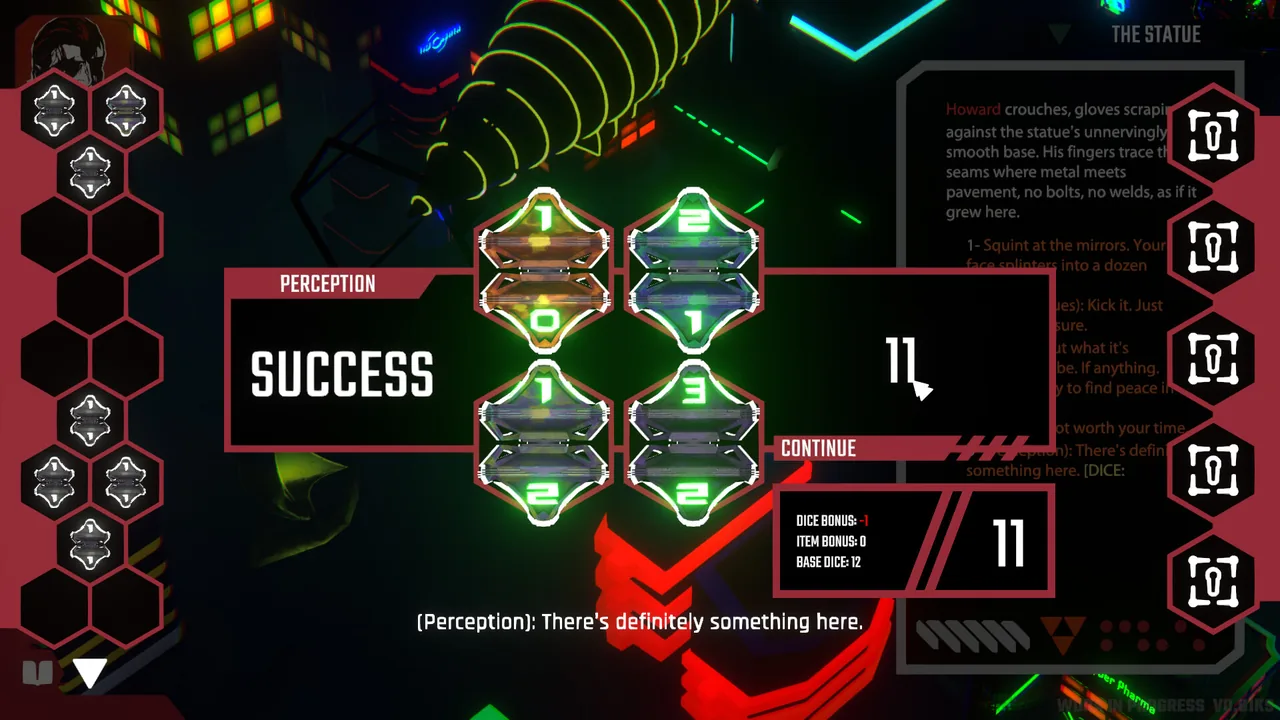
A Perception skill check resolved with the dice system, the game's core resource-management mechanicImage: Shoreline Games via Steam -
Category scores for Celestial ReturnWanderer Game Reviews