Game review
Myth Requiem
6.9 / 10
- Developer
- Mythos Anvil
- Publisher
- Mythos Anvil
The short version
Biggest strengths
- An unusually ambitious, respectfully-researched sweep through world mythology, from Greek and Norse to Egyptian, Chinese, and beyond
- A genuinely deep auto-battler/idle hybrid that reviewers describe as far more mechanically rich than its free price tag suggests
- A living bestiary and companion roster (Sun Wukong, Ulysses, Saint George, and more) with real lore and individualized progression arcs
Biggest weaknesses
- Reported memory leaks and lag serious enough that at least one reviewer needed to restart the game roughly once an hour
- No text-size adjustment option, which reviewers note makes the game genuinely hard to play for anyone without sharp close-up vision
- Missing quality-of-life screens — no dedicated inventory view and no easy way to review a hero's stats and progress at a glance
6.9 / 10
A free, wildly ambitious ode to world mythology
Myth Requiem pitches itself as a mythology exploration RPG with idle and auto-battle mechanics, and the premise is bigger than that modest description lets on: you're commanding a growing company of legendary heroes — Ulysses, Sun Wukong, Saint George, the Egyptian sky goddess Nut, and over fifteen more — on a quest that weaves together the Epic of Gilgamesh, the Odyssey, and the Legend of Fuxi and Nuwa, sailing aboard a mythical ship that crosses land, sea, and sky. It's a striking amount of scope for a project built, according to reviewers, by what appears to be a two-person team. Notably, Myth Requiem wasn't originally free — the developers reportedly switched it to free-to-play after demand for a paid release proved too low, a detail one long-time player specifically brings up while wishing the team got more recognition for the amount of work on display.
Exploring global mythologies, one living bestiary at a time
The world is organized around distinct pantheons and cultures — Greek, Norse, Chinese, and Egyptian get the most dedicated treatment, with Japanese, African, Mayan, Arabian, Aztec, Celtic, Hindu, Incan, and Native American mythologies folded in as further exploration targets. Capturing, battling, and cataloging creatures builds out a bestiary where, per multiple reviewers, every entry carries genuine lore tied to its culture of origin rather than being a reskinned placeholder. One reviewer who fact-checked the mythological details found what they checked to be accurate, which matters for a game built almost entirely on the strength of that research. The one recurring structural complaint here is that the grouping is uneven — specific civilizations like Greece and Egypt get individualized treatment while others are lumped together under broad regional labels, a tension reviewers attribute to the sheer ambition of trying to cover this much ground at all. One reviewer notes that which creatures you can capture shifts with an in-game season that changes daily and a weather/time cycle that changes every couple of hours, which naturally spreads exploration out over multiple sessions instead of letting a single sitting exhaust an area's bestiary. That same reviewer, who explicitly compares Myth Requiem against genre peers like Realm Grinder, Monster Sanctuary, and Palworld, calls it "very niche, very unique" — a hybrid that doesn't map cleanly onto any one established idle, auto-battler, or creature-collector template.
Heroes with their own myths, not just stat sheets
Each companion's progression is tied to their personal story rather than a generic shared leveling curve — Saint George reportedly grows stronger specifically by slaying dragons, while Nut's arc involves stargazing and cosmic puzzles. Reviewers consistently single this out as the game's most distinctive design choice: rather than a roster of interchangeable idle-game units, the heroes are written and mechanically differentiated around the actual myths they come from. The puzzle elements tied to some of these hero arcs come with hints and partial automation, according to one reviewer, which keeps them from becoming a hard wall for players who came for the idle loop rather than the puzzling.
Auto-battles with real strategic depth
Combat runs on an auto-battler structure — deploy the party, then manage abilities, synergies, and divine blessings while battles play out on their own, scaling up to encounters involving what the store page describes as thousands of units. Reviewers repeatedly push back against any assumption that this makes the game shallow: one describes it as a "surprisingly deep autobattler/idle incremental," while another specifically praises the "complexity of the gameplay and the underlying" systems (their review cuts off mid-sentence in the source data, but the sentiment is unambiguous). The idle side of the design is treated as genuinely optional rather than mandatory downtime — you can let hours pass while characters mine resources, write, or make music to build stats, or engage actively with exploration and capture, and reviewers describe comfortably mixing both modes rather than being funneled into one. One reviewer who logged over 500 hours specifically calls it "great for people with little time," a useful signal that the idle systems hold up well past the first few sessions rather than just front-loading their appeal, and another mentions an enormous, constantly-expanding music library, with new tracks turning up in loot chests throughout the run rather than being limited to a handful of looping themes.
Buggy growing pains behind an intuitive front door
The most substantive criticism in the review pool is technical, not design-related. Multiple reviewers flag real stability problems — a memory leak serious enough that one player reports needing to restart roughly every hour, plus general lag described as making the game "a laggy and buggy mess" in its current state by one reviewer who otherwise liked the concept enough to still praise the story. A second concern is responsiveness from the two-person development team: one detailed, high-playtime review describes submitting an extensive bug report that appears to have gone unanswered, and generally slow, inconsistent replies to community bug reports and help requests. On the interface side, the lack of any text-size option is called out as a genuine accessibility barrier, and more than one reviewer wants basic quality-of-life screens — an inventory view, an easier way to check a hero's stats and progress — that the current build doesn't offer. None of this reads as reviewers turning against the game; it reads as real, specific friction layered on top of something they otherwise want to keep playing.
Verdict
Myth Requiem is a remarkably ambitious free mythology RPG that backs up its scope with genuine depth in its auto-battle and hero-progression systems, and reviewers are near-unanimous that it delivers far more than its price tag would suggest. The catch is real: memory leaks and lag serious enough to force hourly restarts for at least one player, a missing text-size option, and a small dev team that reviewers say is slow to engage with bug reports all suggest a game whose ambition has outpaced its current polish. For anyone drawn to mythology and willing to tolerate some launch-era rough edges, it's hard to argue with the price of admission.
Pros and cons
Pros
- An unusually ambitious, respectfully-researched sweep through world mythology, from Greek and Norse to Egyptian, Chinese, and beyond
- A genuinely deep auto-battler/idle hybrid that reviewers describe as far more mechanically rich than its free price tag suggests
- A living bestiary and companion roster (Sun Wukong, Ulysses, Saint George, and more) with real lore and individualized progression arcs
- Completely free, with multiple reviewers calling it a must-play specifically because of that price point
Cons
- Reported memory leaks and lag serious enough that at least one reviewer needed to restart the game roughly once an hour
- No text-size adjustment option, which reviewers note makes the game genuinely hard to play for anyone without sharp close-up vision
- Missing quality-of-life screens — no dedicated inventory view and no easy way to review a hero's stats and progress at a glance
- A reviewer who logged over 8,000 minutes reports the two-person developer team is slow and inconsistent about replying to bug reports and discussion posts
Screenshots
-
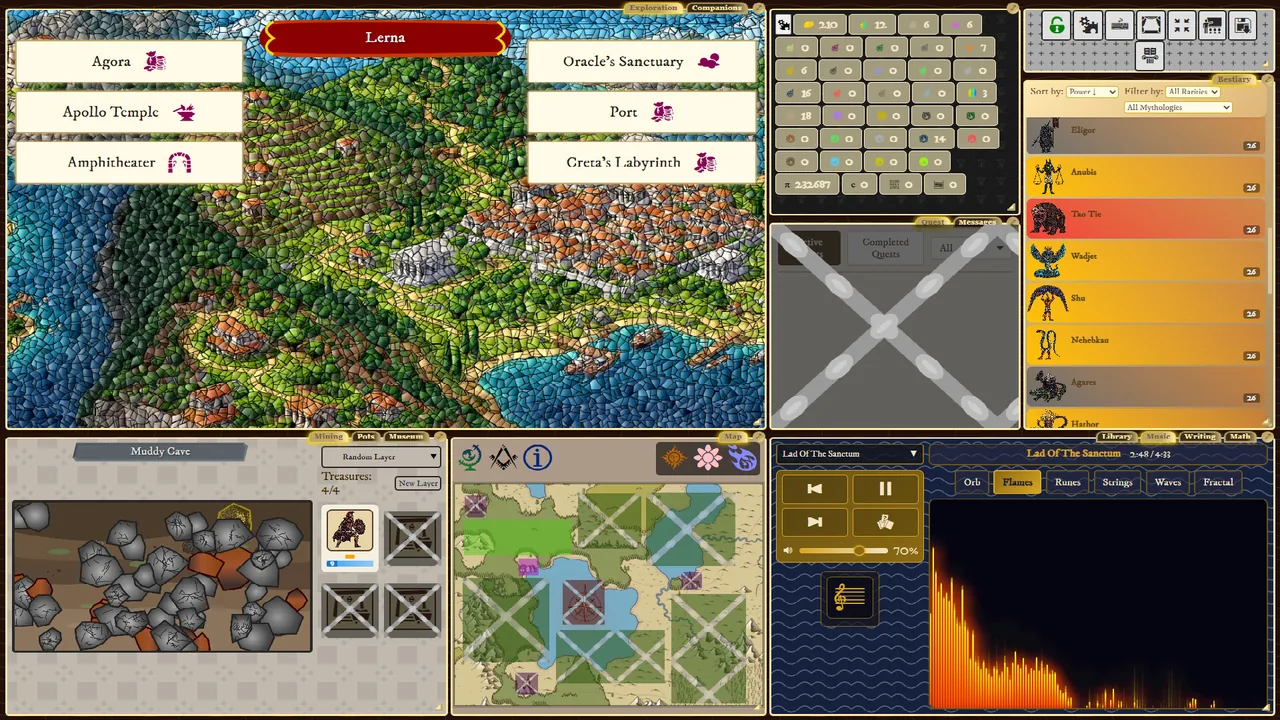
The Greek region hub, with exploration, bestiary, and mining panels all visible at onceImage: Mythos Anvil via Steam -
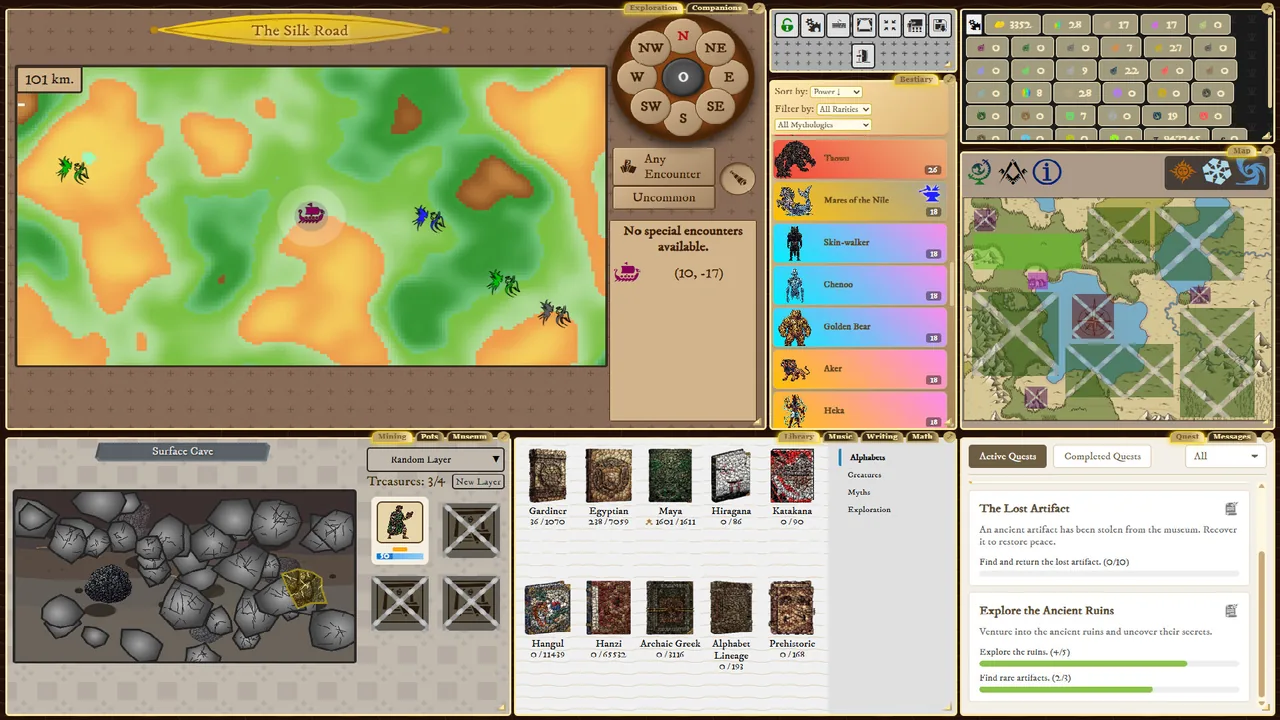
The Silk Road region, showing the quest log and language-collection systems alongside explorationImage: Mythos Anvil via Steam -
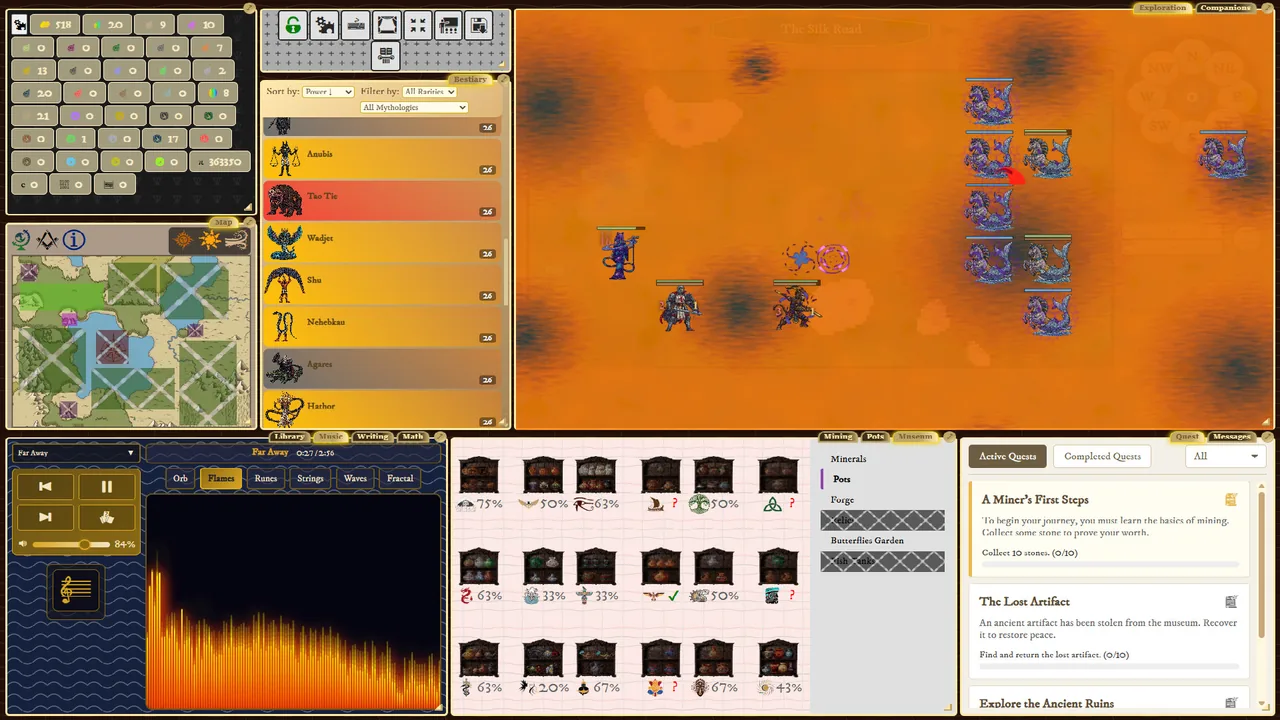
An auto-battle encounter, with the bestiary, mining, and quest panels still docked around the fightImage: Mythos Anvil via Steam -

Category scores for Myth RequiemWanderer Game Reviews