Game review
JUMP KING QUEST
7.3 / 10
- Developer
- Nexile
- Publisher
- Nexile
The short version
Biggest strengths
- A genuinely novel fusion of Jump King's punishing zero-air-control platforming with real Soulslike combat, weapons, and boss fights
- Seamless drop-in multiplayer where strangers climbing nearby can turn into allies or comic relief, widely praised as the game's standout feature when it's working
- 90+ weapons with distinct movesets and special inputs give real build variety on top of a four-humour RPG leveling system
Biggest weaknesses
- Netcode and multiplayer stability are a real, recurring problem — desyncs, unregistered hits, disappearing mobs, and characters teleporting between screens
- RPG stats and attribute systems are deliberately obtuse and under-explained in-game, which some players enjoy puzzling out and others find simply frustrating
- A vocal minority of longtime Jump King fans feel the shift toward Souls-style combat abandons what made the original distinct
7.3 / 10
Punishment platforming grows teeth
JUMP KING QUEST takes the core premise that made the original Jump King a streaming-era meme — zero air control, brutal falls, hours of progress lost to a single mistimed jump — and builds an entire Soulslike RPG around it. You play a "mudman" climbing The Heights toward the promised Smoking Hot Babe at the Top, but where the original was pure platforming endurance, this sequel adds real combat: weapons with unique movesets and special inputs, boss fights, a dueling system, and a four-attribute leveling structure based on the classical humours. Several reviewers who never played or even actively disliked the original describe being won over anyway, with one calling it "genuinely one of the most insane concepts I've played in a video game" and another flatly stating it "may currently be the single most slept-on metroidvania" of its release window.
That fusion is a genuine gamble — grafting Dark Souls combat onto a game whose entire prior identity was "don't touch anything, just jump carefully" could easily have felt like two unrelated ideas duct-taped together. Most reviewers report it doesn't: the precision jumping and the combat timing end up complementing each other, since fights often happen on the same unforgiving ledges the platforming already demands respect for. A smaller but vocal group disagrees, arguing the shift toward combat abandons the original's purity of vision; one reviewer flatly states the devs "copy pasted a bunch of mechanics from Souls games... without ever wondering if they belong here." Both readings show up often enough in the review pool that it's worth going in aware the sequel is a genuinely different kind of game, not just Jump King with a combat patch.
Strangers on the climb
The single most-praised feature across the review pool is JUMP KING QUEST's drop-in multiplayer, where nearby players — friends or complete strangers — can seamlessly join your climb, help with a boss, or simply fall past you as a moment of shared comic misery. Reviewers describe genuinely memorable moments this creates: getting encouraged by strangers waiting outside a boss door, watching two companions splatter on the ground next to you after a missed jump, or forming impromptu parties that stick together for hours. One reviewer specifically praises that "we stay on the same instance," meaning a party doesn't desync and scatter the way many co-op games handle death — the group can die and resume together rather than losing each other.
The catch is that this same multiplayer system draws the sharpest and most frequent criticism in the negative-review pool. Netcode problems recur constantly: rubber-banding, unregistered hits, mobs despawning and respawning unpredictably, characters teleporting between screens, and bosses vanishing mid-fight. One detailed negative review lists a string of these issues and calls a launch asking full price for something this broken "actually crazy, even if it's 'just' an early access game" — a fair criticism at the time it was written, though multiple later reviews note substantial improvement after subsequent patches, with one explicitly crediting a "Redcrown update" for fixing "a large portion" of earlier complaints. The single-player experience, by contrast, draws almost no technical complaints at all — several reviewers who played entirely offline report the game as complete and stable on its own.
Deliberately obtuse, by design
The RPG systems layered onto the climbing and combat won't be for everyone, and the game seems to know it. Attributes are governed by opposed "humour" pairs (Refined/Crude, Mettlesome/Guileful) that shape build identity, but the game does very little to explain how any of it actually works. One long, detailed review calls the stat system "extremely obtuse and purposefully ill-explained," while admitting it was personally satisfying to decipher through trial and error rather than a wiki. That split — delight versus frustration at the same design choice — runs consistently through the review pool, and it's worth going in expecting to learn the systems by feel rather than through clear tooltips.
Weapon variety gets far more unified praise. With 90-plus unique weapons, each carrying its own moveset and special input timing, reviewers consistently describe genuine build expression rather than reskinned stat sticks — one detailed technical review specifically highlights fighting-game-style special inputs (half-circle motions, timed button presses) layered onto weapon combat, a level of mechanical depth uncommon in games built around punishing platforming first and combat second.
A serious amount of game for the price
At NZ$21.99 full price, reviewers repeatedly frame JUMP KING QUEST as underpriced for what it delivers. Estimates of Act 1's length alone range from 10 hours for experienced Jump King veterans to over 25 for newcomers, and multiple reviewers explicitly note the game has kept expanding through free updates since its Early Access debut rather than being left to stagnate. One reviewer who finished the whole game goes as far as calling it "legitimately worth 60 dollars" and describing the asking price as "actually criminal" in the player's favor — a striking level of enthusiasm for value that shows up repeatedly rather than as an outlier opinion. That combination of scope, an actively updating developer, and a below-market price is a meaningfully different value proposition than most Soulslike-adjacent indies offer at launch.
A story with an unfinished ending
Reviewers are largely won over by the game's tone — a blend of genuinely striking claymation-inspired art direction, grim dark-fantasy atmosphere, and toilet humour that somehow doesn't undercut either. Several specifically praise the soundtrack, composed in part by musicians from the original Jump King, and the way the writing balances silliness against real narrative stakes without tipping fully into parody.
Where the story falls down is at the finish line. More than one reviewer who completed the full game describes an anticlimactic, oddly lonely ending — NPCs whose questlines simply stop progressing, characters who vanish without a proper resolution, and a sense that reaching the top doesn't land with the weight the climb built up. One reviewer speculates this may be a bug affecting quest triggers rather than an intentional narrative choice, since it's inconsistent with how carefully the rest of the world is built. It's a real soft spot in an otherwise well-regarded package, and worth tempering expectations around before committing to the full climb.
Verdict
JUMP KING QUEST is a genuinely audacious sequel that earns its ambition more often than not — successfully marrying punishment platforming to real Soulslike combat and RPG systems, anchored by a multiplayer feature that produces some of the most memorable moments in the review pool even while its technical execution lags behind the idea. The obtuse stat systems and rough ending won't land for everyone, and the netcode issues are a legitimate ongoing concern rather than a solved problem, but for players willing to meet its difficulty and its jank halfway, this is one of the more original takes on the Soulslike formula to release in the last year.
Pros and cons
Pros
- A genuinely novel fusion of Jump King's punishing zero-air-control platforming with real Soulslike combat, weapons, and boss fights
- Seamless drop-in multiplayer where strangers climbing nearby can turn into allies or comic relief, widely praised as the game's standout feature when it's working
- 90+ weapons with distinct movesets and special inputs give real build variety on top of a four-humour RPG leveling system
- Consistently praised art direction, claymation-style character designs, music, and self-aware toilet humour that never undercuts the atmosphere
Cons
- Netcode and multiplayer stability are a real, recurring problem — desyncs, unregistered hits, disappearing mobs, and characters teleporting between screens
- RPG stats and attribute systems are deliberately obtuse and under-explained in-game, which some players enjoy puzzling out and others find simply frustrating
- A vocal minority of longtime Jump King fans feel the shift toward Souls-style combat abandons what made the original distinct
- Several reviewers describe an anticlimactic, bug-affected ending where NPC questlines fail to resolve properly
Screenshots
-
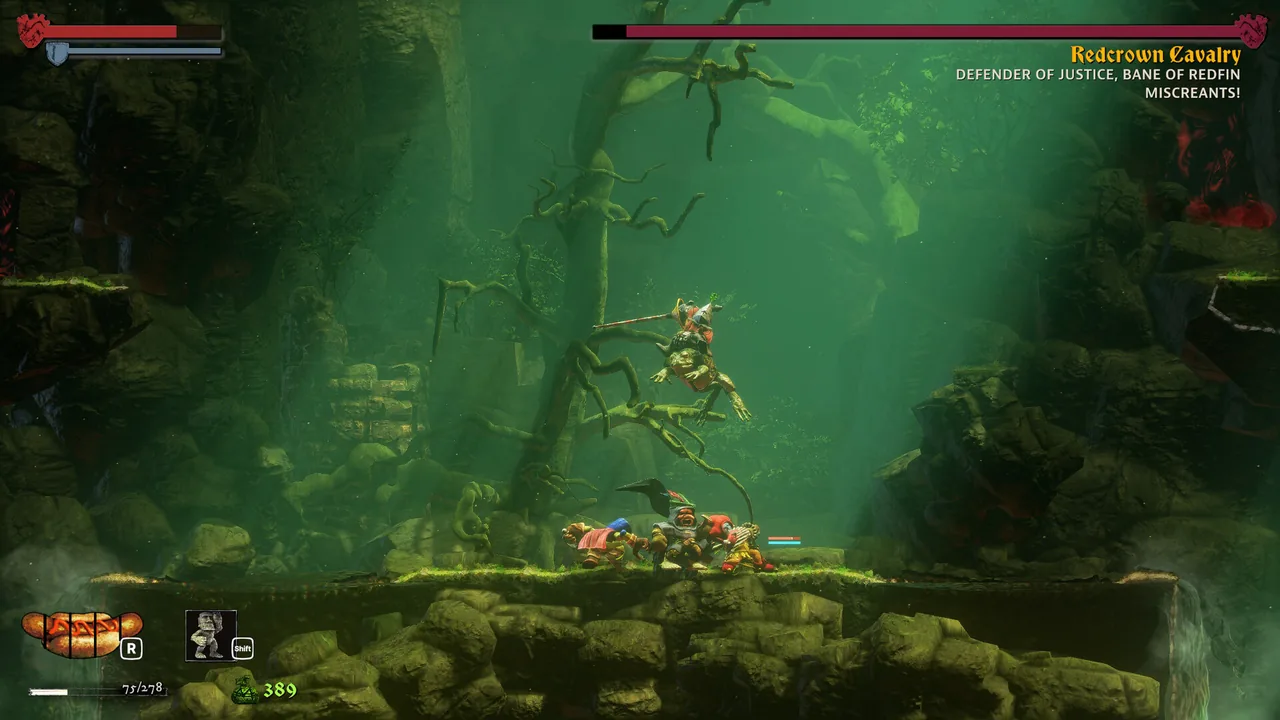
A boss encounter against the Redcrown Cavalry, mid-jump into combatImage: Nexile via Steam -
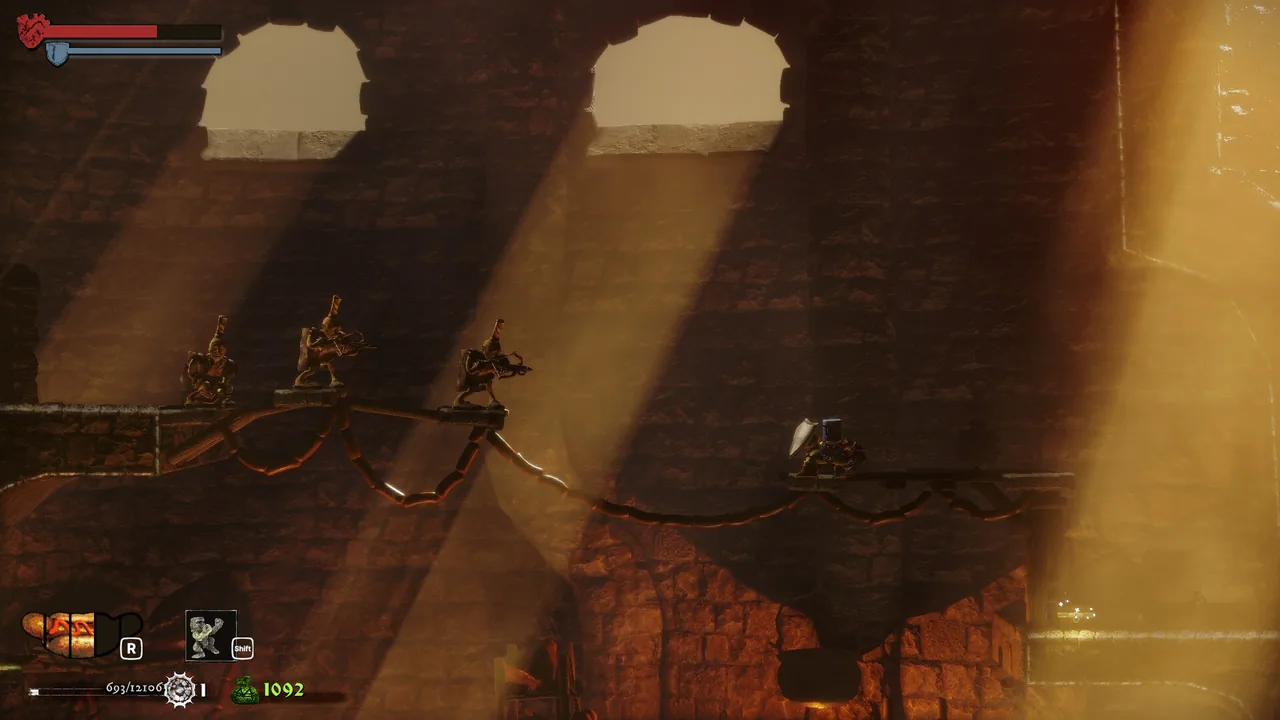
Climbing a sunlit tower ledge past a line of archer enemiesImage: Nexile via Steam -
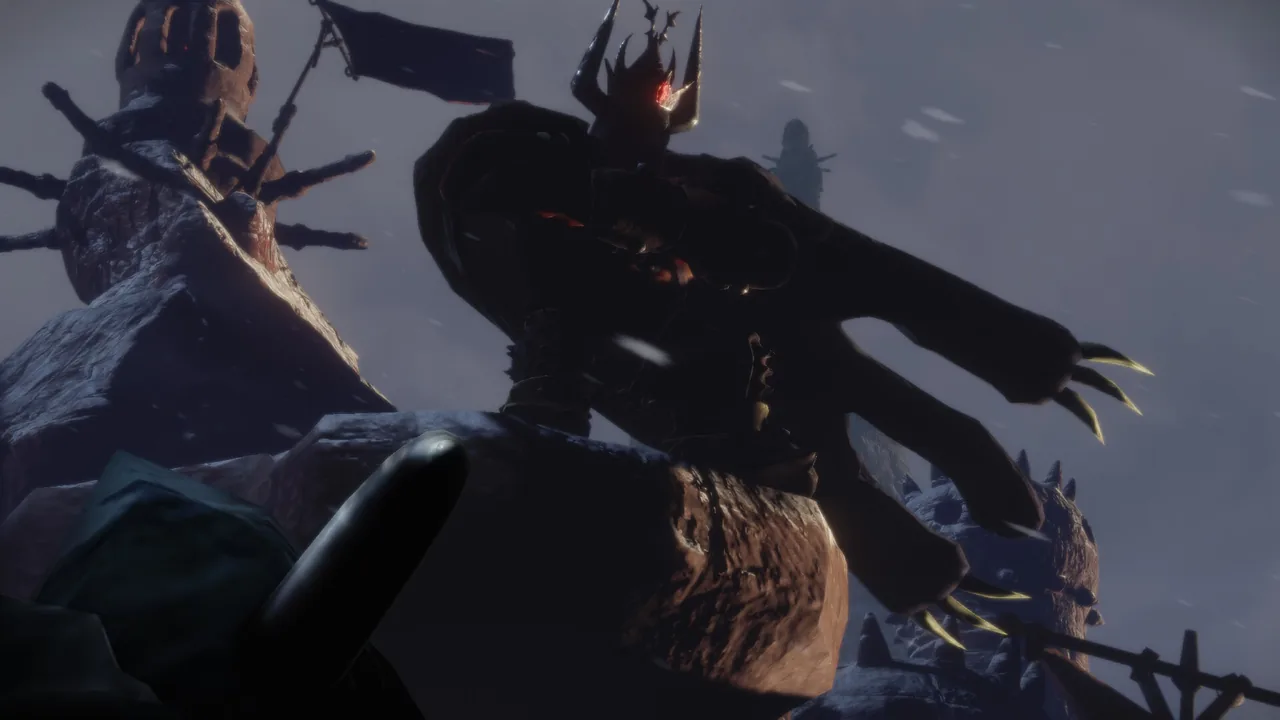
One of the game's imposing Souls-like boss encounters, set against a snowstormImage: Nexile via Steam -
Category scores for JUMP KING QUESTWanderer Game Reviews